

Search Intent: The Four Types and Why They Decide Everything
- April 12, 2025
- Keyword Research
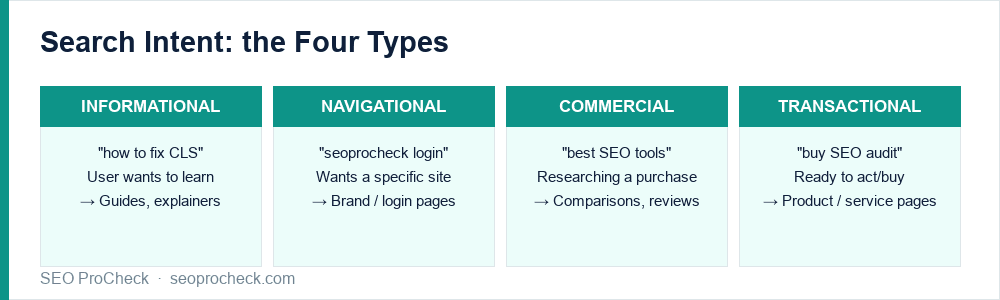
Search intent is the why behind a query — what the person actually wants when they type it. It is the single most important thing to get right in keyword research, because matching intent is now a precondition for ranking at all. You can write the best buyer's guide on the web and it will not rank for a query where Google has decided people want a quick definition.
The four types
Informational — the user wants to learn something ("how does INP work," "what is a canonical tag"). They are not ready to buy; they want a clear answer. Serve it with guides, explainers, and how-tos.
Navigational — the user is trying to reach a specific site or page ("seoprocheck login," "ahrefs pricing"). Serve it with the obvious destination — you rarely compete for someone else's navigational queries.
Commercial investigation — the user is researching before a purchase ("best SEO tools," "ahrefs vs semrush"). They have buying intent but want to compare first. Serve it with comparisons, reviews, "best" lists, and case studies.
Transactional — the user is ready to act ("buy SEO audit," "hire SEO consultant"). Serve it with product, service, or sign-up pages that make the action easy.
How to identify the intent of a keyword
Do not guess — look at the SERP. Google has already decided the dominant intent, and it shows you in what ranks. If the first page is full of blog guides, the intent is informational, and a product page will not rank no matter how good it is. If it is full of product and category pages, it is transactional. Mixed results signal mixed intent — an opportunity to serve a specific angle.
Why matching intent matters so much now
Google's whole job is to satisfy the searcher, so it strongly favors content whose format and angle fit the intent. Intent mismatch is one of the most common reasons good content fails to rank: the page is high quality, but it answers a question the searcher was not asking. Fix the mismatch — change the format, or target a better-matched keyword — and rankings often follow.
Intent shapes the funnel, too
The four types roughly map to the buyer's journey: informational and commercial queries are where you earn trust; transactional queries are where you convert. A healthy site covers all of them, using informational content to build authority and audience, and transactional pages to capture the demand that content creates.
Targeting the right keywords?
Keyword strategy is where every successful SEO campaign starts. See how an advanced SEO audit works →
Take this with you
The assistant links open with a question about this page already written. Nothing is sent until you press enter.
Claude Vincent is a technical SEO consultant focused on crawlability, rendering, and AI-search visibility. He writes the field guides and case studies at SEO ProCheck, with a bias toward the durable, unglamorous work that decides whether search engines and AI answer engines can actually read and cite a site.
About SEO ProCheck
Technical SEO consulting and GEO strategy with 20 years of enterprise experience. Case studies, resources, and tools for search and AI visibility.
Work With Me
Technical SEO audits, GEO strategy, site migrations, and international SEO. Hourly consulting for teams who need hands-on support, not just reports.
Subscribe to our newsletter!








Recent Posts
- Most Top Sites Never Say Who They Are in Structured Data October 14, 2026
- Homepage Titles Are Mostly Too Short, Not Too Long October 8, 2026
- Who Actually Serves an llms.txt? 184 Top Sites Measured September 29, 2026