Deconstructing Google's AI Search: Insights from Antitrust Files & Expert Analysis on MAGIT, Query F
- August 27, 2025
- General
AI Summary
This analysis reads Google's antitrust trial exhibits to reconstruct how AI Overviews and AI Mode are assembled, describing a retrieval augmented pipeline in which a fine tuned Gemini variant generates the answer, queries are decomposed into sub queries, and grounding happens against Google's own processed index rather than a live fetch of your server. The most useful conclusion for practitioners is the least dramatic one: classic ranking signals were not replaced, they now decide which passages the model is permitted to summarise.
- Query fan-out means one visible query triggers several hidden retrievals, so topical coverage beats single keyword targeting.
- Retrieval operates at passage level, so each section needs to make sense removed from its page.
- Trial testimony established that click and engagement data feed reranking, with Navboost described as holding roughly 13 months of click history.
- Treat system names and internal code names as trial exhibit reporting, not as documented product architecture.

Antitrust discovery has done something no amount of industry speculation could: it put Google's internal ranking vocabulary into the public record. The analysis this page summarises works through those documents to describe how AI Overviews and AI Mode are actually assembled. Before going further, one framing note that the rest of this page depends on. Trial exhibits are real evidence, but they are internal engineering artefacts of varying age, presented selectively by litigators and then interpreted by outside analysts. Treat what follows as a well sourced reconstruction, not as a specification.
What the antitrust documents describe
The picture that emerges is a retrieval augmented generation system rather than a language model answering from memory. That distinction carries almost all of the practical consequences, so it is worth stating plainly: the model does not know things about your business, it summarises documents that a retrieval system hands it.
The analysis names a number of components. They fall into two confidence tiers, and conflating them is how bad advice gets written.
| Named component | Role as described | Evidential standing | Does it change your work? |
|---|---|---|---|
| Navboost | Reranking from stored click and engagement history, reported at roughly 13 months | Discussed at length in trial testimony | Confirms that satisfying clicks compound. No new tactic. |
| RankBrain, DeepRank | Deep models applied to an already filtered candidate set | Named in the trial record | Yes: you must pass classic retrieval before any model sees you. |
| RankEmbed | Embedding system said to fuse semantic similarity with hand crafted signals | Named in the record, mechanism detail is the analyst's reading | Directionally: semantics and classic signals are combined, not sequential. |
| MAGIT | Gemini variant said to be fine tuned on search data to generate AI Overviews | Reported from the documents by this analysis | No. You cannot optimise for a model name. |
| Query fan-out | Decomposition of one query into multiple sub queries before synthesis | Consistent with observable AI Mode behaviour | Yes, and it is the single most actionable item here. |
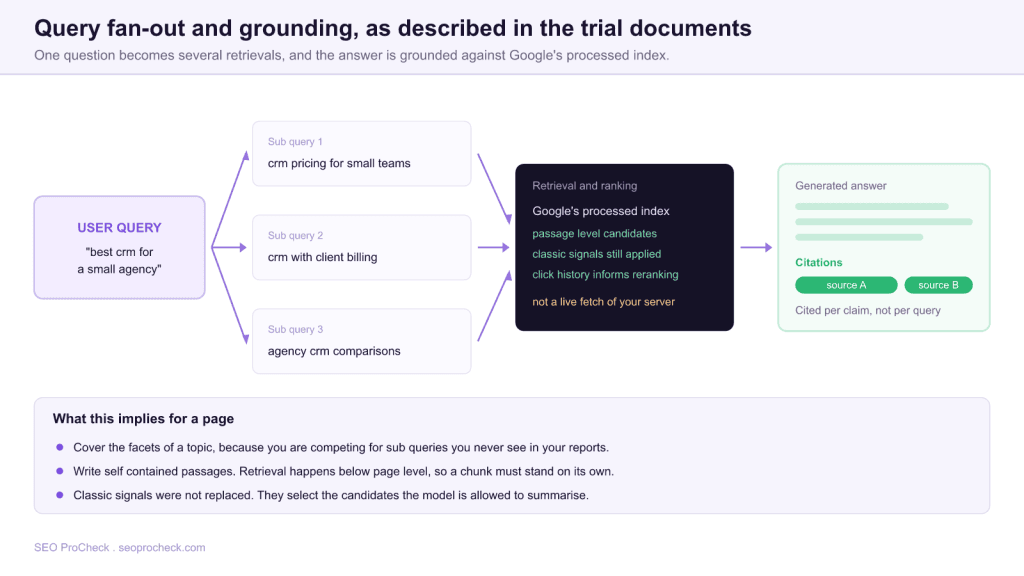
| Cached index grounding | Answers grounded against Google's processed copy rather than a live fetch | Reported, and consistent with how citations resolve | Yes: indexation and freshness gate AI visibility. |
The last row deserves emphasis because it is widely misunderstood. If grounding runs against Google's stored, processed version of your page, then everything that governs ordinary indexing still governs whether you can appear in an AI answer. A page that is not indexed cannot be cited. A page whose most recent crawl predates your rewrite will be summarised from the old version. This is why how AI engines choose sources turns out to be mostly a conventional technical SEO question wearing new clothes.
Query fan-out and what it means for coverage
Fan-out is the mechanism with the clearest implications. When someone asks a composite question, the system does not run one retrieval. It decomposes the question into constituent sub queries, retrieves for each, and synthesises across the results. Google's existing "People also ask" and autosuggest surfaces are visible cousins of the same decomposition.
The consequence is that you are competing in auctions you will never see in a rank tracker. A page can be cited because it answered a sub query the user never typed, and can be omitted despite ranking well for the head term because it never addressed the facet that mattered.
What to do about it, concretely:
- Enumerate the facets before writing. For a target topic, list the questions a buyer would decompose it into: cost, alternatives, prerequisites, failure modes, timelines, who it suits, who it does not. Mine "People also ask", autosuggest and your own Search Console query set for the real phrasings.
- Answer each facet in a self contained block. Retrieval operates below page level, so a passage that depends on three paragraphs of earlier setup is a weak candidate. Restate the subject in the passage rather than relying on "it" and "this". Our explainer on passage indexing covers why this matters mechanically.
- Use headings as retrieval handles. A heading phrased as the question a user would ask gives the retrieval layer an unambiguous anchor. Vague section titles waste the strongest signal on the page.
- Put comparable facts in tables. Tabular data is straightforward to extract and hard to misattribute, which is exactly the property you want when a model is assembling a comparison.
- Do not scatter the cluster across thin pages. Fan-out rewards a genuinely comprehensive document. Splitting one topic into eight shallow URLs to chase eight sub queries produces the scaled content pattern that quality systems demote.
What actually changes in your practice
Reading the whole analysis, the striking thing is how much of it argues for continuity. The documents describe deep learning models operating on candidate sets that classic retrieval produced, hand crafted signals persisting inside the ranking stack, and click history feeding reranking over a long window. None of that describes a system where traditional SEO stopped mattering.
So the honest list of changes is short:
- Coverage strategy replaces keyword strategy. Plan against the facets of a topic rather than a primary term and variants.
- Passage level writing becomes a hard requirement rather than a stylistic preference.
- Indexation and freshness become AI visibility levers, because grounding uses the stored copy. A stale crawl is a stale citation.
- Provenance signals matter more, since attribution and fact checking are explicit steps. Named authors with real credentials, visible dates, cited sources and accurate structured data all support that.
- Measurement gets harder, because sub query performance is not exposed. Expect to reason from citation appearances and referral patterns rather than from a clean rank number.
Equally important is the list of things this evidence does not license. It does not support writing for a named internal model. It does not support "optimising for MAGIT" or any similar phrasing, which is the kind of doctrine that appears within days of a leak and ages badly. And it does not support abandoning conventional technical work, since the pipeline it describes depends on that work at every stage. For the practical, observable version of this, see our guide to Google AI Mode optimisation and the AI Overview presence check.
Frequently asked questions
What is query fan-out in Google AI Mode?
It is the decomposition of a single user question into several sub queries, each retrieved separately before the results are synthesised into one answer. It means you can be cited for a facet the user never typed, and it is why topical coverage now outperforms narrow keyword targeting.
What is MAGIT?
It is the name reported in these antitrust documents for a Gemini variant said to be fine tuned on search data and used to generate AI Overviews within a retrieval augmented framework. Treat it as reporting from trial exhibits rather than confirmed product documentation, and note that there is nothing you can do differently because of a model's internal name.
Does Google fetch my page live when generating an AI answer?
According to this analysis, grounding for main search features runs predominantly against Google's own cached and processed version of the web rather than a live request to your server. The practical implication is significant: if a page is unindexed or its stored copy is stale, that is what any AI answer will reflect.
Do clicks still affect rankings?
Trial testimony described systems that store and use click and engagement data for reranking, with Navboost reported as retaining roughly 13 months of history. This does not make clicks a knob you can turn directly, and manipulating them is both detectable and against the spam policies. It does mean genuinely satisfying results accrue an advantage over time.
Should I write shorter, chunked content for AI retrieval?
Write in self contained passages, which is not the same as writing short pages. Retrieval works below page level, so each section should make sense in isolation, restate its subject and resolve one question. A comprehensive page composed of independently coherent passages outperforms both a wall of prose and a set of thin fragments.
How much of this should I actually act on?
Act on the mechanisms, not the code names. Facet coverage, self contained passages, solid indexation and freshness, and clear provenance are all defensible regardless of which internal system is doing what. Anything framed as optimising for a specific named model is speculation built on a selectively disclosed, undated document set.
The value of leaked architecture is rarely a new tactic. It is calibration: it tells you which of the things you already believed are load bearing. On that measure, this material argues that conventional retrieval, indexation and quality signals still decide who gets to appear in an AI answer at all.
Claude Vincent is a technical SEO consultant focused on crawlability, rendering, and AI-search visibility. He writes the field guides and case studies at SEO ProCheck, with a bias toward the durable, unglamorous work that decides whether search engines and AI answer engines can actually read and cite a site.
About SEO ProCheck
Technical SEO consulting and GEO strategy with 20 years of enterprise experience. Case studies, resources, and tools for search and AI visibility.
Work With Me
Technical SEO audits, GEO strategy, site migrations, and international SEO. Hourly consulting for teams who need hands-on support, not just reports.
Subscribe to our newsletter!