

AI Summary
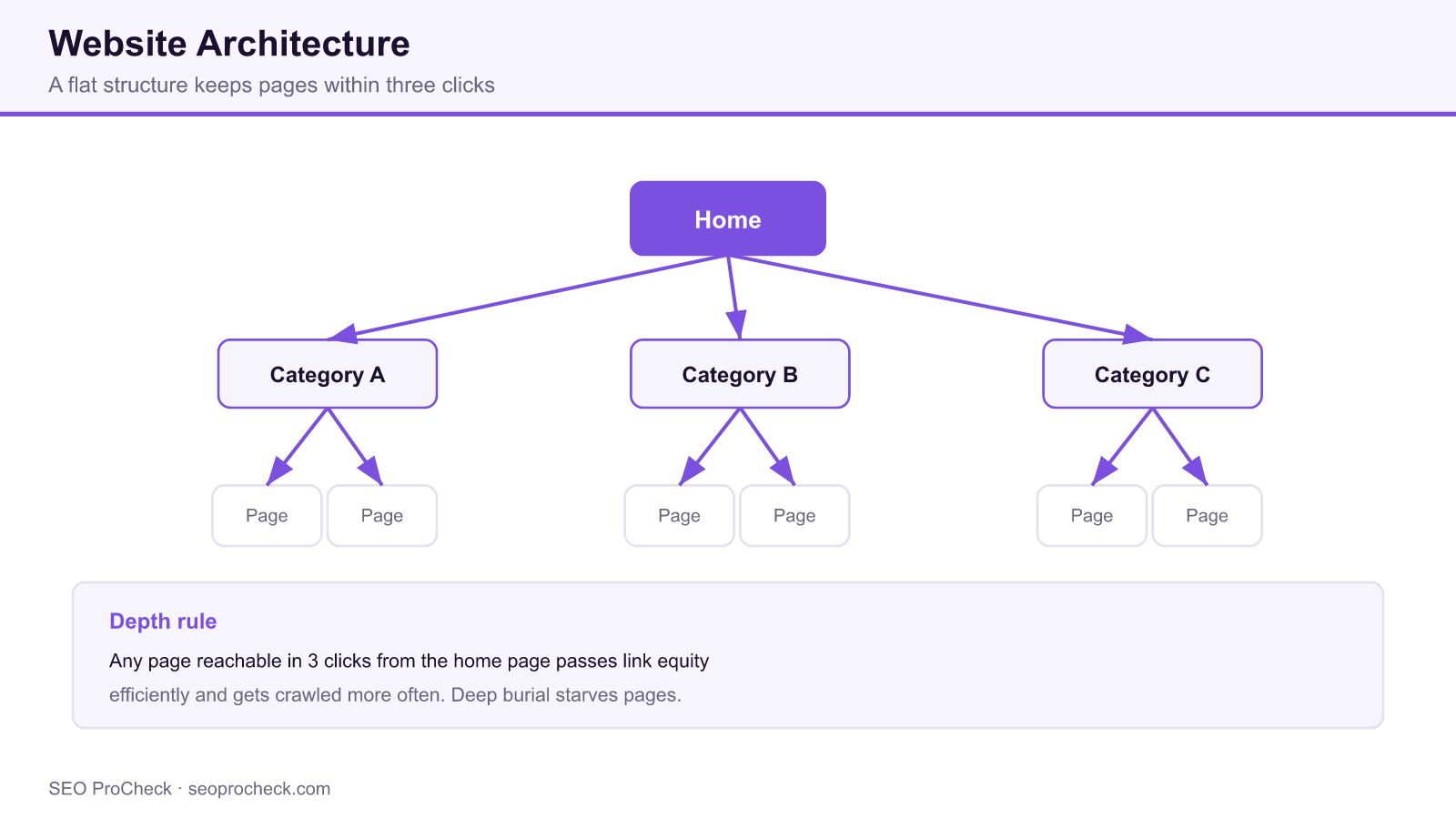
Website architecture is how your pages are organized and linked to each other. A flat, logical structure that keeps important pages within about three clicks of the home page helps both users and crawlers find content, and it distributes link equity to the pages that need to rank.
- Flat beats deep: aim to reach any key page in three clicks from the home page.
- Group content into clear categories, then link related pages within each group.
- Internal links pass ranking signals, so the structure decides which pages get authority.
- A clean architecture improves crawl efficiency and makes the site easier to scale.
Website Architecture: A Beginner's Guide to Boosting Success provides valuable insights for SEO practitioners. This resource examines approaches and considerations that can improve organic search performance.
Key Concepts
Understanding the fundamental principles behind this topic helps inform strategic decisions. Whether optimizing for traditional search or emerging AI platforms, foundational concepts remain relevant. This resource covers the essential knowledge practitioners need.
Implementation Considerations
Moving from concept to execution requires understanding practical constraints and opportunities. Different situations call for different approaches. This resource provides guidance for applying concepts in real-world contexts.
Measuring Impact
SEO efforts require measurement to demonstrate value and guide optimization. Identifying appropriate metrics, establishing baselines, and tracking progress enables data-driven improvement. This resource addresses how to evaluate success.
This resource contributes to the knowledge base SEO practitioners need for effective optimization in an evolving search landscape.
Source: https://level343.com/search-marketing-articles/beginners-guide-website-architecture
Practitioner commentary: structure is a ranking decision
Beginners often treat site architecture as a design concern, something the navigation menu handles. In SEO it is closer to a budgeting decision. The way pages link to one another decides how authority flows through the site and which pages crawlers reach quickly and often. A logical, shallow structure is not just tidier; it is how you make sure the pages you actually want to rank are the ones receiving the most internal support.
The practical target most teams use is the three click rule: any page that matters for search should be reachable within about three clicks of the home page. That is a heuristic, not a law, but it captures a real effect. Pages buried five or six clicks deep get crawled less, accumulate less internal link equity, and tend to underperform regardless of content quality. Grouping pages into clear topical categories, then linking related pages to each other within a group, keeps depth low while building the topical clusters search engines reward.
Flat versus deep structure
| Factor | Flat structure | Deep structure |
|---|---|---|
| Clicks to key pages | About three or fewer | Five or more |
| Crawl efficiency | High, important pages found fast | Low, deep pages crawled rarely |
| Link equity flow | Spread to pages that matter | Diluted before it reaches depth |
| User experience | Fewer steps to the goal | More navigation friction |
| Scalability | Categories absorb new pages cleanly | New pages pushed deeper over time |
How to build a structure that scales
- Map topics before pages. Decide the main categories your site covers, then slot pages under them. The taxonomy comes first, the URLs follow.
- Keep the depth shallow. Home links to categories, categories link to pages, and related pages cross link. That is usually enough to stay within three clicks.
- Use internal links deliberately. Link from strong pages to the ones you want to lift, with descriptive anchor text. Our internal linking guide covers the mechanics, and the missing internal links check finds orphaned pages.
- Support it with a clean XML sitemap. Architecture helps discovery, and a well organized XML sitemap reinforces it, especially on large sites.
- Watch crawl efficiency. A shallow structure spends crawl budget on pages that matter; see crawl budget explained.
What's changed since the guide was written
The fundamentals of flat, logical architecture have not changed, which is why this remains beginner friendly advice. What has been added on top is the topical authority lens: search engines increasingly reward sites that cover a subject comprehensively and link those pages together into coherent clusters, so architecture and content strategy have merged. The same structure also helps AI answer engines, which follow internal links to understand which page is the definitive source on a topic. Good architecture used to be about crawlability and user flow; it now doubles as the scaffolding for topical authority.
Frequently asked questions
What is website architecture in SEO?
It is how a site's pages are organized and linked together. Good architecture groups content into logical categories and keeps important pages within a few clicks of the home page, which helps users, crawlers, and the flow of ranking signals.
What is the three click rule?
A guideline that any important page should be reachable within about three clicks from the home page. It is a heuristic rather than a strict limit, but it reflects that deeply buried pages get crawled less and receive less internal link equity.
Is a flat or deep site structure better for SEO?
Flat is generally better. A shallow structure means crawlers reach key pages faster and internal link equity is not diluted across many levels. Deep structures push important pages far from the home page, where they tend to underperform.
How do internal links relate to site architecture?
Internal links are the connections that make up the architecture. They pass ranking signals between pages, so linking from strong pages to the ones you want to rank is how architecture translates into actual performance.
How does site architecture affect crawl budget?
A shallow, logical structure lets search engines spend their crawl budget on the pages that matter instead of wandering through deep, low value paths. That improves how quickly new and updated pages get discovered and indexed.
Does website architecture matter for AI search?
Yes. AI answer engines follow internal links to understand which page is the authoritative source on a topic. A clear structure that clusters related pages helps them identify and cite the right page, just as it helps traditional crawlers.
Claude Vincent is a technical SEO consultant focused on crawlability, rendering, and AI-search visibility. He writes the field guides and case studies at SEO ProCheck, with a bias toward the durable, unglamorous work that decides whether search engines and AI answer engines can actually read and cite a site.
About SEO ProCheck
Technical SEO consulting and GEO strategy with 20 years of enterprise experience. Case studies, resources, and tools for search and AI visibility.
Work With Me
Technical SEO audits, GEO strategy, site migrations, and international SEO. Hourly consulting for teams who need hands-on support, not just reports.
Subscribe to our newsletter!







Recent Posts
- Can AI Crawlers Actually Read Your Site? I Measured 400 of the Biggest September 5, 2026
- The Pre-Publish Quality Gate for AI-Assisted Content August 6, 2026
- AGENTS.md vs llms.txt vs llms-full.txt: Which Agent File Does What July 18, 2026