Google's EEA Product Search Changes: What Moved Since September 2026
- November 4, 2026
- E-commerce SEO
TL;DR
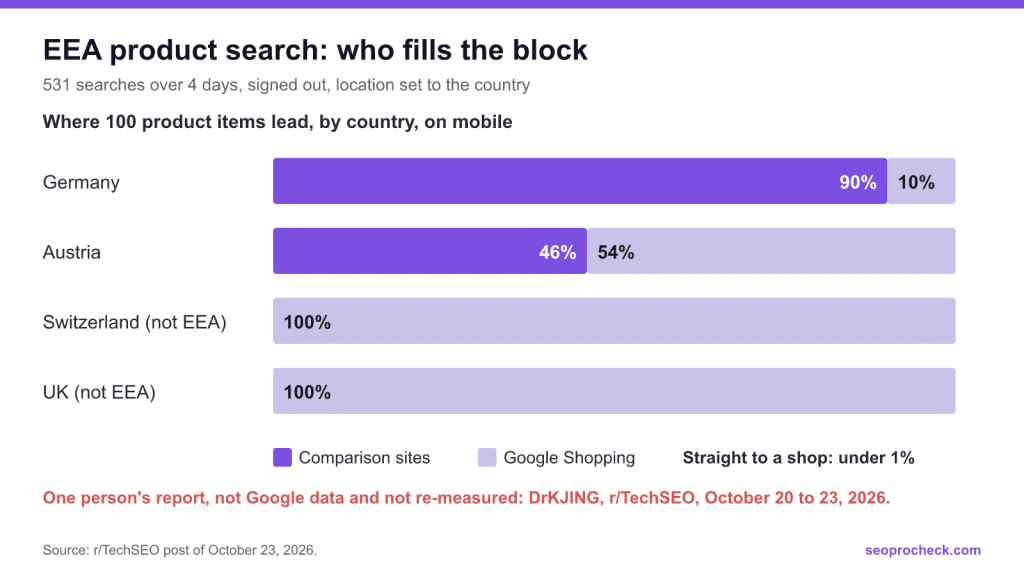
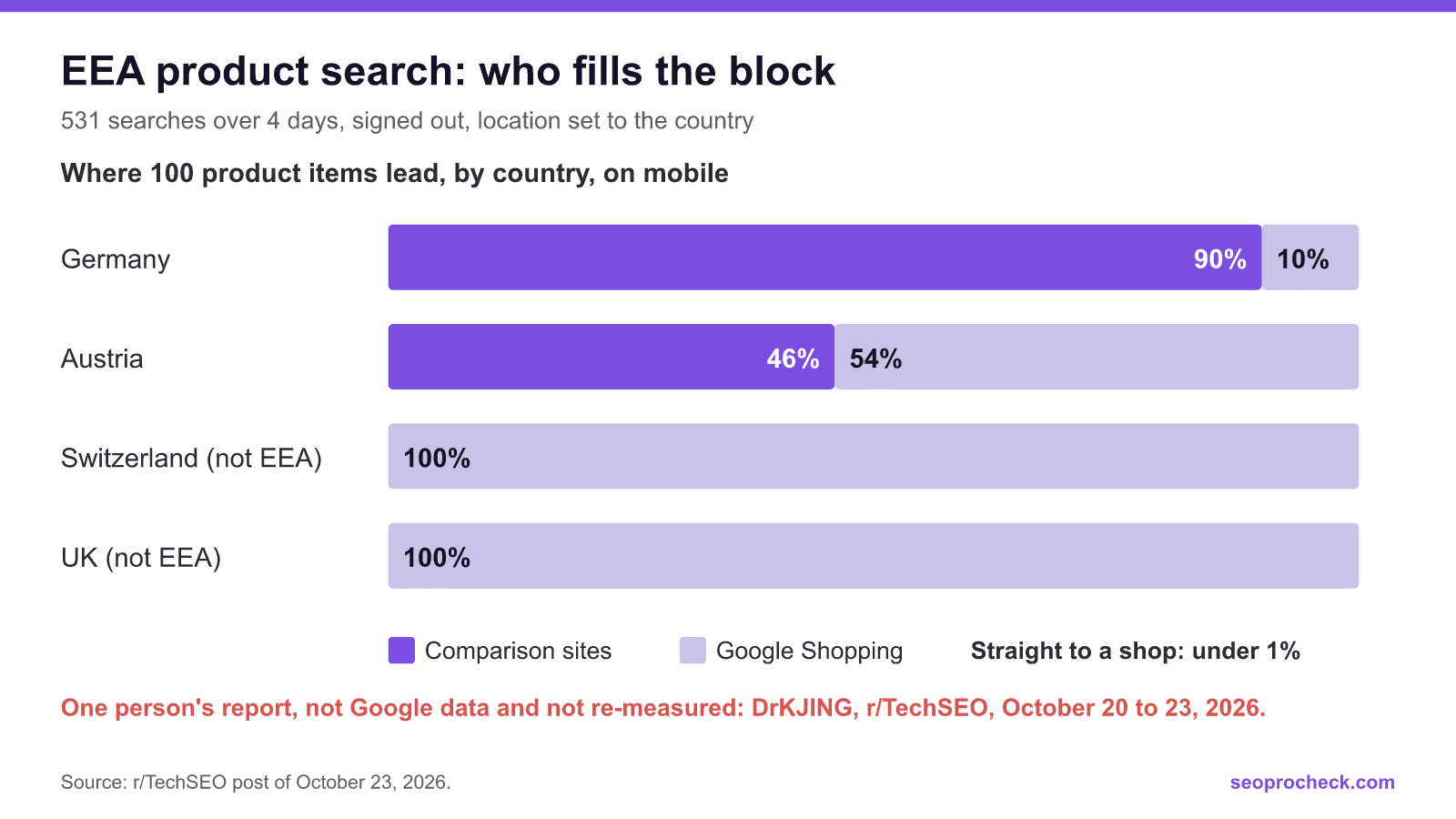
Since mid-September 2026, product searches in European Economic Area countries have lost most free product listings and carousels, and comparison sites fill much of that space. Google documents the new aggregator and supplier units for products in the EEA, and one r/TechSEO report puts numbers on it: on mobile in Germany, 90% of product items led to comparison sites and under 1% went straight to a shop.
- That report is one person's: 4 days, 531 searches, 6,440 result pages and one shop's data. I read it, I did not reproduce it.
- Its shop saw Search Console merchant listings fall 62.9% while Merchant Center free listings fell 9.2%. Those reports count different things, so neither is the shop's total loss.
- Switzerland and the UK, outside the EEA, showed 0% of items going to comparison sites in the same test.
- Merchant Center changed its own counting on August 24, 2026, so note that in any year-on-year comparison.
What Google has said, and what it has not
On September 8, 2026, Google's documentation updates list added a page on regional differences in Search. That page lists the aggregator unit and supplier unit for the EEA, and products are among the covered query types. Here is how the 2 units work, from Google's own pages:
| Unit | Who appears | What a click does | How to get in |
|---|---|---|---|
| Aggregator unit | Approved vertical search services, including comparison shopping services | Goes to the aggregator's page | For products, through the comparison shopping services contact form |
| Supplier unit | Direct providers, shown only when an aggregator unit shows | Not spelled out on the page | No data needed beyond what web crawling reaches; feeds can add to it |
The removal itself is not on any Google page I could find. Search Engine Roundtable's report, dated September 18, 2026, is my source: it cites screenshots and tracker charts from LinkedIn, plus a Semrush chart it checked itself, and reports that Google's Ads Liaison, Ginny Marvin, confirmed in a comment that free product listings were removed because of the Digital Markets Act ruling. I read that report, not the LinkedIn comment. It also relays Hugo Huijer of Productrise, who saw popular products carousels fall about 90% to 100% in Germany, France, Belgium, Sweden and the Netherlands.
Merchant Center's free listings help page, as I read it on October 31, 2026, does not mention the EEA. So if your team reads only that page, nothing looks different.
What one practitioner measured
The useful numbers come from an r/TechSEO post by the user DrKJING, posted on October 23, 2026. Treat this as that person's report, not as a fact about the market. The method, as stated:
- 531 non-brand product searches across 12 sectors: 274 German terms for Germany, Austria and Switzerland, and 257 English terms for the UK.
- 4 days, October 20 to 23, signed out, with location set to the country. Mobile in all 4 countries, desktop in Germany and the UK: 6,440 result pages.
- Every product item in the block counted, including collapsed groups: where it leads, and whether it shows stars.
- A before state from 2,299 archived captures of the same terms, April to October.
- One shop's data shared with permission, relative changes only.
| Country, device | Searches with a product block | Items leading to comparison sites | Items leading to Google Shopping | Items with stars |
|---|---|---|---|---|
| Germany, mobile | 92% | 90% | 10% | 2% |
| Germany, desktop | 53% | 87% | 13% | 4% |
| Austria, mobile | 90% | 46% | 54% | 7% |
| Switzerland, mobile | 95% | 0% | 100% | 73% |
| UK, mobile | 100% | 0% | 100% | 71% |
| UK, desktop | 100% | 0% | 100% | 71% |
Figures as reported by DrKJING, r/TechSEO, October 23, 2026. Not re-measured by me. Items leading straight to a shop: under 1% everywhere.
In the German grid no single site dominates: the report has Google Shopping at 10.0%, testberichte.de at 6.6%, billiger.de at 6.3%, shopping.de at 5.7% and idealo.de at 5.5%, out of 53,625 mobile product items. Its stated limits are worth keeping: these are volume-heavy non-brand terms and not a random sample, signed-out automated retrieval can differ from what a person sees, and German desktop only repeated about half the time across the 4 days.
Why Search Console and Merchant Center disagree
This is the part of the report I find most useful, and the part you can check against your own account. The 2 reports were never measuring the same thing:
| Search Console, Merchant listings | Merchant Center, free listings | |
|---|---|---|
| What it covers | Web search, plus the Images tab when you pick that search type (added then, June 2024) | Free listings across Google. Google's help page names Search, Maps, Gemini, YouTube, the Shopping tab, Images and Lens |
| How close to the EEA change | Directly on the surface that changed | Only partly, in my reading: Merchant Center adds the other surfaces |
| Recent change in counting | None I could find | Yes, August 24, 2026: YouTube affiliate traffic split out and YouTube definitions changed, backfilled to July 1, 2026. Google warns of a one-time drop |
| Shop in the report, September 21 to October 4 vs September 1 to 14 | Down 62.9% (same dates in 2025: down 7.9%) | Down 9.2% (same dates in 2025: down 10.6%, on the old counting) |
The definition of the Search Console column is the report author's, supported by the 2024 note. I did not find a Google page that defines it in full.
The author also says merchant listing clicks in Search Console were about a fifth of Merchant Center's free clicks before September 15. That is one shop. I would not use it as a conversion factor, and neither does the author.
How to read your own shop
- Split every report by country first. Google links to Eurostat's glossary for who is in the EEA. Countries outside it are your best comparison, though not a true control.
- Leave out September 15 to 20. Compare September 21 to October 4 with September 1 to 14, as the report does, and pull the same days in 2025 for the season.
- Read 4 lines together: Search Console merchant listings, organic clicks on product pages without merchant listings, Merchant Center free listings, and analytics visits from comparison sites.
- Do not compare Merchant Center with last year without noting the August 24 change, because its YouTube numbers now use different definitions.
- Keep the srsltid parameter through your redirects. Merchant Center adds it to free listing clicks when auto-tagging is on, and the report warns that losing it makes this channel hard to measure.
- Re-read later. In the report, the window of October 5 to 18 looks different: merchant listings down 60%, Merchant Center down 18%, and organic product page clicks down 4.4% against a 23.6% fall in 2025.
The organic number deserves care. The first window showed organic product page clicks up 6.5%, and it would be easy to call that a recovery. The author says only that it offset about 57% of the merchant listing decline on those pages, by calculation, and that the data cannot show whether the same people moved.
What you can still control
- Complete merchant listing markup on product pages: price, availability and variants, as the report suggests. Google's supplier unit needs nothing beyond what crawling reaches, and my notes on product page SEO covers the page itself.
- Decide on comparison sites as a budget question. The report's point is that a listing there costs per click. That is a commercial call and not an SEO one.
- Keep your feeds current. This is a change inside Google's EEA results, and it does not reach other engines' surfaces. In the reported shop, Bing clicks rose 1%, and feed quality still applies to them.
- Check my product schema guide against your templates. It is the same markup you need for any other merchant result.
What I do not know
I do not know whether Germany's 90% holds across the rest of the EEA. Austria is already at 46% in the same test, and the Roundtable report names 4 other countries besides Germany without item-level data. Google's aggregator unit page was also updated on October 19, 2026 with no entry on its updates list that I could see, and I cannot tell what changed. The report's author says it needs a repeat in a few months, and I agree.
FAQ
Did Google remove free product listings everywhere?
No. The reports are about the European Economic Area. In the r/TechSEO test, Switzerland and the UK, both outside the EEA, still showed product blocks with every item going to Google Shopping.
Why does Search Console show a much bigger drop than Merchant Center?
They count different things. The Merchant listings appearance in Search Console covers web search, and Images when you pick that search type. Merchant Center's free listings add other Google surfaces. In the one shop reported, Search Console fell 62.9% and Merchant Center 9.2%.
Can a shop still appear in these product units?
Google's supplier unit is for direct providers, needs no data beyond what web crawling reaches, and only shows when an aggregator unit shows. In the r/TechSEO test, under 1% of product items went straight to a shop, so I would not count on it for volume yet.
Which date should I mark on my charts?
September 15, 2026, for Search Console, which is where the report sees the break. Search Engine Roundtable's report of September 18 relays a tracker's view that the carousels disappeared over the previous 2 days, so I would treat September 15 to 20 as a transition and leave those days out.
Which countries count as the EEA?
The EU member states plus Iceland, Liechtenstein and Norway, per Eurostat's glossary, which is the page Google links to. Switzerland and the UK are not in it.
Did organic clicks on product pages fall too?
In that one shop, they rose 6.5% in the first window and fell 4.4% in a later one, while the same dates in 2025 fell 15.6% and 23.6%. It is one shop, and the author says it cannot show whether the same people moved from the listing to the organic result.
Sources I read
- DrKJING on r/TechSEO: 531 product searches. October 23, 2026. Read through the Arctic Shift archive. One person's report; the post's images were not read.
- Google: regional differences in Search. Last updated September 18, 2026.
- Google: aggregator unit. Last updated October 19, 2026.
- Google: supplier unit. Last updated September 18, 2026.
- Search Engine Roundtable: free product listings dropped from the EEA. September 18, 2026.
- Google: free listings for products
- Google: Merchant Center performance reporting updates. August 11, 2026.
- Google: key event tracking in Merchant Center. Explains srsltid.
- Google: merchant listing structured data
Take this with you
The assistant links open with a question about this page already written.
Claude Vincent is a technical SEO consultant focused on crawlability, rendering, and AI-search visibility. He writes the field guides and case studies at SEO ProCheck, with a bias toward the durable, unglamorous work that decides whether search engines and AI answer engines can actually read and cite a site.
About SEO ProCheck
Technical SEO consulting and GEO strategy with 20 years of enterprise experience. Case studies, resources, and tools for search and AI visibility.
Work With Me
Technical SEO audits, GEO strategy, site migrations, and international SEO. Hourly consulting for teams who need hands-on support, not just reports.
Subscribe to our newsletter!