

AI Summary
Machine learning for SEO means using models to do at scale the pattern work an analyst does by hand: classifying intent, clustering keywords, forecasting traffic, and scoring where to spend effort. You rarely need to train a model from scratch; the fastest wins come from applying existing embeddings and classifiers to your own Search Console and crawl data.
- Frame ML as a way to prioritise work, not to replace judgement.
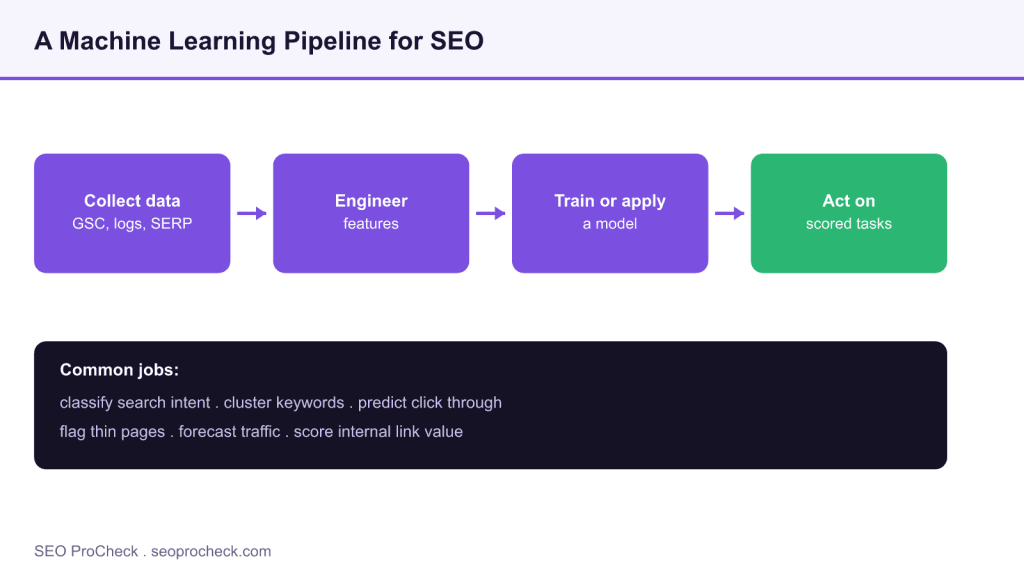
- The reusable pipeline is collect data, engineer features, apply a model, act on scores.
- Embeddings now make keyword clustering and intent matching cheap and practical.
- Validate model output against real rankings before you act on it.

A working definition for practitioners
JC Chouinard's guide is a great primer, so here we focus on how a working SEO actually puts machine learning to use without a data science team. The mental model that keeps projects honest is the four step pipeline in the diagram: collect data, engineer features, apply or train a model, then act on the scores it produces. Most of the value sits in the first and last steps. Clean inputs and a clear decision beat a fancy model every time.
You almost never start by training a model. You start by applying one. Off the shelf embedding models turn a Search Console query export into vectors you can cluster in minutes, which is the practical engine behind modern keyword grouping and intent labelling. If you want the traditional, code first angle on the same problem, our walkthrough of a Python striking distance keyword script shows how far you get with plain ranking data before any model is involved.
High value jobs machine learning does well
The tasks that reliably pay off are classification and clustering. Classify search intent so you route queries to the right template. Cluster thousands of queries into themes so you can map them to pages instead of guessing. Score internal link opportunities so your equity flows to money pages: that idea underpins AI driven internal link optimization. Forecasting traffic from seasonality and trend lets you set realistic targets. In every case the model proposes and a human disposes.
What's changed since this resource was published
The ground shifted from feature engineered classifiers toward large language models and embeddings. Two years ago clustering keywords meant TF-IDF and k-means; today a single embedding call captures semantic similarity that those methods missed, so near synonyms land in the same group without hand tuned rules. The other shift is that SEO is now partly optimising for the models themselves, since LLM answer engines read and cite pages. That raises strategic questions we explore in a technical SEO's adaptation for AI visibility and in the debate over whether generative AI will replace SEO. The pipeline is unchanged; the models plugged into step three simply got far more capable.
| SEO job | What the model does | Typical input |
|---|---|---|
| Intent classification | Labels queries as informational, commercial, or transactional | Query text plus SERP features |
| Keyword clustering | Groups related queries into themes | Query embeddings from GSC export |
| Thin page detection | Flags pages unlikely to satisfy intent | Content features and engagement signals |
| Traffic forecasting | Projects clicks from trend and seasonality | Historical clicks by page or query |
| Internal link scoring | Ranks link opportunities by likely value | Site graph plus relevance scores |
Machine Learning for SEO - JC Chouinard provides valuable insights for SEO practitioners. This resource examines approaches and considerations that can improve organic search performance.
Key Concepts
Understanding the fundamental principles behind this topic helps inform strategic decisions. Whether optimizing for traditional search or emerging AI platforms, foundational concepts remain relevant. This resource covers the essential knowledge practitioners need.
Implementation Considerations
Moving from concept to execution requires understanding practical constraints and opportunities. Different situations call for different approaches. This resource provides guidance for applying concepts in real-world contexts.
Measuring Impact
SEO efforts require measurement to demonstrate value and guide optimization. Identifying appropriate metrics, establishing baselines, and tracking progress enables data-driven improvement. This resource addresses how to evaluate success.
This resource contributes to the knowledge base SEO practitioners need for effective optimization in an evolving search landscape.
Source: https://www.jcchouinard.com/machine-learning-for-seo/
Frequently asked questions
Do I need to train my own model to use ML for SEO?
Usually not. The fastest wins come from applying existing models, especially embedding models, to your own data. Training from scratch is rarely worth it for typical SEO tasks when a pretrained model already captures what you need.
What is the most practical first ML project for SEO?
Keyword clustering from a Search Console export. You turn queries into embeddings, group them by similarity, and map each group to a page. It is low risk, fast, and immediately useful for content planning.
How is ML different from just using AI writing tools?
AI writing tools generate text; machine learning for SEO is about analysis and prioritisation, classifying, clustering, scoring, and forecasting on your own data. One produces content, the other tells you where to focus effort.
Are embeddings better than TF-IDF and k-means for clustering?
For most SEO clustering, yes. Embeddings capture meaning, so near synonyms and paraphrases group correctly without hand tuned rules. Older TF-IDF methods rely on exact word overlap and miss semantic matches.
How do I trust a model's output?
Validate against reality before acting. Spot check clusters and classifications by hand, and compare forecasts to actual results over a few cycles. Treat model output as a ranked suggestion, not a decision.
Is machine learning replacing SEO analysts?
No. It removes repetitive pattern work so analysts spend time on strategy and judgement. The model proposes; a person decides what to ship, which is where domain knowledge still wins.
Take this with you
The assistant links open with a question about this page already written. Nothing is sent until you press enter.
Claude Vincent is a technical SEO consultant focused on crawlability, rendering, and AI-search visibility. He writes the field guides and case studies at SEO ProCheck, with a bias toward the durable, unglamorous work that decides whether search engines and AI answer engines can actually read and cite a site.
About SEO ProCheck
Technical SEO consulting and GEO strategy with 20 years of enterprise experience. Case studies, resources, and tools for search and AI visibility.
Work With Me
Technical SEO audits, GEO strategy, site migrations, and international SEO. Hourly consulting for teams who need hands-on support, not just reports.
Subscribe to our newsletter!







Recent Posts
- Finding a Competitor's Sitemap, and Turning It Into a Change Log September 15, 2026
- AI Crawler User Agents: The Current Names, and Which Ones Sites Actually Block September 9, 2026
- Can AI Crawlers Actually Read Your Site? I Measured 400 of the Biggest September 5, 2026