

AI Summary
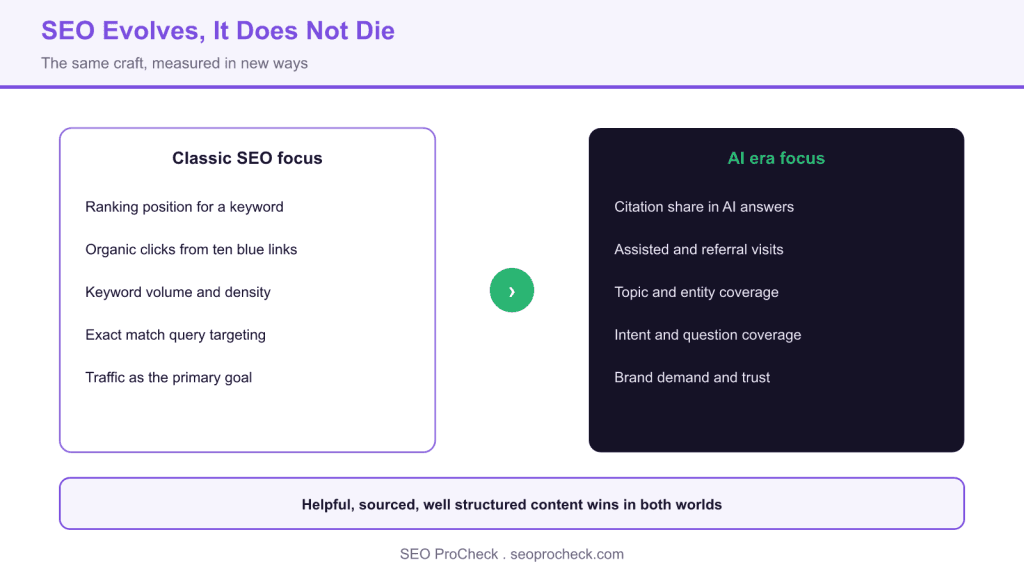
Generative AI is not killing SEO, it is reshaping what SEO optimises for and how success is measured. Rankings give way to citation share, some informational clicks shift to assisted and referral visits, and keyword tracking broadens into topic coverage and brand demand, but the underlying craft of publishing helpful, well structured, trustworthy content still decides who wins.
- Zero click behaviour was already rising before AI, and generative answers extend the trend.
- The work shifts from chasing one ranking to being a cited, trusted source.
- Brand demand and returning visitors become more valuable as discovery changes.
- Measurement broadens to include AI referral traffic and citation presence.
The emergence of AI-powered search and large language models has created new considerations for content optimization. This resource explores how content creators can adapt their strategies to maintain visibility as AI increasingly mediates information discovery.
Understanding AI Content Consumption
Large language models process content differently than traditional search algorithms. They seek factual, well-structured information that can be confidently cited. Understanding these consumption patterns helps optimize content for AI visibility alongside traditional search performance.
Optimization Approaches
Research indicates specific approaches improve AI citation likelihood: including statistics with sources, maintaining factual accuracy, structuring content for easy extraction, and demonstrating clear expertise. These tactics complement rather than replace traditional SEO fundamentals.
Strategic Implications
As AI search grows, early optimization provides compounding advantages. Building citation presence now establishes your content as an authoritative source that AI systems learn to trust. The convergence of good SEO and good GEO practices suggests quality-focused strategies benefit both channels.
This resource provides actionable guidance for the evolving intersection of content strategy and AI visibility.
Source: https://seo.ai/blog/will-generative-ai-kill-seo
SEO ProCheck practitioner notes
The honest answer to the headline question is that generative AI changes the job without ending it. Search has been reinventing itself for two decades, through featured snippets, People Also Ask, and knowledge panels, each of which absorbed clicks and forced practitioners to adapt. Generative answers are the next turn of that wheel, larger than the last, but the same principle holds: the sites that publish the clearest, most trustworthy answer keep winning attention, even as the shape of that attention changes.
Zero click was already here
The fear behind will AI kill SEO is really a fear of losing clicks. That erosion started long before generative answers, as featured snippets and instant answers began satisfying simple queries on the results page. Generative AI accelerates the trend for purely informational intent, where a synthesised answer often suffices. The measured response is to stop treating every impression as a click you are owed and to focus on the queries where a click still has value: comparisons, decisions, purchases, and tasks where the user needs your page, not just a fact.
From ranking to being cited
The unit of success is shifting from a ranking position to a citation. Instead of asking whether you rank first for a keyword, ask whether you are the source an AI answer quotes and links for your priority topics. That reframes the work toward clarity and sourcing: lead passages with direct answers, attach named sources to claims, and structure content so a machine can lift a clean statement. The pages that earn citations are the same pages that would have earned featured snippets, so the muscle is familiar.
Brand becomes a moat
As discovery gets mediated by assistants, brand demand becomes more valuable, not less. People who already know and search for you by name, who return directly, and who trust your content are insulated from shifts in how anonymous discovery works. Investing in a recognisable brand, a distinctive point of view, and genuine expertise pays off across every channel, and it is one of the few assets an algorithm change cannot erase overnight. This is why generative AI rewards real publishers over thin aggregators.
Measure the new signals
You cannot manage what you do not measure, and the metrics are broadening. Alongside rankings and organic clicks, start tracking referral traffic from AI assistants in your analytics, watch for your brand appearing in AI answers for target queries, and monitor branded search demand as a proxy for mind share. None of the classic reports become useless, but leaning only on average position will increasingly understate the value your content creates in an answer led world.
Old metric, new metric
| Classic SEO metric | AI era companion metric | Why it matters |
|---|---|---|
| Ranking position | Citation share in AI answers | Answers often replace the click |
| Organic clicks | Assisted and referral visits | Value arrives via more paths |
| Keyword volume | Topic and entity coverage | Depth beats single keywords |
| Exact match targeting | Question and intent coverage | Fan out rewards breadth |
| Total traffic | Brand demand and returning users | Loyalty survives algorithm shifts |
What has changed since this expert take
Since this opinion was written, the theoretical has become concrete. Google rolled out AI Overviews across a large share of queries and expanded AI Mode, ChatGPT added a citing search mode, and Perplexity built a whole product around cited answers. The prediction that SEO would adapt rather than die has held up, and a new practice often called generative engine optimisation has formed around it, focused on earning citations and measuring AI referral traffic. The core conclusion of the source, that helpful and trustworthy content still wins, is more accurate now than when it was first argued.
Related reading
- How AI Mode works and how SEO can prepare
- A practical framework for LLM consumption
- A technical SEO adaptation for AI visibility
Frequently asked questions
Will generative AI kill SEO?
No, but it is reshaping it. Generative answers absorb some informational clicks and shift the goal from ranking first to being cited and trusted, yet the underlying work of publishing helpful, well structured, sourced content still decides who wins. SEO adapts, as it has through every previous change to search.
How is SEO changing because of AI?
The emphasis moves from a single ranking position toward citation share in AI answers, from exact keyword targeting toward broad topic and entity coverage, and from raw traffic toward brand demand and returning visitors. Measurement broadens too, adding AI referral traffic and citation presence to the classic reports.
Should I stop doing traditional SEO?
No. AI answers are grounded in the search index, so being crawlable, indexable, relevant, and authoritative is still the foundation. Traditional SEO is the price of entry, and the AI era layers additional goals on top rather than replacing the fundamentals you already invest in.
What content wins in the AI era?
Helpful, clearly structured, well sourced content that covers a topic in depth and comes from a trusted brand. These are the same pages that earned featured snippets, so leading with direct answers, citing sources, and demonstrating real expertise remains the most reliable strategy.
How do I measure SEO success with AI answers?
Track referral traffic from AI assistants in your analytics, watch whether your brand appears in AI answers for target queries, and monitor branded search demand as a proxy for mind share. Use these alongside rankings and clicks rather than relying on average position alone.
Why does brand matter more with generative AI?
As assistants mediate discovery, people who already know and trust your brand return directly and search for you by name, which insulates you from shifts in anonymous discovery. A recognisable brand and genuine expertise are assets an algorithm change cannot erase, so they become a durable advantage.
Take this with you
The assistant links open with a question about this page already written. Nothing is sent until you press enter.
Claude Vincent is a technical SEO consultant focused on crawlability, rendering, and AI-search visibility. He writes the field guides and case studies at SEO ProCheck, with a bias toward the durable, unglamorous work that decides whether search engines and AI answer engines can actually read and cite a site.
About SEO ProCheck
Technical SEO consulting and GEO strategy with 20 years of enterprise experience. Case studies, resources, and tools for search and AI visibility.
Work With Me
Technical SEO audits, GEO strategy, site migrations, and international SEO. Hourly consulting for teams who need hands-on support, not just reports.
Subscribe to our newsletter!








Recent Posts
- Most Top Sites Never Say Who They Are in Structured Data October 14, 2026
- Homepage Titles Are Mostly Too Short, Not Too Long October 8, 2026
- Who Actually Serves an llms.txt? 184 Top Sites Measured September 29, 2026