

AI Summary
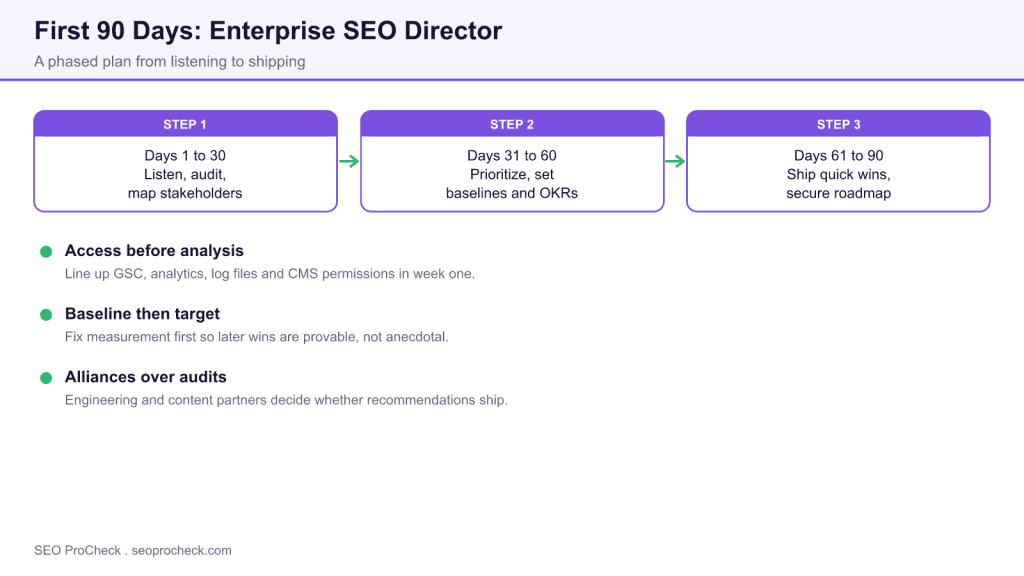
The first 90 days as an enterprise SEO director are about earning trust, fixing measurement and shipping a few credible wins, not launching a giant audit no one asked for. Spend the first month listening and gathering access, the second setting baselines and priorities, and the third delivering quick wins while you lock in a defensible roadmap.
- Days 1 to 30: gather access, map stakeholders, audit quietly and learn the business.
- Days 31 to 60: set baselines and OKRs, prioritize by impact and effort, build alliances.
- Days 61 to 90: ship quick wins, prove measurement and secure a funded roadmap.
- In enterprise SEO, influence over engineering and content decides whether anything ships.
Days 1 to 30: listen before you audit
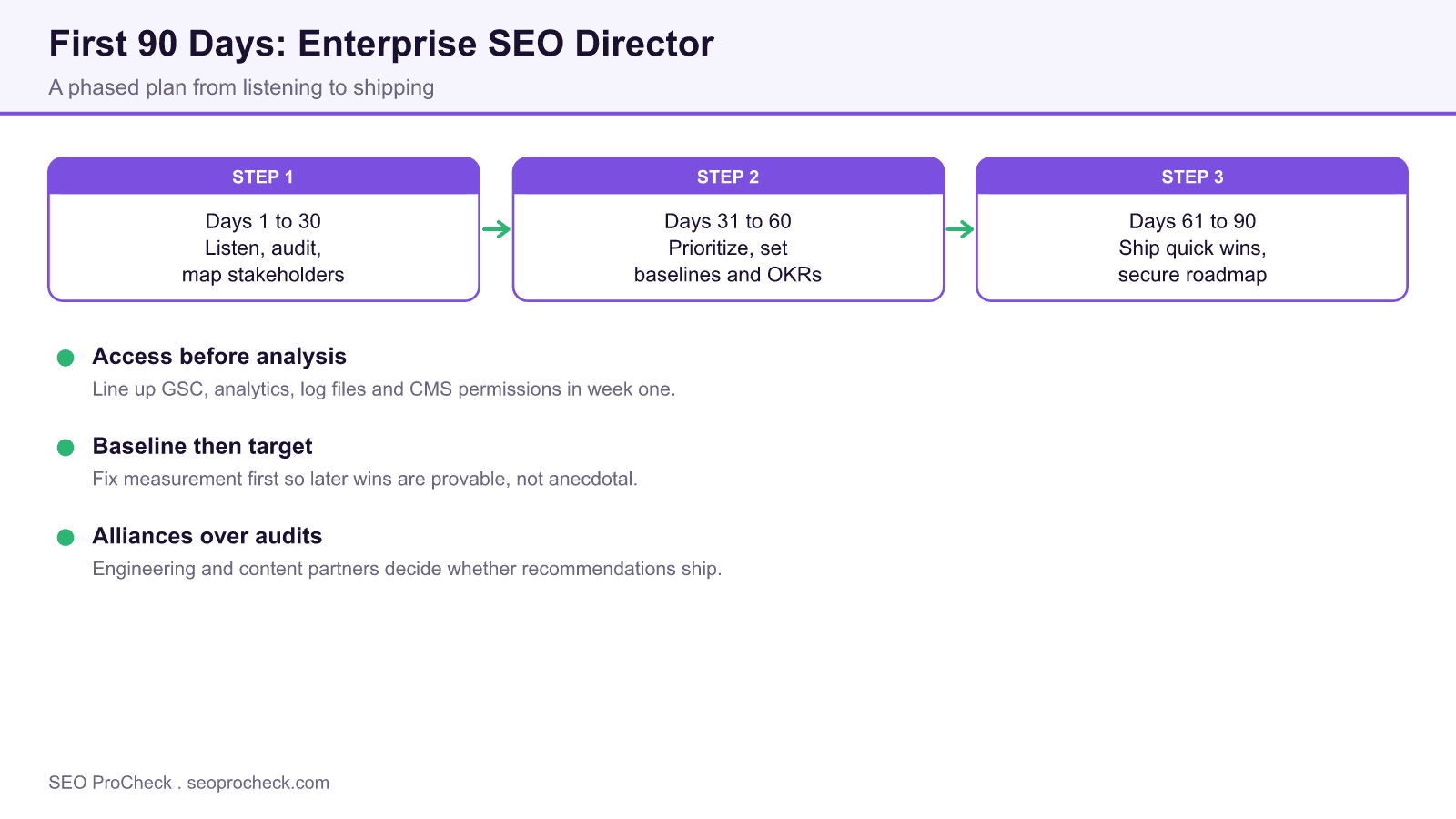
New enterprise SEO leaders often lose the room by arriving with a 200 item audit in week two. The higher leverage move is to listen. Meet the people who own the levers you will need: engineering, product, content, analytics, PR and the commercial teams whose revenue you affect. Learn how the business actually makes money, what the current SEO narrative is, and where past recommendations went to die.
In parallel, secure access. You cannot lead what you cannot see. Line up Search Console, the analytics platform, server log access, the CMS, the deployment pipeline and any existing rank and site audit tools. Document the crawl and indexation baseline, the template inventory and the release process. This is also the month to run a quiet technical review so that later recommendations are grounded, using a repeatable framework like our technical SEO audit checklist.
Days 31 to 60: baselines, priorities and alliances
Now convert listening into structure. Establish honest baselines for organic traffic, indexed pages, Core Web Vitals, conversions and revenue so every future claim is provable rather than anecdotal. Translate business goals into a small set of OKRs that a non SEO executive can understand. Prioritize the backlog by expected impact against implementation effort, and be ruthless: at enterprise scale, a template level fix beats a hundred page level tweaks.
This is also where alliances are won or lost. In a large organization, SEO rarely owns the code or the editorial calendar, so your recommendations only ship if engineering and content partners choose to prioritize them. Package requests as clear tickets with business rationale, effort estimates and measurable outcomes. A strong operating model here mirrors what seasoned leaders describe in this enterprise SEO strategy guide.
Days 61 to 90: ship wins and fund the roadmap
Credibility comes from shipped outcomes, not slide decks. Deliver two or three quick wins that were already validated: fixing a broken canonical or indexation pattern across a template, restoring lost internal links, improving title and metadata generation at scale, or reclaiming a decayed high value section. Tie each to the baseline you set so the impact is visible.
By day 90 you should be presenting a funded roadmap, not asking for permission to think. Show the baseline, the early wins, the prioritized backlog and the resourcing each phase needs. Frame it in the language of the business: pipeline, revenue and risk. That is what turns an SEO director from a cost center into a strategic partner. For definitions your stakeholders can share, point them to our SEO audit glossary entry.
| Phase | Primary focus | Deliverable by end of phase |
|---|---|---|
| Days 1 to 30 | Access, listening, stakeholder mapping | Access secured, baseline crawl and a quiet technical review |
| Days 31 to 60 | Baselines, OKRs, prioritization | Measurement baseline, prioritized backlog and executive OKRs |
| Days 61 to 90 | Quick wins and roadmap | Two or three shipped wins and a funded, prioritized roadmap |
Frequently asked questions
What should an enterprise SEO director do first?
Listen and gather access. Meet engineering, product, content and analytics owners, learn how the business earns revenue, and secure access to Search Console, analytics, logs and the CMS before proposing any changes.
Why not launch a full audit in week one?
Because a large audit with no relationships or business context rarely gets implemented. Spend early weeks building trust and baselines so that when recommendations arrive, the teams who own the code and content will actually prioritize them.
What are good 90 day OKRs for enterprise SEO?
Tie them to the business: restore or grow indexed high value pages, improve Core Web Vitals on key templates, recover a decayed section, and establish reliable measurement. Each should have a baseline and a target an executive can understand.
How do you get engineering to prioritize SEO work?
Package requests as clear tickets with business rationale, effort estimates and measurable outcomes, and build relationships early. At enterprise scale, influence and prioritization, not the audit itself, decide whether fixes ship.
How do you prove SEO impact in 90 days?
Set honest baselines in the first month, ship two or three pre validated wins, and report their effect against those baselines in the language of revenue, pipeline and risk rather than rankings alone.
Source: https://searchengineland.com/enterprise-seo-director-first-90-days-386743
Claude Vincent is a technical SEO consultant focused on crawlability, rendering, and AI-search visibility. He writes the field guides and case studies at SEO ProCheck, with a bias toward the durable, unglamorous work that decides whether search engines and AI answer engines can actually read and cite a site.
About SEO ProCheck
Technical SEO consulting and GEO strategy with 20 years of enterprise experience. Case studies, resources, and tools for search and AI visibility.
Work With Me
Technical SEO audits, GEO strategy, site migrations, and international SEO. Hourly consulting for teams who need hands-on support, not just reports.
Subscribe to our newsletter!





Recent Posts
- Can AI Crawlers Actually Read Your Site? I Measured 400 of the Biggest September 5, 2026
- The Pre-Publish Quality Gate for AI-Assisted Content August 6, 2026
- AGENTS.md vs llms.txt vs llms-full.txt: Which Agent File Does What July 18, 2026