

AI Summary
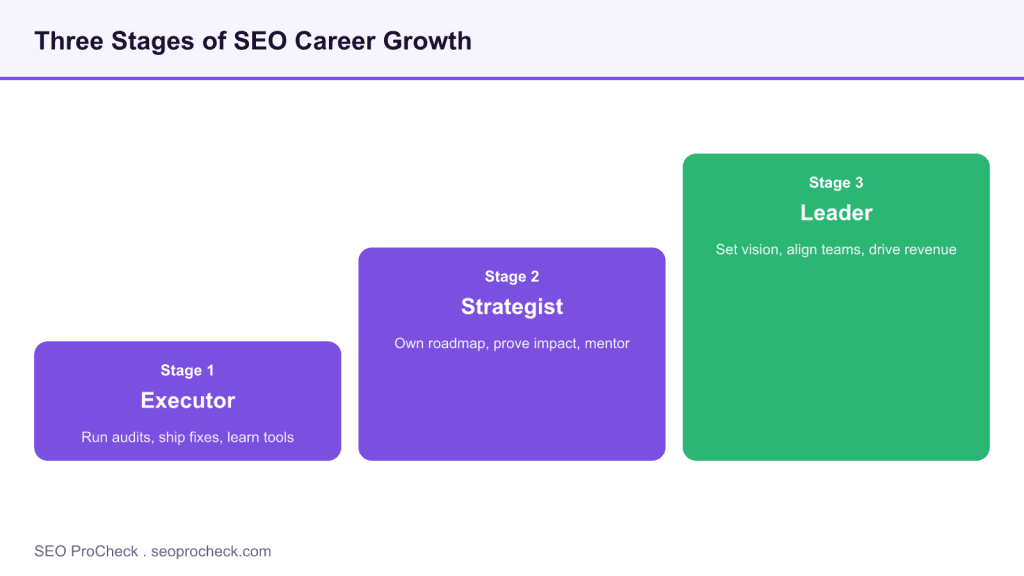
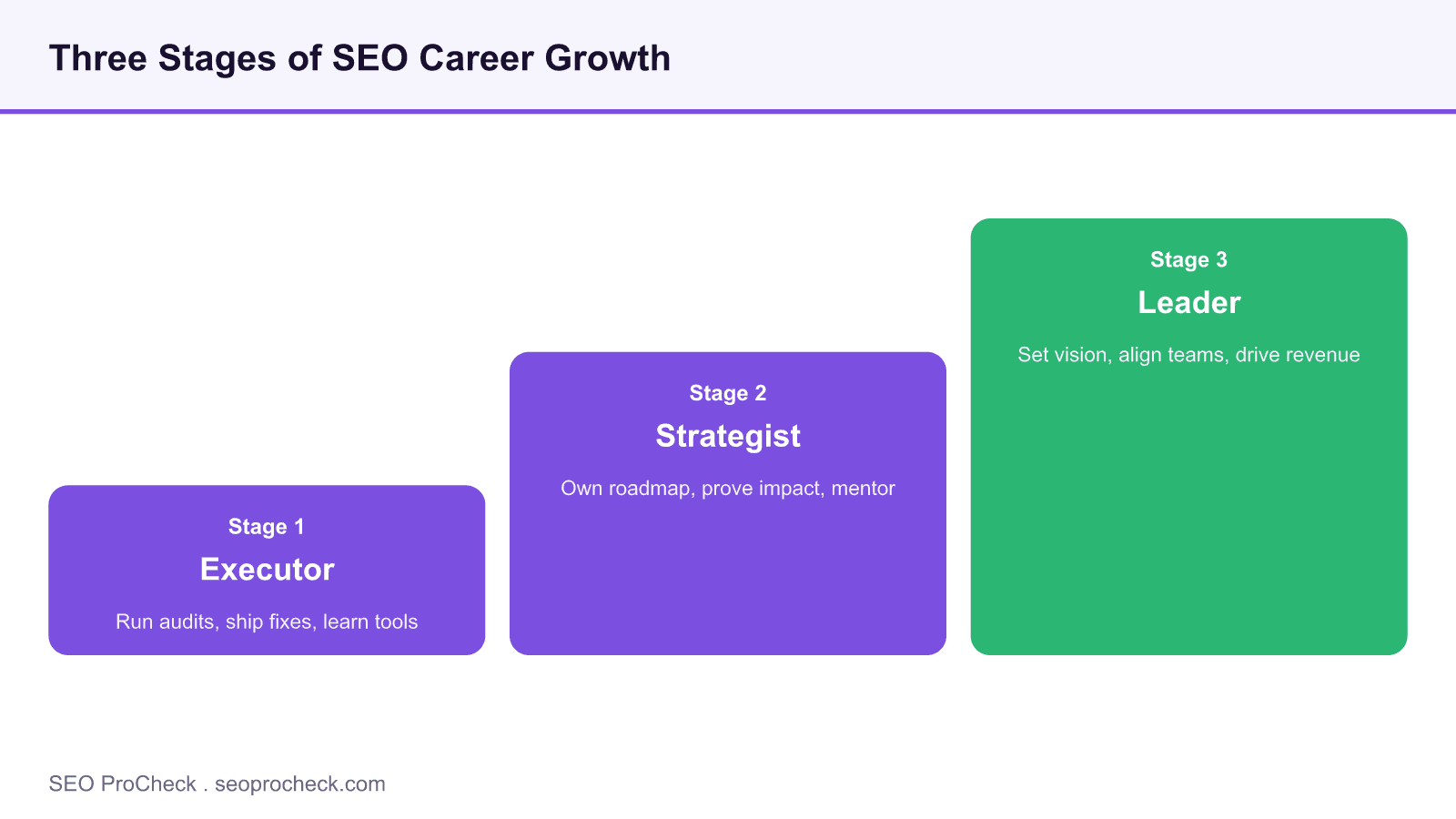
Most SEO careers move through three stages: executor who ships fixes, strategist who owns the roadmap and proves impact, and leader who sets vision and drives revenue. The jump between stages is not about knowing more tactics; it is about widening the scope of the problem you own and how you communicate value to people outside SEO.
- Stage one is execution: audits, fixes, tooling, and craft.
- Stage two is strategy: owning a roadmap, proving impact, and mentoring.
- Stage three is leadership: vision, cross team alignment, and revenue.
- Progress comes from broadening scope and business communication, not just more tactics.
Reading the three stages as scope, not seniority
Kevin Indig's framing resonates because the stages map to how much of the problem you own, not to a job title. Plenty of people carry a senior title while still operating as executors, and some junior SEOs already think like strategists. The commentary worth adding is what actually unlocks each jump, because that is where careers stall.
The first stage is craft. You run audits, ship fixes, and learn the tools deeply. This is where you build the pattern library that everything else rests on, and there is no shortcut through it. Grounding in fundamentals like keyword research and technical hygiene is what earns you the right to be trusted with strategy.
The jumps that stall careers
The move from executor to strategist is the one most people get stuck on, and it is rarely about tactics. It is about learning to prioritise ruthlessly, to say no, and to tie SEO work to outcomes a business leader cares about. This is where a systems view matters: understanding topic cluster strategy instead of chasing single keywords, and building durable processes instead of one off wins. The move from strategist to leader adds a second shift: you stop being the person with the answers and become the person who builds the team and the vision so others produce the answers.
What's changed since this resource was published
AI reshaped the bottom of the ladder fastest. Routine execution work, drafting, basic auditing, bulk metadata, is increasingly automated, which raises the bar on what an entry level SEO must bring. The counterintuitive result is that strategy and judgement, the stage two and three skills, became more valuable, not less, because someone still has to decide what the automation should do and why. Practical fluency with data and models, including machine learning skills for SEO, now accelerates the climb from executor to strategist. The three stages still hold; the tools you use to move between them changed.
| Stage | Core focus | What you own | Signal you are ready to move up |
|---|---|---|---|
| Executor | Craft and delivery | Tasks and fixes | You anticipate problems before they are assigned |
| Strategist | Prioritisation and impact | A roadmap and its outcomes | Leaders ask for your view before deciding |
| Leader | Vision and people | A team and a revenue number | Your team ships strong work without you in the room |
The 3 stages of SEO career development provides valuable insights for SEO practitioners. This resource examines approaches and considerations that can improve organic search performance.
Key Concepts
Understanding the fundamental principles behind this topic helps inform strategic decisions. Whether optimizing for traditional search or emerging AI platforms, foundational concepts remain relevant. This resource covers the essential knowledge practitioners need.
Implementation Considerations
Moving from concept to execution requires understanding practical constraints and opportunities. Different situations call for different approaches. This resource provides guidance for applying concepts in real-world contexts.
Measuring Impact
SEO efforts require measurement to demonstrate value and guide optimization. Identifying appropriate metrics, establishing baselines, and tracking progress enables data-driven improvement. This resource addresses how to evaluate success.
This resource contributes to the knowledge base SEO practitioners need for effective optimization in an evolving search landscape.
Source: https://www.kevin-indig.com/the-3-stages-of-seo-career-development/
Frequently asked questions
What are the three stages of an SEO career?
Executor, who runs audits and ships fixes; strategist, who owns the roadmap and proves impact; and leader, who sets vision, builds the team, and drives revenue. Each stage widens the scope of the problem you own.
Why do so many SEOs get stuck at the executor stage?
Because the jump to strategist is about prioritisation, saying no, and tying work to business outcomes, not about learning more tactics. People who keep collecting tactics without widening their scope tend to plateau.
Does a senior job title mean you are a strategist?
Not necessarily. The stages describe how much of the problem you own, not your title. Some senior titled people still operate as executors, while some junior SEOs already think strategically.
How is AI changing the SEO career ladder?
It automates much of the routine execution work, raising the bar for entry level roles and making strategy and judgement more valuable. The ability to direct automation well now matters more than doing the manual task yourself.
What skills speed up the climb from executor to strategist?
Ruthless prioritisation, clear communication with non SEO stakeholders, a systems view like topic clusters over single keywords, and comfort with data and models. These let you own outcomes rather than tasks.
Do I still need deep technical craft to become a leader?
Yes. The craft stage builds the pattern library that lets you make good strategic calls and earn a team's trust. You can delegate execution later, but you cannot skip learning it first.
Claude Vincent is a technical SEO consultant focused on crawlability, rendering, and AI-search visibility. He writes the field guides and case studies at SEO ProCheck, with a bias toward the durable, unglamorous work that decides whether search engines and AI answer engines can actually read and cite a site.
About SEO ProCheck
Technical SEO consulting and GEO strategy with 20 years of enterprise experience. Case studies, resources, and tools for search and AI visibility.
Work With Me
Technical SEO audits, GEO strategy, site migrations, and international SEO. Hourly consulting for teams who need hands-on support, not just reports.
Subscribe to our newsletter!





Recent Posts
- Finding a Competitor's Sitemap, and Turning It Into a Change Log September 15, 2026
- AI Crawler User Agents: The Current Names, and Which Ones Sites Actually Block September 9, 2026
- Can AI Crawlers Actually Read Your Site? I Measured 400 of the Biggest September 5, 2026