

AI Summary
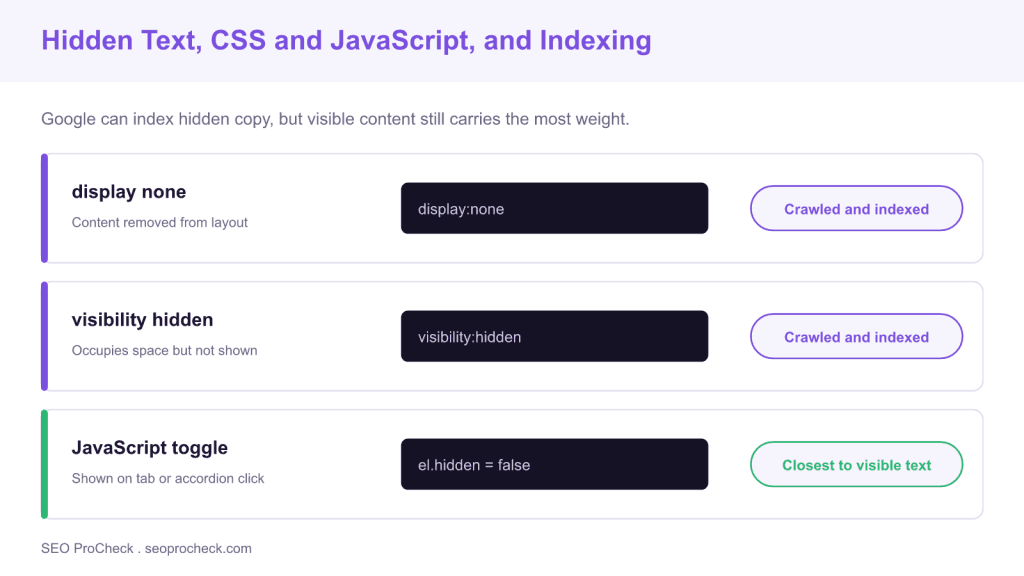
Google does crawl and index text that is hidden with CSS or revealed by JavaScript, so hidden copy is not invisible to search. The nuance is weighting and intent: content tucked into tabs and accordions for genuine user experience is generally treated fairly under mobile first indexing, while text hidden purely to stuff keywords risks being discounted or flagged as a policy violation.
- Text set to display none or visibility hidden stays in the DOM and can be indexed.
- Under mobile first indexing, content in tabs and accordions is generally given full weight.
- Hiding text only to manipulate rankings is a spam signal, not a tactic.
- If a passage matters, make it visible or reachable without deception.
This SEO case study documents a successful optimization initiative, providing actionable insights for practitioners. The documented approach demonstrates how strategic SEO implementation drives measurable results.
Initial Situation
Understanding the starting point is essential context for evaluating any case study. This documentation covers the initial challenges, competitive position, and business objectives that shaped the SEO strategy.
Strategy and Approach
The strategic approach combined multiple SEO disciplines to address identified opportunities. Key decisions around prioritization and resource allocation provide a template for similar initiatives.
Implementation
Moving from strategy to execution required specific technical implementations, content development, and process changes. This case study documents the practical steps that translated strategy into action.
Results and Learnings
The outcomes demonstrate effectiveness through measurable improvements in rankings, traffic, and business metrics. Analysis of successes and challenges provides learning value for practitioners.
Case studies like this contribute to the SEO knowledge base, helping practitioners learn from documented real-world experiences.
Source: https://www.rebootonline.com/blog/hidden-text-experiment/
What the experiment set out to answer
The long running question behind this study is simple to state and easy to get wrong: if you hide text with CSS or reveal it with JavaScript, does Google still read it, and does that text still influence rankings? A long term experiment is the right instrument here, because a one off snapshot cannot separate a real effect from the ordinary drift of the search results. By holding a controlled setup in place over an extended period, the test can observe whether hidden passages are picked up and how they behave once indexed.
The practical answer has been consistent for years. Hidden text is not the same as absent text. Anything present in the HTML or in the rendered DOM is available to the crawler, whether or not a person can see it on screen. What changes is how much that content is trusted and weighted, and whether the way it is hidden crosses the line from user experience into manipulation.
How the hiding method changes the picture
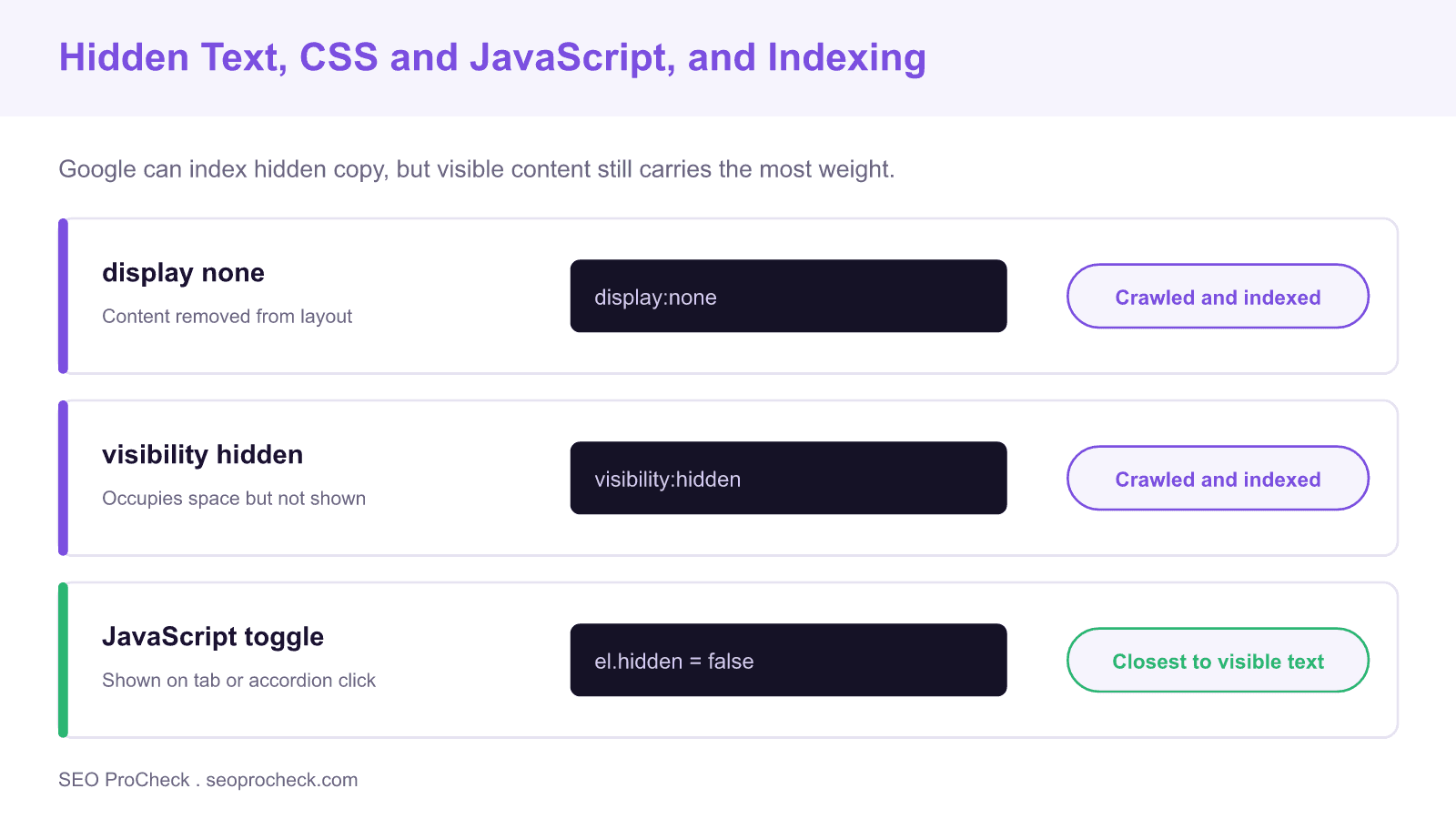
The methods in the diagram above sit on a spectrum. Setting display none or visibility hidden leaves the text in the source, so it is crawled and indexed, but content that is hidden by default has historically been treated as less prominent than content shown on load. A JavaScript toggle that reveals a tab or accordion is closest to normal visible content under mobile first indexing, provided the text ships in the markup rather than being fetched only after the click. The riskiest pattern is old style cloaking, such as pushing text off screen with a large negative indent or coloring it to match the background, which exists only to feed keywords to crawlers and is treated as spam.
/* indexed, present in DOM */
.panel { display:none; }

/* indexed, occupies layout space */
.note { visibility:hidden; }

/* legitimate: full text in markup, toggled on click */
<section hidden>full answer text here</section>

/* spam pattern, avoid: off screen keyword stuffing */
.cloak { text-indent:-9999px; }
How each method is treated
| Method | In the DOM | Indexable | Recommended use |
|---|---|---|---|
| display none | Yes | Yes, may be less prominent | Tabs and accordions with real content |
| visibility hidden | Yes | Yes | Transient interface states |
| JavaScript toggle, text in markup | Yes | Yes, full weight on mobile | Read more and expandable sections |
| JavaScript fetch on click only | No until fetched | Risky, may be missed | Avoid for important content |
| Off screen or same color text | Yes | Treated as spam | Never use |
What has changed since this experiment
The move to mobile first indexing was the turning point. Because so many mobile layouts rely on tabs, accordions, and read more patterns, Google confirmed that content hidden in those interface elements is indexed and given full weight, which retired a long standing worry that expandable copy was quietly discounted. The line that has not moved is intent. Hiding text so that only crawlers see it remains a spam policy violation and a good way to earn a manual action. The clean modern approach is to put the full text in the markup, use CSS or a toggle only to organize the reading experience, and reserve visible, prominent placement for anything that genuinely needs to rank.
For related studies see our crawling and indexing case study library, the test on client side rendered content and indexing, and our meta robots and X Robots Tag reference.
Frequently asked questions
Does Google index text that is hidden with CSS?
Yes. Text set to display none or visibility hidden is still present in the HTML and in the rendered DOM, so Googlebot can read and index it. Being hidden from a human viewer does not remove the content from the page source that search engines parse.
Is text inside tabs and accordions counted the same as visible text?
Under mobile first indexing Google has said that content hidden behind tabs, accordions, and read more toggles is indexed and given full weight, because on mobile that pattern is a normal, user friendly way to manage space. The key is that the content is genuinely present in the markup rather than loaded only after a separate request.
Is hidden text against Google guidelines?
It depends entirely on intent. Hiding text so users cannot see it while feeding keywords to search engines is classic sneaky hidden text and violates the spam policies. Using CSS or a toggle to organize content that users can still reach is fine and common.
Does display none hurt SEO?
Using display none for legitimate interface patterns does not carry a penalty, but content you hide by default may be treated as less prominent than content shown immediately. If a passage is important for ranking, the safe choice is to make it visible rather than to rely on hidden markup.
Should I hide long content behind a read more toggle?
You can, and on mobile it often improves the experience. Just make sure the full text is in the initial HTML or rendered DOM so it is available to the crawler, rather than fetched from the server only when a user clicks.
How can I see exactly what text Google indexes on my page?
Use the URL Inspection tool in Google Search Console, run a live test, and open the rendered HTML tab to see the DOM Googlebot builds. You can also compare the raw source with the rendered view in browser DevTools to confirm which passages depend on scripts.
Claude Vincent is a technical SEO consultant focused on crawlability, rendering, and AI-search visibility. He writes the field guides and case studies at SEO ProCheck, with a bias toward the durable, unglamorous work that decides whether search engines and AI answer engines can actually read and cite a site.
About SEO ProCheck
Technical SEO consulting and GEO strategy with 20 years of enterprise experience. Case studies, resources, and tools for search and AI visibility.
Work With Me
Technical SEO audits, GEO strategy, site migrations, and international SEO. Hourly consulting for teams who need hands-on support, not just reports.
Subscribe to our newsletter!




Recent Posts
- Can AI Crawlers Actually Read Your Site? I Measured 400 of the Biggest September 5, 2026
- The Pre-Publish Quality Gate for AI-Assisted Content August 6, 2026
- AGENTS.md vs llms.txt vs llms-full.txt: Which Agent File Does What July 18, 2026