AI Summary
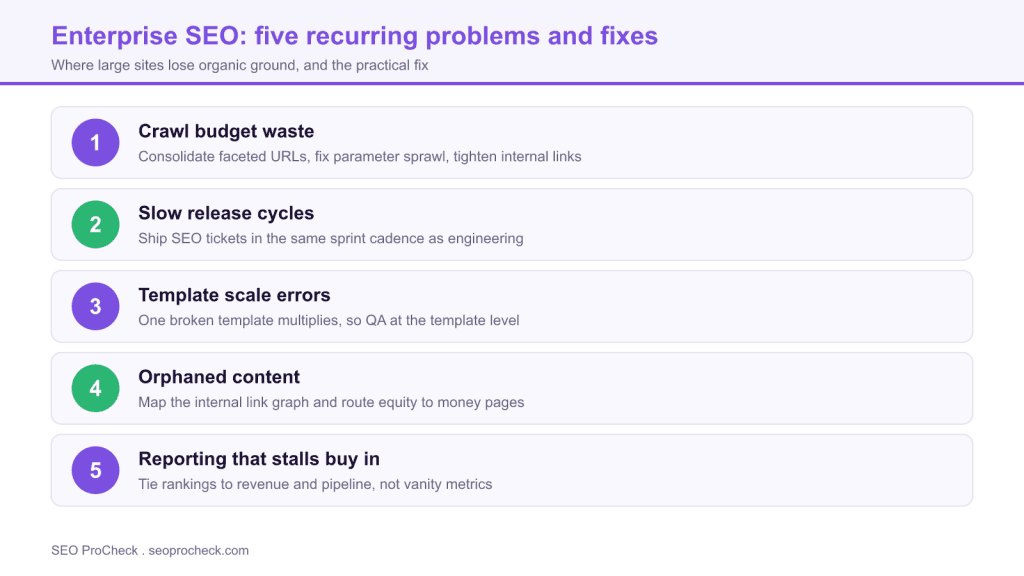
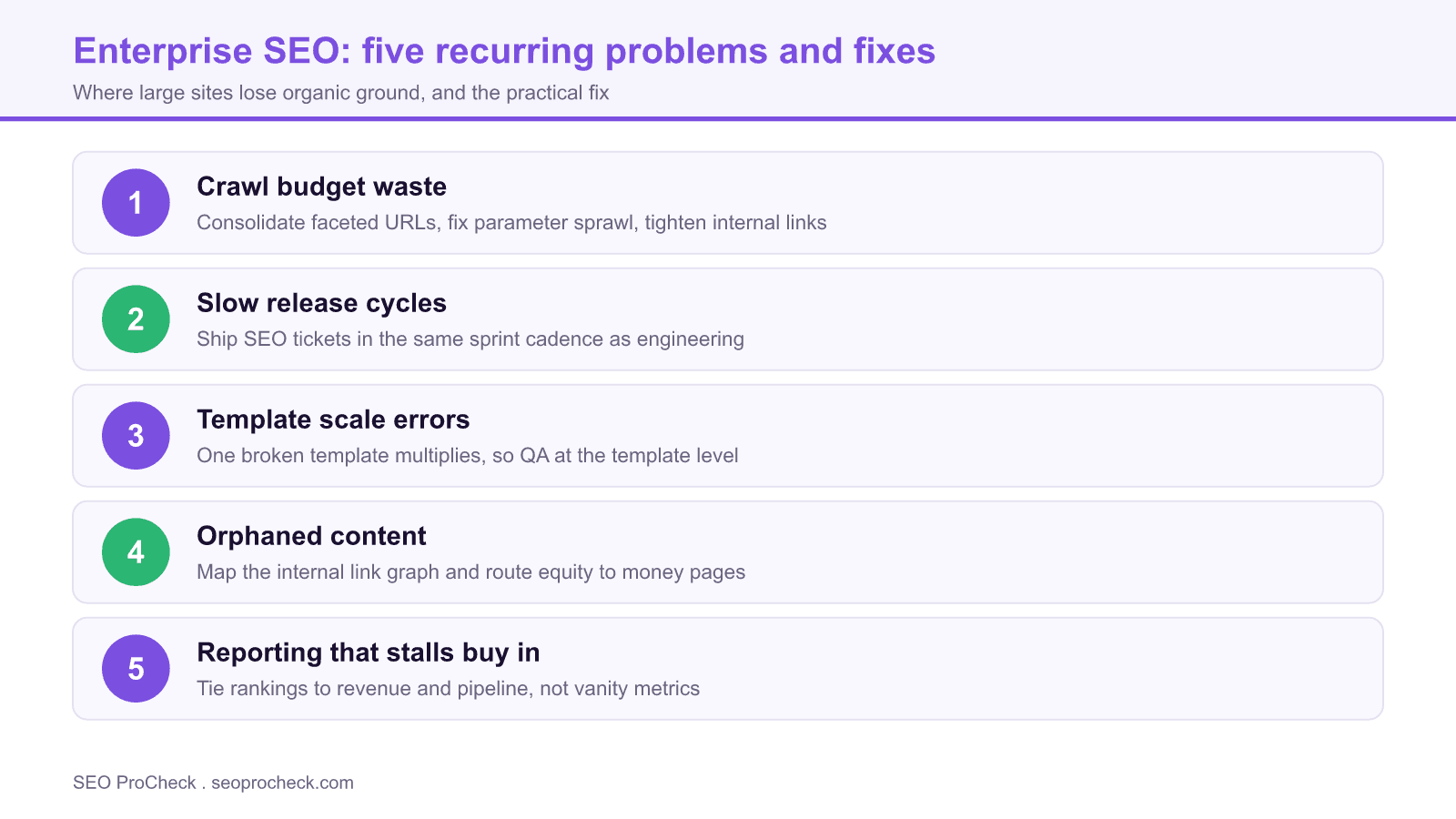
Enterprise SEO problems are rarely about a single missing tag: they come from scale, slow release cycles and weak internal ownership. This guide keeps the original iPullRank roundup and adds a practitioner view of the five problems that cost large sites the most organic traffic, plus the fix for each.
- Crawl budget is wasted by parameter sprawl and faceted URLs long before content is the issue.
- A single broken template multiplies across thousands of URLs, so template level QA matters most.
- Orphaned pages leak equity: map the internal link graph and route it to money pages.
- Reporting that talks revenue, not rankings alone, is what keeps SEO funded at the enterprise level.
11 Common Enterprise SEO Problems and Solutions, iPullRank provides valuable insights for SEO practitioners. This resource examines approaches and considerations that can improve organic search performance.
Why enterprise SEO problems look different at scale
On a small site you can fix pages by hand. On an enterprise site the same fix has to survive templates, a content management system, a release train and several teams who do not report to you. That is why the enterprise strategies that work are process changes, not one off edits. The roundup this page summarizes groups the symptoms well, and the practitioner job is to translate each symptom into an owner and a repeatable control.
The five problems that cost the most traffic
1. Crawl budget waste
Faceted navigation, session parameters and infinite filter combinations can generate millions of low value URLs. Googlebot spends its time there instead of on the pages that earn revenue. The fix is boring and effective: decide which parameters create indexable value, block or canonicalize the rest, and keep the XML sitemap limited to canonical, indexable URLs. If you are unsure how a directive behaves, the meta robots and x robots tag reference lays out exactly what index, noindex and follow do.
2. Slow release cycles
SEO recommendations that sit in a backlog for two quarters are not recommendations, they are hopes. Ship SEO work as tickets inside the same sprint cadence engineering already runs, with acceptance criteria a developer can test. Small, frequent, verifiable changes beat a giant annual migration.
3. Template scale errors
A missing canonical or a duplicated title in one template repeats across every page built from it. Review at the template and component level, not the individual URL, and add automated checks that fail a build when a title, canonical or heading rule is violated.
4. Orphaned content
Pages with no internal links rarely rank and rarely get recrawled. Export your internal link graph, find pages with zero or one inbound internal link, and route links from strong hub pages to the ones that should earn traffic. This is also how you resolve cannibalization before chasing new keywords, a theme covered in the striking distance keyword workflow.
5. Reporting that stalls buy in
Executives fund outcomes, not positions. If your dashboard shows only average rank, budget is fragile. Tie organic work to sessions on revenue pages, assisted conversions and pipeline so leadership sees SEO as an investment rather than a cost.
Enterprise SEO problem reference
| Problem | Symptom you will see | Practical fix |
|---|---|---|
| Crawl budget waste | Log files show bots hitting parameter URLs | Block or canonicalize parameters, trim the sitemap |
| Slow release cycles | Fixes approved but never shipped | Put SEO in the engineering sprint with test criteria |
| Template scale errors | One bug repeats across thousands of URLs | QA at the template level, add build time checks |
| Orphaned content | Pages with no internal links, rarely crawled | Map the link graph, route equity to money pages |
| Duplicate or thin variants | Many near identical URLs compete | Consolidate, canonicalize, or improve depth |
| Weak reporting | Leadership questions SEO value | Report revenue pages, conversions and pipeline |
What has changed since this roundup
The mechanics above are stable, but two things shifted. First, AI overviews and answer engines now sit above classic results for many queries, so enterprise teams optimize for being cited, not only ranked. Second, the cost of low quality scaled content rose sharply: large sites that mass produced thin pages have seen impressions compress. The safe path is depth and consolidation, which is exactly why the fixes here favor fewer, stronger pages over more URLs.
Key Concepts
Understanding the fundamental principles behind this topic helps inform strategic decisions. Whether optimizing for traditional search or emerging AI platforms, foundational concepts remain relevant. This resource covers the essential knowledge practitioners need.
Implementation Considerations
Moving from concept to execution requires understanding practical constraints and opportunities. Different situations call for different approaches. This resource provides guidance for applying concepts in real-world contexts.
Measuring Impact
SEO efforts require measurement to demonstrate value and guide optimization. Identifying appropriate metrics, establishing baselines, and tracking progress enables data-driven improvement. This resource addresses how to evaluate success.
This resource contributes to the knowledge base SEO practitioners need for effective optimization in an evolving search landscape.
Frequently asked questions
What is the most common enterprise SEO problem?
Wasted crawl budget from parameter and faceted URLs is the most common and most expensive problem, because search engines spend their time on low value URLs instead of the pages that earn revenue.
How do you fix crawl budget waste?
Decide which URL parameters create indexable value, block or canonicalize the rest, keep the sitemap limited to canonical indexable URLs, and confirm the behavior in log files over the following weeks.
Why do template errors matter so much on large sites?
Because a single mistake in a template repeats across every page built from it, so a small error becomes thousands of broken pages. Reviewing at the template level catches the issue once instead of URL by URL.
What is orphaned content?
Orphaned content is any page with no internal links pointing to it. Those pages rarely rank and rarely get recrawled, so mapping the internal link graph and adding links is a fast, low risk win.
How should enterprise SEO be reported to executives?
Report outcomes leaders already fund: sessions on revenue pages, assisted conversions and pipeline influenced by organic search, rather than average rank alone.
Does AI search change enterprise SEO priorities?
Yes. Answer engines reward clear, well structured, genuinely useful pages, so consolidating thin variants and improving depth now helps both classic rankings and AI citations.
Claude Vincent is a technical SEO consultant focused on crawlability, rendering, and AI-search visibility. He writes the field guides and case studies at SEO ProCheck, with a bias toward the durable, unglamorous work that decides whether search engines and AI answer engines can actually read and cite a site.
About SEO ProCheck
Technical SEO consulting and GEO strategy with 20 years of enterprise experience. Case studies, resources, and tools for search and AI visibility.
Work With Me
Technical SEO audits, GEO strategy, site migrations, and international SEO. Hourly consulting for teams who need hands-on support, not just reports.
Subscribe to our newsletter!