

AI Summary
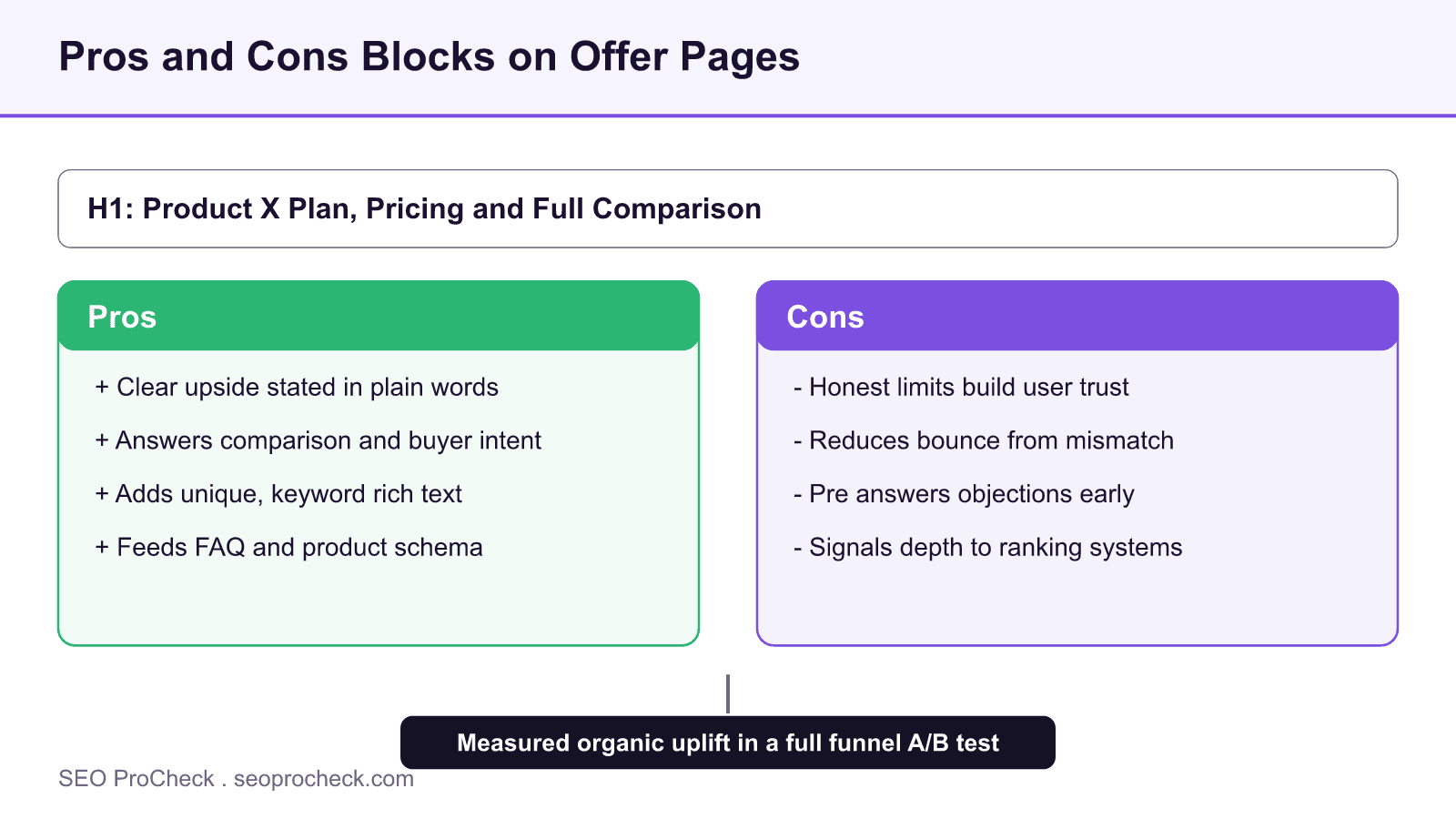
Adding a clearly structured pros and cons block to an offer or product page can lift organic performance because it adds unique, intent matching text and answers the comparison questions buyers actually type. The reliable way to know if it helps your site is a controlled A/B test rather than a blanket rollout.
- A pros and cons block targets comparison and evaluation intent that plain sales copy misses.
- It adds original body text, which helps thin, templated offer pages that engines suppress.
- Honest cons build trust, reduce pogo sticking back to the SERP and can improve conversion.
- Validate the change with a split test measuring rankings, clicks and revenue, not just traffic.
Offer pages and product pages are notorious for being thin. They carry a price, a button and a few lines of marketing copy, then rely on the brand to do the ranking. That leaves a large gap: people comparing options ask concrete questions before they buy, and a page that never states a downside reads as a brochure rather than a genuine answer. A structured pros and cons block closes that gap by putting the trade offs in plain language, directly on the page where the decision happens.
Why a pros and cons block can move rankings
There are three mechanisms at work. First, the block adds unique, substantive text to a page that was previously light on content, which matters when a template stamps out hundreds of near identical offer pages. Second, the wording naturally captures comparison and evaluation intent: phrases like best for, not ideal if, works well when and the main drawback map onto the long tail queries buyers use late in their research. Third, stating honest limitations builds trust, which tends to keep visitors on the page instead of bouncing back to the results to try the next listing. That last behaviour, often called pogo sticking, is a pattern search systems can read as dissatisfaction.
The important nuance is that a pros and cons block is not a magic ranking token. It works when it adds information the page genuinely lacked. Bolting a generic list onto a page that is already deep and well optimised will do little. This is why testing the change rather than assuming beats guessing: the same change can help one template and do nothing on another.
How to structure the block so it earns the win
Keep the two columns balanced and specific. Vague pros like great quality carry no information and no keywords. Concrete, benefit led lines do both jobs at once. A workable pattern:
- Pros: lead each line with the outcome the buyer cares about, then the reason. For example, Fast to deploy: most teams are live inside a day.
- Cons: name a real, non fatal limitation and, where you can, the workaround. For example, No free tier: a trial is available but a card is required.
- Placement: put the block high enough to be seen without scrolling to the footer, ideally just under the summary and above deeper specs.
- Markup: use real list and heading elements, not images of text, so the content is crawlable and eligible for rich results.
Run it as a controlled A/B test
The source below is a full funnel split test, and that is the right model to copy. Rather than change every page and hope, split a set of comparable templated pages into a control group and a variant group, ship the block only to the variant, and measure the difference over a meaningful window. Because SEO tests run against a moving background of algorithm updates and seasonality, a proper split with a control is the only way to separate the effect of your change from the noise.
| Test element | What to define before you start |
|---|---|
| Hypothesis | Adding a pros and cons block to offer pages increases organic entrances and revenue per session. |
| Unit | A group of structurally similar templated pages, split into control and variant. |
| Primary metric | Organic clicks or organic revenue, not raw impressions. |
| Guardrail metric | Conversion rate and bounce, so a traffic win does not hide a revenue loss. |
| Duration | Long enough to cross recrawl and reindex, commonly several weeks. |
| Decision rule | Roll out only if the variant beats control beyond normal variation. |
Watch the guardrails. A block that pulls in more comparison traffic but scares buyers off with a poorly framed con can raise sessions while lowering revenue. That is why the con column should describe limitations honestly but constructively, and why revenue, not just traffic, decides the rollout.
What has changed since this test
Comparison intent now also feeds AI Overviews and chat based answer engines, which frequently synthesise pros and cons directly into their responses. A page that already lays out balanced trade offs in clean markup is easier for those systems to quote, and being the cited source is increasingly where the click originates. The same structured block that helped in a classic ranking test now doubles as raw material for answer engines, so the practice has aged well. If you also phrase nearby headings as the questions buyers ask, you compound the effect.
Before rolling a pros and cons block across a large template set, sanity check the pages for the usual suspects: duplicate boilerplate, missing structured data and headings that do not match search intent. A quick pass through related content case studies will surface pages where the block will pay off most. If you are auditing at scale, a structured content review can prioritise which templates to test first.
Source: https://www.searchpilot.com/resources/case-studies/adding-pros-cons-content-to-offer-pages
Frequently asked questions
It can, mainly by adding unique text and matching comparison intent on pages that were previously thin. The gain depends on the page and the query, so the dependable way to confirm it for your site is a controlled A/B test rather than a blanket assumption.
Place it high, just under the summary and above the deeper specifications, so users and crawlers reach it without scrolling to the footer. Burying it at the bottom reduces both the user benefit and the ranking signal.
Honest, well framed cons usually help conversion because they build trust and pre answer objections. The risk is a badly worded limitation, so pair each con with context or a workaround and watch conversion as a guardrail metric during testing.
If the block maps to genuine questions, FAQ style markup can still describe it clearly for machines, though Google stopped showing FAQ rich results for every site on May 7, 2026, and product markup can carry pros and cons attributes where supported. Only mark up content that is actually visible on the page.
Run it long enough for search engines to recrawl and reindex the changed pages and to average out weekly seasonality, which in practice is usually several weeks. Ending a test early is the most common way teams reach a false conclusion.
You can, but then you cannot tell whether it worked. Splitting comparable pages into a control group and a variant group is what lets you attribute any change to the block rather than to an algorithm update or seasonality.
Want a page that actually earns the click?
Thin, templated pages get suppressed. A focused review finds the gaps and turns them into content that ranks and converts.
Take this with you
The assistant links open with a question about this page already written. Nothing is sent until you press enter.
Claude Vincent is a technical SEO consultant focused on crawlability, rendering, and AI-search visibility. He writes the field guides and case studies at SEO ProCheck, with a bias toward the durable, unglamorous work that decides whether search engines and AI answer engines can actually read and cite a site.
About SEO ProCheck
Technical SEO consulting and GEO strategy with 20 years of enterprise experience. Case studies, resources, and tools for search and AI visibility.
Work With Me
Technical SEO audits, GEO strategy, site migrations, and international SEO. Hourly consulting for teams who need hands-on support, not just reports.
Subscribe to our newsletter!








Recent Posts
- Most Top Sites Never Say Who They Are in Structured Data October 14, 2026
- Homepage Titles Are Mostly Too Short, Not Too Long October 8, 2026
- Who Actually Serves an llms.txt? 184 Top Sites Measured September 29, 2026