

AI Summary
Rephrasing statement style H2s into the natural questions users actually ask can help organic traffic by aligning your headings with featured snippets, People Also Ask and AI Overviews; Google stopped showing FAQ rich results for every site on May 7, 2026. The effect depends on the content underneath answering the question directly and concisely, so pair the question heading with a clear answer and confirm the lift with a test.
- Question headings match how people and answer engines phrase queries.
- A question followed by a direct answer is prime material for snippets and AI Overviews.
- It costs little: you are re labelling existing sections, not rewriting the page.
- The answer under the heading must be concise and complete, or the heading alone does nothing.
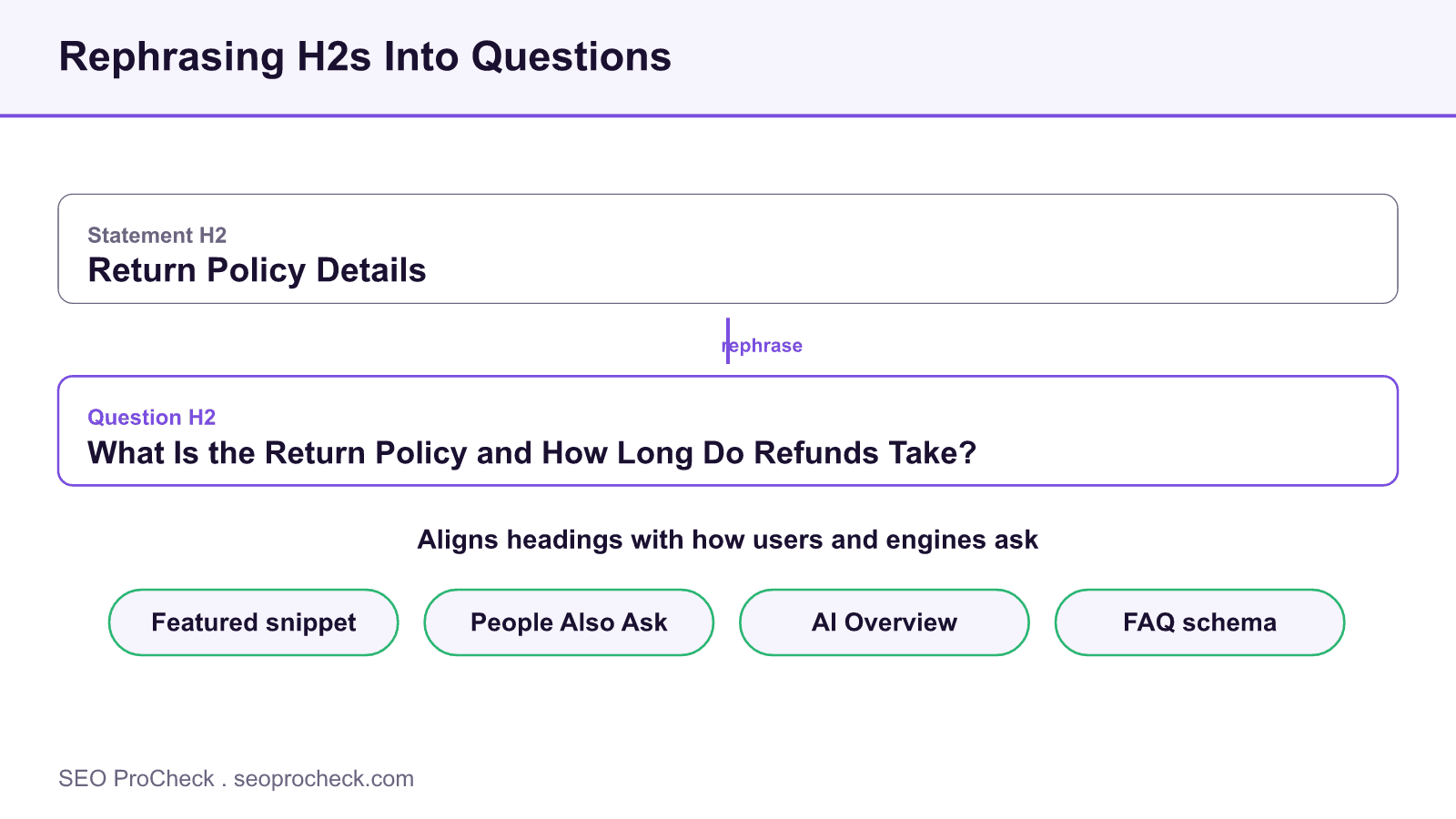
Most pages use statement headings: Return Policy, Pricing, Installation. They are fine, but they do not match the way people actually search, which is in questions: what is the return policy, how much does it cost, how do I install it. This case study tests a small, low risk change: rewrite those statement H2s as the questions users type, and see whether organic traffic responds. The logic is that headings phrased as questions line up with the query, the People Also Ask box and the answer engines that increasingly sit above the classic results.
Why question headings can help
Search has shifted toward answering questions directly. Featured snippets lift a concise answer to the top of the results, People Also Ask expands into a ladder of related questions, and AI Overviews synthesise answers from pages that state them clearly. A heading written as a question, immediately followed by a short and complete answer, is exactly the shape those features want. It also helps users scanning the page: a question heading tells them precisely what the section resolves, which improves engagement and reduces the bounce back to the results.
The mechanism is alignment, not magic. The question heading signals relevance, but the section beneath it has to deliver the answer in the first sentence or two. A question heading over a rambling section wins nothing. That is why this change pairs so well with clean structure and, where appropriate, balanced, scannable content blocks.
Statement to question rewrites
| Statement H2 | Question H2 that matches search |
|---|---|
| Return Policy | What is the return policy and how long do refunds take? |
| Pricing | How much does it cost and are there hidden fees? |
| Installation | How do I install it, and how long does it take? |
| Warranty | What does the warranty cover and for how long? |
| Compatibility | Which devices and systems is it compatible with? |
Keep the questions natural. Write them the way a person would speak them, not stuffed with keywords, and make sure each one is answered directly underneath. If a section cannot be reduced to a clear question, that is often a sign the section itself is unfocused and worth restructuring.
Reinforce it with FAQ schema
When a question heading is followed by a self contained answer, it becomes eligible for FAQ style structured data. Marking up genuine on page questions and answers gives search engines an explicit map of the pairs, though Google stopped showing FAQ rich results for every site on May 7, 2026. The rule is that the markup must reflect content actually visible on the page, so build the visible question and answer first, then add the schema to describe it. This is the same discipline used across our other on page tests.
Test it, do not assume it
Because the change is cheap and site wide temptation is strong, it is worth measuring properly. Split comparable templated pages into control and variant, convert the H2s to questions only on the variant, and compare organic clicks and snippet capture over a window long enough to recrawl and reindex. Track whether the variant pages start appearing in People Also Ask and featured snippets for the target questions, not just total sessions, so you can see the mechanism working. You can explore related experiments in our content case studies.
What has changed since this test
AI Overviews and chat based search have raised the value of clearly answered questions, because those systems extract and cite direct answers. A page organised as a set of real questions with concise answers is easier for them to quote, and being the cited source is now a meaningful share of the click. The practice that helped in a classic snippet oriented test has become even more useful as answer engines have grown.
Source: https://www.searchpilot.com/resources/case-studies/rephrasing-h2s-into-questions/
Frequently asked questions
It can, by aligning headings with featured snippets, People Also Ask and AI Overviews, but only when the content directly answers each question. The heading sets up the match, and the concise answer underneath is what actually earns the placement.
No. Convert the headings that map to genuine user questions, and leave purely structural or navigational headings as statements. Forcing every heading into a question reads awkwardly and can dilute the clarity you are trying to create.
Featured snippets lift a concise answer to a query to the top of the results. A question heading followed immediately by a short, complete answer is the exact structure snippets favour, which is why the rewrite targets snippet and People Also Ask visibility.
No, the on page benefit comes from the visible question and answer structure. FAQ schema is an optional reinforcement that describes genuine on page questions to search engines, and it must only mark up content that is actually visible.
Yes. Answer engines extract and cite direct answers, so a page organised as clear questions with concise answers is easier for them to quote. That has made the practice more valuable as these features have grown.
Split comparable pages into a control group and a variant group, rewrite the H2s only on the variant, and compare organic clicks plus snippet and People Also Ask appearances over several weeks. Tracking those features shows whether the mechanism, not just seasonality, drove any change.
Want a page that actually earns the click?
Thin, templated pages get suppressed. A focused review finds the gaps and turns them into content that ranks and converts.
Take this with you
The assistant links open with a question about this page already written. Nothing is sent until you press enter.
Claude Vincent is a technical SEO consultant focused on crawlability, rendering, and AI-search visibility. He writes the field guides and case studies at SEO ProCheck, with a bias toward the durable, unglamorous work that decides whether search engines and AI answer engines can actually read and cite a site.
About SEO ProCheck
Technical SEO consulting and GEO strategy with 20 years of enterprise experience. Case studies, resources, and tools for search and AI visibility.
Work With Me
Technical SEO audits, GEO strategy, site migrations, and international SEO. Hourly consulting for teams who need hands-on support, not just reports.
Subscribe to our newsletter!








Recent Posts
- Most Top Sites Never Say Who They Are in Structured Data October 14, 2026
- Homepage Titles Are Mostly Too Short, Not Too Long October 8, 2026
- Who Actually Serves an llms.txt? 184 Top Sites Measured September 29, 2026