

Content Marketing Case Study - William Russell Insurance - SISTRIX
- November 10, 2022
- Content
AI Summary
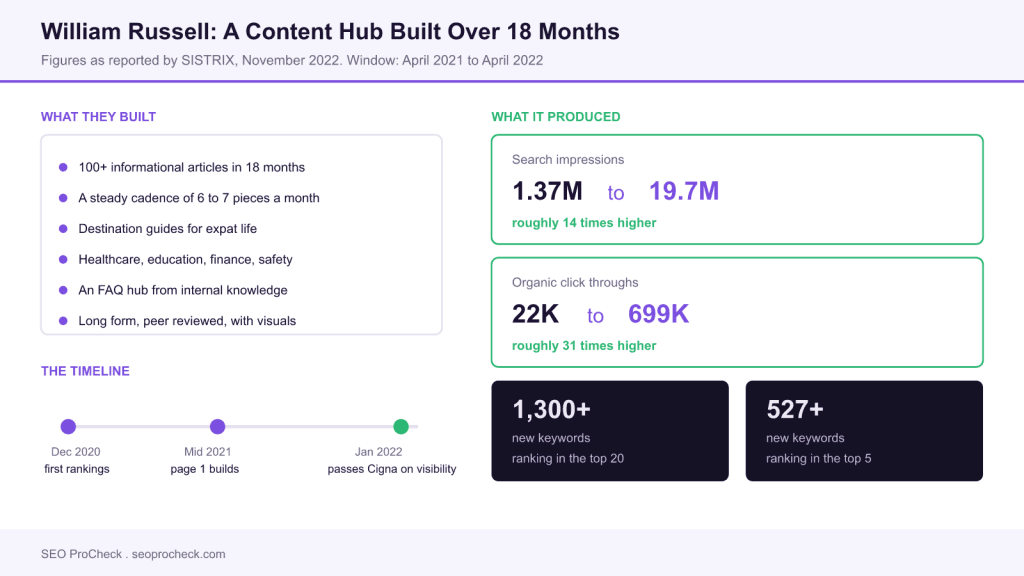
SISTRIX documented how William Russell, a UK expatriate insurance provider, turned its blog into a comprehensive content hub covering expat healthcare, education, finances and safety, publishing over 100 informational articles in roughly 18 months. Between April 2021 and April 2022 the reported result was search impressions rising from 1.37 million to 19.7 million and organic click-throughs from 22,000 to 699,000, with the brand overtaking Cigna on SISTRIX visibility by January 2022.
- Published by SISTRIX on 10 November 2022, last modified February 2024.
- Cadence: six to seven pieces a month, over 100 articles in 18 months.
- Reported gains: 1,300+ new keywords in the top 20 and 527+ in the top 5.
- The /blog directory came to supply the majority of the domain's search visibility.

What SISTRIX documented
William Russell is a UK-based expatriate insurance provider founded in 1992. The case study describes how the company
identified content gaps around the practical realities of expat life, healthcare access, schooling, personal finance and
personal safety, and built a blog that addressed them systematically rather than episodically.
The execution details reported are worth listing precisely, because the discipline is the story. Over 100 informational
articles were published across roughly 18 months, at a rate of six to seven pieces per month. The formats were destination
guides, healthcare advice and how-to content. Articles were long form, peer reviewed, and built with visual elements,
graphs and accessible data formatting for a global audience. Separately, the company built an FAQ hub by migrating internal
knowledge resources into public pages. Eka Vankova, Head of Content and SEO, is quoted describing a "streamlined content
pipeline to ensure a regular flow of content publication, informed by keyword trends."
On the visibility side, SISTRIX reports the first ranking URLs appearing on 21 December 2020, page one rankings building
from around six months later, and the domain overtaking competitor Cigna in search visibility by January 2022. Performance
figures for April 2021 to April 2022 are impressions from 1.37 million to 19.7 million, organic click-throughs from 22,000
to 699,000, more than 1,300 new keywords ranking in the top 20 and more than 527 in the top 5. Link building is mentioned as
running in the background, with no specific results given.
Practitioner commentary: what actually drove this
Three things in this case study matter more than the headline multiples, and none of them is a tactic.
The topic space was bounded and ownable. "Expatriate life" is narrow enough that one mid-sized brand can
cover it exhaustively, and broad enough to contain thousands of real queries. That combination is rare and it is the actual
precondition for this kind of result. Choosing a topic space that a competitor with fifty times your budget is also
targeting head-on produces a very different chart.
The cadence was boring and it never stopped. Six to seven pieces a month for eighteen months is not an
impressive output rate. It is an impressive consistency rate. Most content programmes fail not because the content is bad
but because month four produces two articles, month six produces none, and the topical coverage never reaches critical
mass. The compounding in this case only starts to show around month six of publishing, which is exactly the point at which
most programmes get their budget questioned.
The impressions multiple is larger than the ranking multiple, and clicks larger still. Read the numbers
carefully: impressions grew roughly 14 times while clicks grew roughly 31 times. Clicks growing faster than impressions
means average position improved on the queries that already had visibility, not merely that more pages entered the index.
That is the signature of consolidation and authority accrual rather than of pure page-count expansion, and it is the pattern
you want to see if you are checking whether a content programme is genuinely working.
How the reported numbers break down
| Metric | April 2021 | April 2022 | Change | What it tells you |
|---|---|---|---|---|
| Search impressions | 1.37M | 19.7M | About 14x | Index coverage and query surface expanded |
| Organic click-throughs | 22K | 699K | About 31x | Average position improved, not just page count |
| New keywords in top 20 | n/a | 1,300+ | Net new | Breadth of topical coverage achieved |
| New keywords in top 5 | n/a | 527+ | Net new | Depth: roughly 40 percent of top-20 terms reached top 5 |
| Articles published | n/a | 100+ over 18 months | 6 to 7 per month | Sustained cadence, not a campaign burst |
Figures as reported by SISTRIX. Impressions and clicks are Search Console metrics for the domain; visibility comparisons are SISTRIX Visibility Index.
One ratio worth extracting: 527 top-5 terms from 1,300 top-20 terms means roughly two in five keywords that
broke into the top 20 went on to reach the top 5. That conversion rate is a useful internal benchmark. If your own content
programme is generating top-20 rankings that never progress further, the constraint is usually page quality or internal
linking rather than publishing volume, and publishing more will not fix it.
Replicating the model
Define the topic space before the keyword list. Write down, in one sentence, the audience and the life
situation you intend to own. "Expats choosing international health cover" is a topic space. "Insurance keywords with volume
over 500" is not. The first produces a hub; the second produces a pile.
Start with your own FAQ archive. Support tickets, sales call notes and internal knowledge bases contain
the exact phrasing of real questions, already answered accurately by people who know the subject. Migrating that material
publicly, as William Russell did, is the fastest route to content that is both differentiated and correct. Group the
questions into pages by intent rather than publishing one page per question, using the SERP overlap method described in our
keyword clustering breakdown.
Build the internal link spine as you publish, not afterwards. Each destination guide should link to the
relevant healthcare, schooling and finance pieces, and each of those back to the guides. Retrofitting this across a hundred
articles is a painful project; doing it at publication time costs minutes. Check the resulting distribution with our
internal link analyzer.
Instrument for a two-year horizon. Report impressions and average position from month one, because those
move long before clicks do. Reporting only on sessions for the first six months of a content hub is how good programmes get
cancelled at month five. Our briefing on why SEO
takes time is written for exactly that conversation, and the
content and E-E-A-T briefing
covers the quality dimension.
Caveats worth stating
This is a vendor-published case study, and the usual limitations apply. The figures are self-reported and not
independently audited. No control group exists, so some portion of the growth is attributable to overall category recovery:
the measurement window of April 2021 to April 2022 sits precisely across the period when international travel demand
returned after pandemic restrictions eased, and expatriate insurance queries would have risen with it regardless of any
publishing effort. The case study also notes link building was running in the background without quantifying it, so the
content programme is not a clean isolated variable.
None of that invalidates the model. It does mean you should treat the multiples as an illustration of what a sustained,
well-targeted hub can contribute, rather than as a forecast for your own site.
FAQ
In this case the first ranking URLs appeared in December 2020 and page one positions started building around six months later, with the headline traffic growth measured over the April 2021 to April 2022 window. That two-year arc from first publication to competitive visibility is typical for a content hub in a regulated, high-competition vertical, and it is the single most important expectation to set with stakeholders before you start.
William Russell published over 100 informational articles in roughly 18 months, a cadence of six to seven pieces a month. The number that matters is not the total but the coverage: enough pages to cover a defined topic space completely. A hundred articles scattered across unrelated topics would not have produced this result.
Because commercial pages target a small number of high-competition transactional queries while informational content targets an enormous long tail. SISTRIX reported that the /blog directory provides the majority of this domain's search visibility, which is the normal shape for insurance, finance and similar considered-purchase categories where buyers research extensively before converting.
There is no confirmed ranking factor called peer review. What review processes reliably produce is factual accuracy and depth, which affects whether the page satisfies the query and whether other sites cite it. In regulated topics such as health insurance, that review layer is also a practical necessity independent of any SEO benefit.
This case shows it happening: SISTRIX data indicates William Russell overtook Cigna, a far larger insurer, on search visibility by January 2022. The mechanism is focus. A large generalist covers many categories thinly; a specialist can cover one category, in this case expatriate life, more completely than anyone else, and topical completeness is what wins the long tail.
Start with the questions your existing customers already ask, because you can answer those better than any competitor and the internal knowledge already exists. William Russell explicitly migrated internal knowledge resources into a public FAQ hub. That is the lowest-risk, highest-accuracy content you will ever publish, and it doubles as the structural spine the rest of the hub links into.
Planning a content hub and need the topic map first?
An advanced audit defines the ownable topic space, clusters it into pages, and sequences the build.
Source: https://www.sistrix.com/blog/content-marketing-case-study-william-russell-insurance/
Take this with you
The assistant links open with a question about this page already written. Nothing is sent until you press enter.
Claude Vincent is a technical SEO consultant focused on crawlability, rendering, and AI-search visibility. He writes the field guides and case studies at SEO ProCheck, with a bias toward the durable, unglamorous work that decides whether search engines and AI answer engines can actually read and cite a site.
About SEO ProCheck
Technical SEO consulting and GEO strategy with 20 years of enterprise experience. Case studies, resources, and tools for search and AI visibility.
Work With Me
Technical SEO audits, GEO strategy, site migrations, and international SEO. Hourly consulting for teams who need hands-on support, not just reports.
Subscribe to our newsletter!








Recent Posts
- Most Top Sites Never Say Who They Are in Structured Data October 14, 2026
- Homepage Titles Are Mostly Too Short, Not Too Long October 8, 2026
- Who Actually Serves an llms.txt? 184 Top Sites Measured September 29, 2026