

Enterprise ecommerce SEO: Why good technology can’t fix a bad process
- November 10, 2022
- General
AI Summary
At enterprise scale, ecommerce SEO usually fails on process, not platform: unclear ownership, no prioritization, and SEO left out of release planning waste even the best technical stack. Fix the intake, the roadmap, and the cross team handoffs, and the technology finally pays off.
- Most enterprise SEO problems are organizational: ownership, prioritization, and communication.
- SEO must join release planning so template changes ship with SEO requirements included.
- A backlog ranked by revenue beats a long, unranked list of technical fixes.
- Shared dashboards keep merchandising, engineering, and SEO reading the same numbers.
E-commerce SEO requires specialized approaches for product pages, category optimization, and purchase-intent queries. This resource covers strategies for improving organic visibility and conversions for online retail.
Product Page Optimization
Product pages need unique, valuable content beyond manufacturer descriptions. Detailed product information, use cases, specifications, and user reviews all contribute to page quality. Proper schema markup enables rich results that improve click-through rates from search results.
Category Page Strategy
Category pages often target high-value head terms. Adding substantive content, managing faceted navigation properly, and internal linking to important categories improves their ranking potential. Balancing SEO needs with user experience requires thoughtful implementation.
Technical Considerations
E-commerce sites face unique technical challenges: handling large product catalogs, managing URL parameters from filtering, avoiding duplicate content from product variants, and maintaining site speed despite heavy page requirements. Proper technical foundations enable content and authority building to deliver results.
This resource provides guidance for the specific challenges and opportunities of e-commerce SEO.
Source: https://searchengineland.com/enterprise-ecommerce-seo-good-technology-bad-process-388253
Where enterprise ecommerce SEO really breaks
Large retailers rarely lack tools. They have the crawler, the log analyzer, the enterprise CMS, and a rendering budget most teams envy. What they lack is a process that turns findings into shipped changes. A recommendation sits in a backlog for two quarters because no one owns it, a template fix is deprioritized because it competes with a promotion, and an SEO requirement is discovered only after a redesign has already launched. None of that is a technology problem. It is a workflow problem, and better software will not solve it.
The tell is easy to spot: your audit from last year reads the same as this year's. If the same issues recur, the constraint is the path from insight to release, not the insight itself. That path is governed by who owns SEO, how work is prioritized, and whether SEO has a seat when templates change.
Building the process layer
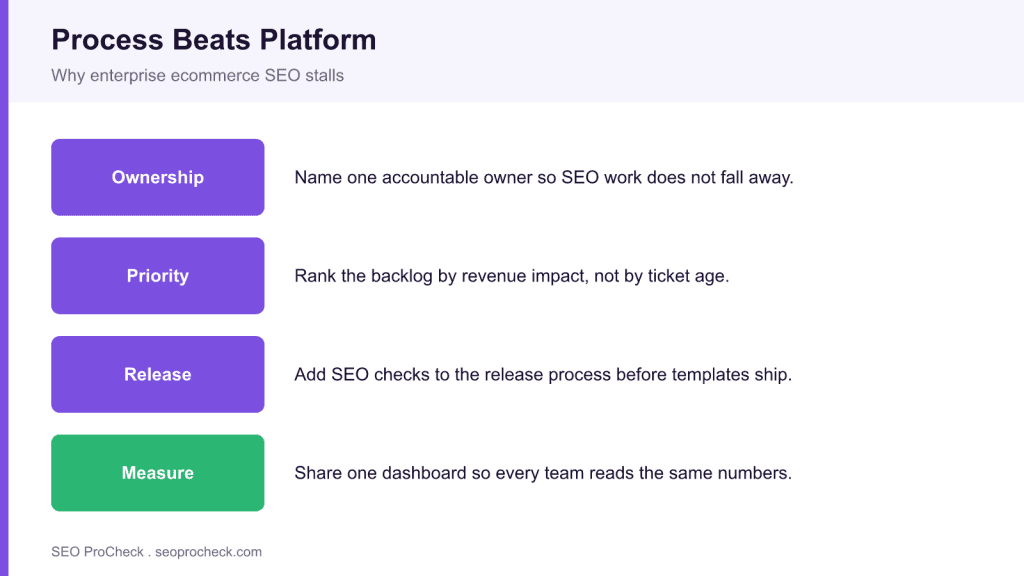
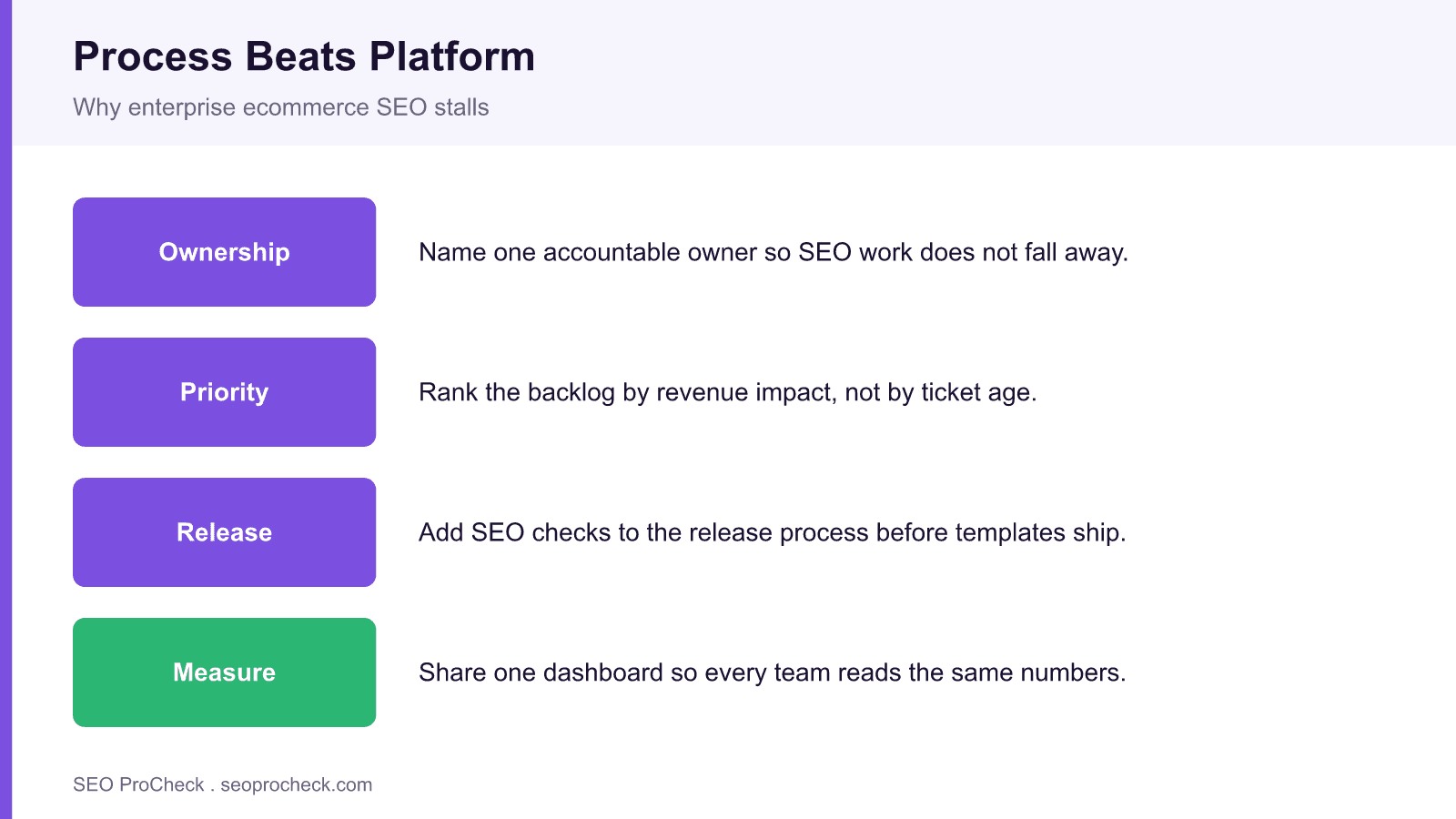
Four moving parts turn a capable stack into results. Ownership: name a single accountable owner for organic revenue so work does not fall between merchandising, engineering, and content. Prioritization: score the backlog by estimated revenue impact and effort, and work the top of that list, not the newest ticket. Release discipline: add a short SEO checklist to the definition of done so template and platform changes cannot ship without it. Measurement: publish one dashboard that merchandising, engineering, and SEO all read, so debates are about priorities, not about whose numbers are right. Faceted navigation is the classic example where process matters, because uncontrolled filters spin up thousands of thin URLs; see our guide to controlling index bloat for the technical side of that fix.
Symptom, root cause, and the process fix
| Symptom | Root cause | Process fix |
|---|---|---|
| Fixes never ship | No clear owner | Assign one accountable owner for organic revenue |
| Wrong work gets done | Backlog ordered by age | Score by revenue impact and effort |
| Redesign breaks SEO | SEO excluded from planning | Add SEO to the release definition of done |
| Endless number debates | Conflicting data sources | Adopt one shared dashboard |
What's changed since
The process argument has only gotten stronger. Google's helpful content signals and recurring core updates reward genuinely useful category and product pages, which is a content and governance outcome, not a plugin setting. Structured data has become table stakes for product listings, so shipping it reliably across a catalog is again a process question; our roundup of underused ecommerce schema types shows which types to prioritize. And AI powered results increasingly summarize product information, which rewards clean, complete product data maintained by a real workflow. The platform can render all of it. Whether it ships depends on the process around it.
Frequently asked questions
Why isn't better SEO software improving our rankings?
Because tools surface problems; they do not ship fixes. If recommendations sit in a backlog with no owner and no prioritization, the best crawler in the world changes nothing. The constraint is the workflow from insight to release.
Who should own ecommerce SEO in a large company?
Give one person or team clear accountability for organic revenue, with the authority to prioritize work across merchandising, engineering, and content. Shared ownership usually means no ownership, and work falls between the gaps.
How do we prioritize hundreds of SEO fixes?
Score each item by estimated revenue impact and implementation effort, then work the top of that list. Ordering the backlog by ticket age or by whoever shouts loudest guarantees the wrong work gets done first.
How do we stop faceted navigation from creating index bloat?
Decide which filter combinations deserve indexable URLs and control the rest with canonical tags, robots rules, or parameter handling. This is both a technical and a governance decision, so document the rules and enforce them in the release process.
How do we get engineering to act on SEO?
Move SEO upstream into planning and add a short SEO checklist to the definition of done, so requirements ship with the feature instead of being retrofitted. Framing work by revenue impact also helps it compete for engineering time.
How do we measure enterprise SEO progress?
Publish one dashboard that every team reads, tying organic visibility and revenue to the specific changes shipped. Shared measurement ends the debates about whose numbers are correct and keeps focus on outcomes.
Take this with you
The assistant links open with a question about this page already written. Nothing is sent until you press enter.
Claude Vincent is a technical SEO consultant focused on crawlability, rendering, and AI-search visibility. He writes the field guides and case studies at SEO ProCheck, with a bias toward the durable, unglamorous work that decides whether search engines and AI answer engines can actually read and cite a site.
About SEO ProCheck
Technical SEO consulting and GEO strategy with 20 years of enterprise experience. Case studies, resources, and tools for search and AI visibility.
Work With Me
Technical SEO audits, GEO strategy, site migrations, and international SEO. Hourly consulting for teams who need hands-on support, not just reports.
Subscribe to our newsletter!







Recent Posts
- Finding a Competitor's Sitemap, and Turning It Into a Change Log September 15, 2026
- AI Crawler User Agents: The Current Names, and Which Ones Sites Actually Block September 9, 2026
- Can AI Crawlers Actually Read Your Site? I Measured 400 of the Biggest September 5, 2026