

AI Summary
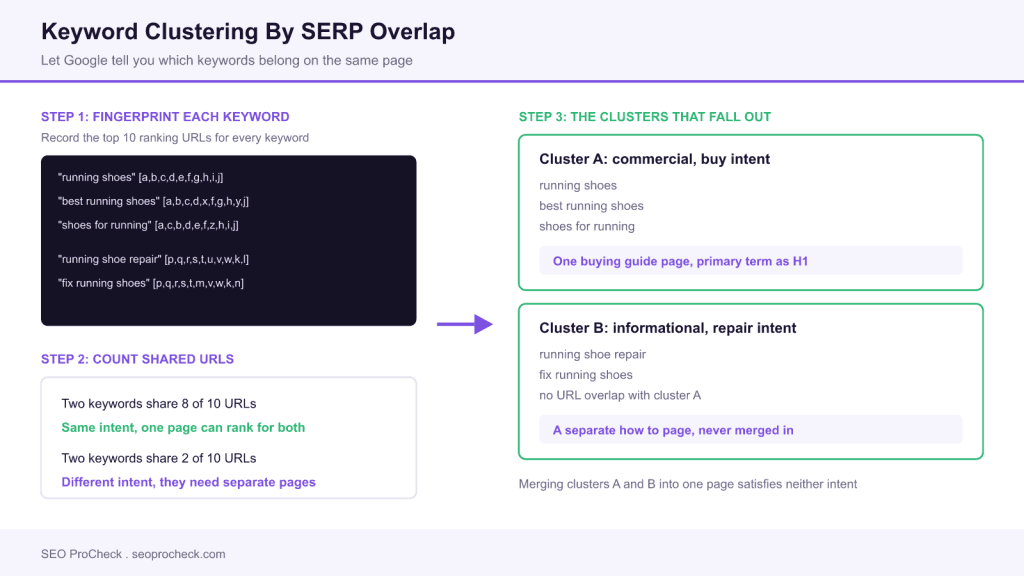
Keyword clustering groups queries that one page can rank for, and the most dependable way to build those groups is SERP overlap: fingerprint each keyword by the URLs currently ranking for it, then merge keywords whose result sets largely coincide. Doing this before you write prevents the most common cause of stalled organic growth, which is several of your own pages splitting the same intent between them.
- Cluster on SERP overlap, not on semantic similarity or word stems.
- A practical merge threshold is five or more shared URLs in the top ten, reviewed manually between three and five.
- Clustering reduces page count and increases per-page authority; it is a consolidation exercise, not an expansion one.
- The originally cited source article is no longer reachable, so the method below is described from practice rather than restated from it.
A note on the source
This post was originally filed as a summary of an article on keyword clusters published by Keyword Insights, linked in
the source line at the foot of this page. That URL now returns HTTP 404 and the article is not retrievable at its original
address. Rather than paraphrase claims we cannot verify, the method below is written from practice: it is the standard SERP
overlap approach that Keyword Insights and comparable tools implement, described so you can execute or reproduce it
yourself. No figures, thresholds or results are attributed to the original article, because we cannot confirm what it
said.
Why clustering beats keyword lists
The default content planning workflow produces a spreadsheet of keywords sorted by volume, and then one article per row.
On any topic with real depth this reliably creates internal competition. You publish "best running shoes", then "running
shoes for beginners", then "top rated running shoes", and Google has to pick one of the three to show. It picks
inconsistently, rotating between them, and every rotation splits your click-through data and your internal link equity
across three URLs that should have been one.
Clustering inverts the process. Instead of asking what keywords exist, you ask how many distinct jobs those keywords
represent. The answer is almost always a much smaller number than the keyword count, which means fewer pages, each of them
stronger.
Why SERP overlap is the right similarity measure
Most naive clustering methods group keywords by string similarity or by embedding distance. Both fail in predictable
ways. String similarity puts "running shoe repair" next to "running shoes" because they share tokens, when those are
completely different intents. Embedding similarity puts "cheap flights" next to "budget airfare", which is correct, but
also puts "how to fix a leaking tap" next to "how to fix a leaking pipe", which may or may not be one page depending
entirely on what Google is currently rewarding.
SERP overlap sidesteps the question of what the keywords mean by observing what Google already does. If the top ten
results for two queries are largely the same URLs, Google has judged one set of documents to satisfy both. That is an
empirical answer to an otherwise subjective question, and it updates itself as the SERP changes.
The method, step by step
1. Build the keyword set. Pull everything relevant from Search Console, a rank tracker, and competitor
gap analysis. Do not filter by volume yet; zero-volume queries frequently belong in clusters and contribute traffic
collectively.
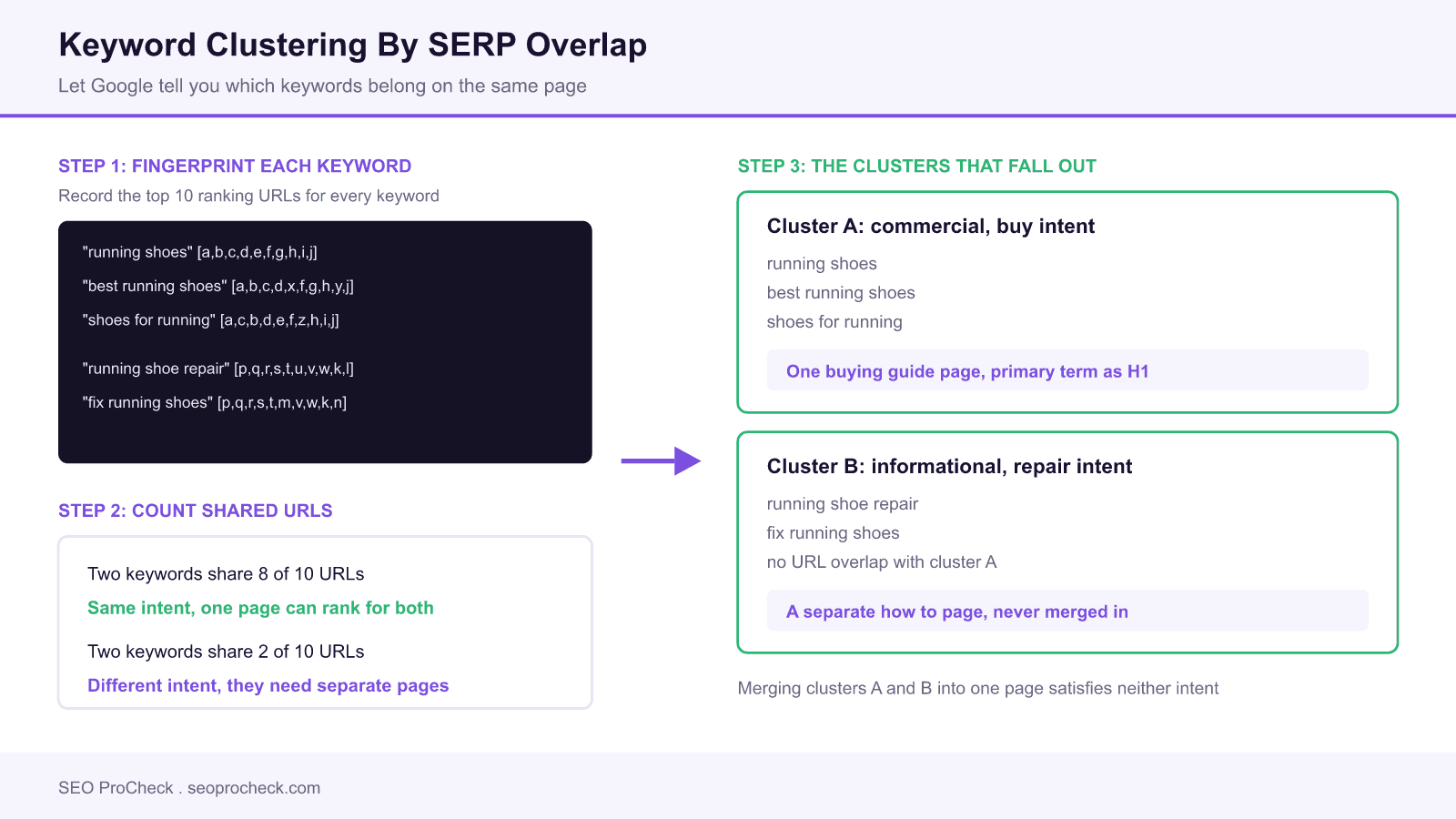
2. Fingerprint every keyword. For each query, record the ranking URLs in the top ten as an ordered list.
Keep the position, because you will want it later for weighting. This is the only expensive step: it is one SERP request
per keyword, per location, per device.
3. Compute pairwise overlap. For each pair of keywords, count how many URLs appear in both top tens.
A short script does this in seconds:
from itertools import combinations

serps = {
    "running shoes":      ["a","b","c","d","e","f","g","h","i","j"],
    "best running shoes": ["a","b","c","d","x","f","g","h","y","j"],
    "running shoe repair":["p","q","r","s","t","u","v","w","k","l"],
}

for k1, k2 in combinations(serps, 2):
    shared = len(set(serps[k1]) & set(serps[k2]))
    print(k1, "|", k2, "=>", shared, "shared URLs")
4. Apply a threshold and build groups. Treat every pair above the threshold as an edge in
a graph, then take the connected components as clusters. Be aware that naive connected-component clustering chains: if A
matches B and B matches C, A and C end up in one cluster even when they share nothing. On large sets, require that every
member of a cluster meets the threshold against the cluster's highest-volume keyword rather than against any member.
5. Name the primary keyword. Within each cluster, the primary is the term with the highest volume whose
SERP most resembles the cluster average. That term becomes the H1 and the URL slug; the rest become subheadings, FAQ
entries and natural body variations.
Choosing a threshold
| Shared URLs in top 10 | Interpretation | Action | Confidence |
|---|---|---|---|
| 8 to 10 | Effectively the same SERP | Merge without review | Very high |
| 5 to 7 | Same intent, differing emphasis | Merge, cover both angles on one page | High |
| 3 to 4 | Adjacent intents | Review manually, check SERP features and result types | Ambiguous |
| 1 to 2 | Coincidental overlap, usually one strong domain ranking for both | Keep separate | High |
| 0 | Unrelated intents | Keep separate, consider different site sections | Very high |
Thresholds are practitioner defaults, not published constants. Validate them against a sample of twenty pairs you can judge by hand before trusting them across thousands.
Two refinements pay for themselves. First, weight by position: an overlap in the top three is a stronger
signal than an overlap at positions nine and ten. Second, compare result types, not just URLs. Two queries returning the
same domains but one showing product listings and the other showing how-to videos are not the same intent, whatever the URL
count says.
Turning clusters into pages
A cluster is a page brief, not a page. The mapping that works:
The primary keyword sets the H1 and the slug. Secondary keywords with materially different phrasing become H2 or H3
sections, which is also what makes the page extractable for AI answer engines and featured snippets. Question-form keywords
in the cluster go into the FAQ block verbatim, because they are literally how people phrase the query. Keywords that are
pure syntactic variants need no dedicated treatment at all; they will be matched by the page as written.
Check the result before publishing. Our heading
analyzer shows whether the outline actually reflects the cluster structure, and the
keyword density analyzer is useful in
the negative sense: if one variant dominates the body text, you have written for a term rather than for the intent.
The consolidation case, which is where the traffic actually comes from
Clustering an existing site is usually more valuable than clustering a plan. Map every current URL to the cluster it
serves. Wherever two or more URLs land in the same cluster, you have found live internal competition. Consolidate them:
pick the strongest URL, merge the useful content from the others into it, and 301 the rest.
The gain here is not incremental. Three pages each ranking around position twelve for the same cluster, once merged,
frequently land inside the top five, because the merged page inherits all three link profiles and covers the intent more
completely than any of them did. Verify the redirects resolve in a single hop with our
redirect checker, and use the
content gap finder to confirm the merged
page picked up everything the retired pages covered.
Never delete the losing pages outright. Redirect them, so the links pointing at them keep contributing.
FAQ
A keyword cluster is a group of queries that a single page can realistically rank for because they share the same underlying search intent. The reliable way to identify one is not semantic similarity but SERP overlap: if Google returns largely the same URLs for two queries, Google has already decided they are the same job, and one page can serve both.
There is no universal constant, and anyone quoting one is quoting their own tool's default. As a practitioner starting point, three or more shared URLs in the top ten is a weak signal worth reviewing, five or more is a confident merge, and fewer than three means separate pages. Tighten the threshold in competitive commercial niches where SERPs are volatile and loosen it in stable informational ones.
They answer different questions. Volume tells you how much demand exists; clustering tells you how many pages you need to capture it. Planning by volume alone is what produces five near-identical articles competing with each other for the same SERP. Cluster first, then sum the volume within each cluster to prioritise.
Pull the top ten results for each keyword from a rank tracker export or the Search Console Performance API, store them as a list per keyword, then compute pairwise intersections in a spreadsheet or a short Python script. The arithmetic is trivial; the expensive part is acquiring the SERP data, which is why commercial clustering tools charge per query rather than per calculation.
Frequently, yes, and that is the normal outcome of correct clustering rather than an anomaly. A well-built page targeting a single intent typically accumulates long tail variants it was never explicitly optimised for. If your pages each rank for only a handful of terms, that usually indicates the site is fragmented across too many thin pages rather than consolidated into fewer strong ones.
Arguably more. AI answer engines synthesise a response from a small number of sources per query, so being the one comprehensive page on a topic beats being one of five partial pages. Clustering is the discipline that produces comprehensive single pages, which is also the shape of content most readily cited in generated answers.
Not sure how many pages your keyword set actually needs?
An advanced audit clusters your live URLs against your query set and identifies the consolidation wins.
Source: https://www.keywordinsights.ai/blog/keyword-clusters/
Claude Vincent is a technical SEO consultant focused on crawlability, rendering, and AI-search visibility. He writes the field guides and case studies at SEO ProCheck, with a bias toward the durable, unglamorous work that decides whether search engines and AI answer engines can actually read and cite a site.
About SEO ProCheck
Technical SEO consulting and GEO strategy with 20 years of enterprise experience. Case studies, resources, and tools for search and AI visibility.
Work With Me
Technical SEO audits, GEO strategy, site migrations, and international SEO. Hourly consulting for teams who need hands-on support, not just reports.
Subscribe to our newsletter!







Recent Posts
- Can AI Crawlers Actually Read Your Site? I Measured 400 of the Biggest September 5, 2026
- The Pre-Publish Quality Gate for AI-Assisted Content August 6, 2026
- AGENTS.md vs llms.txt vs llms-full.txt: Which Agent File Does What July 18, 2026