

AI Summary
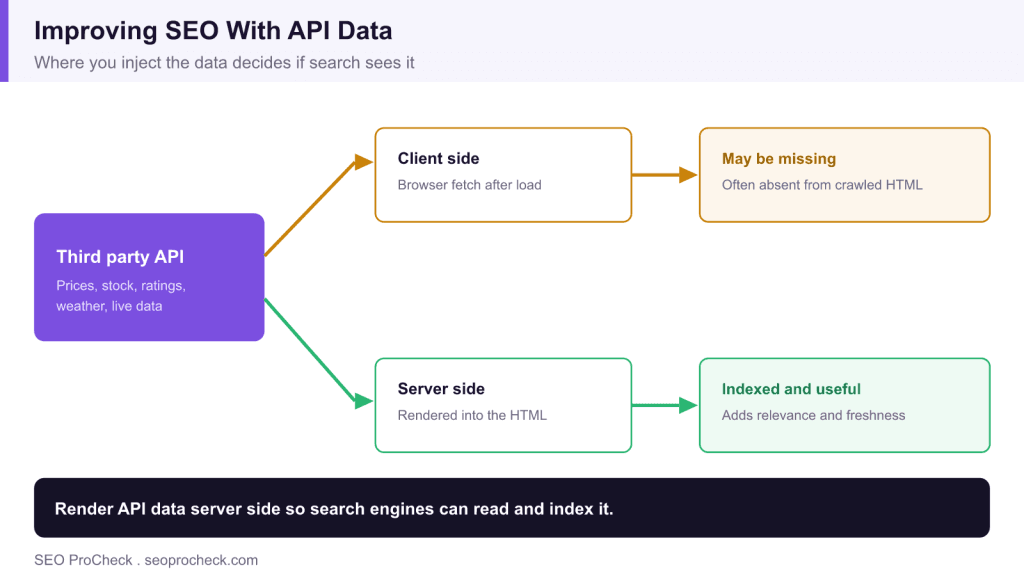
Third party API data can improve SEO by making pages richer, fresher, and more relevant, but only if search engines can actually read that data. Data injected in the browser after load is often missing from the crawled HTML, so the reliable win comes from rendering API data server side where it becomes indexable content.
- API data such as prices, stock, ratings, and live figures can raise relevance and freshness.
- Client side injection with a browser fetch may never reach the index.
- Server side rendering places the data in the initial HTML, so it is crawled and counts.
- Pair rendered data with structured data where a schema type fits, for example Product or Review.
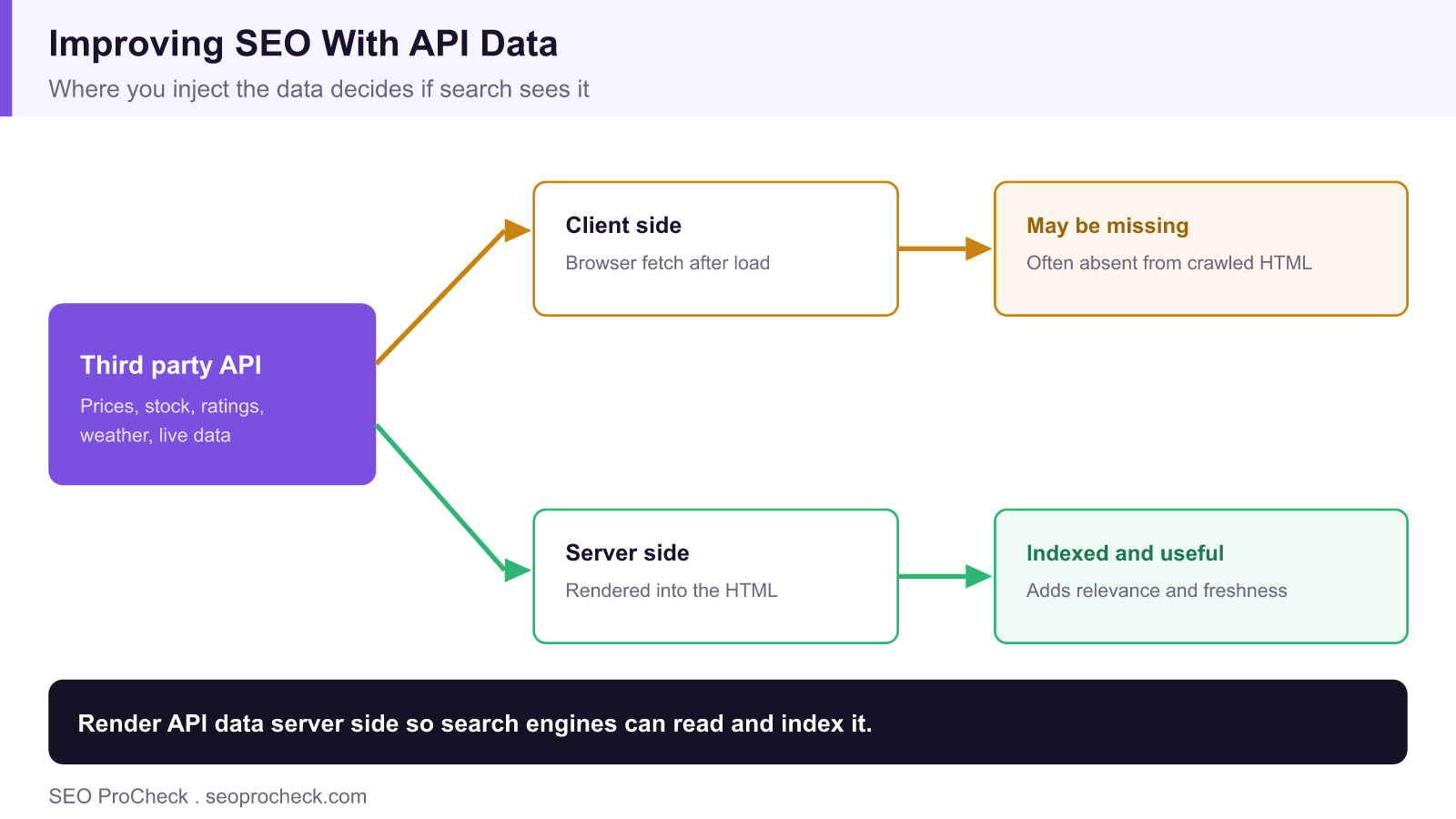
Adding third party API data to a page is one of the most under used ways to make thin templates genuinely useful. A product page that pulls live pricing, stock, and aggregated ratings answers real user questions that static copy never could. The catch is that the SEO benefit depends entirely on one implementation choice: whether the data lands in the HTML a crawler receives, or only in a browser after the user arrives.
Why API data can help rankings
Search engines reward pages that satisfy intent. External data can push a page from generic to specific: current price and availability answer buying intent, live ratings add trust signals, fixtures and scores add freshness, and location or weather data adds context. When that information is present as real text and markup, it deepens the page's relevance for long tail and comparison queries and gives the page a reason to be crawled more often.
The client side trap
The common mistake is to render an empty shell, then call the API with fetch() from JavaScript once the page loads. Users see the data; crawlers frequently do not. Google can render JavaScript, but rendering is deferred, resource limited, and never guaranteed for every URL at the frequency you want. Other search engines and AI crawlers are far weaker at executing scripts. If the number that matters only exists after a client side call, you are betting your relevance on a render that may not happen.
You can diagnose this quickly. Fetch the page with a plain HTTP request and search the raw HTML for the API value. A simple check:
curl -s https://example.com/product/123 | grep "in stock"
If the value is missing from that raw response and only appears in the browser, the data is client side only and at risk.
The server side fix
Fetch the API on the server, at request time or during a build, and render the values into the HTML your server returns. Now the price, stock status, and ratings are in the initial document, visible to every crawler without executing a line of script. Add caching so you do not hammer the upstream API, set a sensible time to live for freshness, and always ship a graceful fallback for when the API is slow or down so the page never renders a blank where content should be.
- Render API values into the server response, not only in a client fetch.
- Cache upstream responses and set a time to live that matches how fast the data changes.
- Provide a fallback value or last known good data if the API fails.
- Where a schema type fits, mirror the data in structured markup such as Product, Offer, or AggregateRating.
What has changed since: AI crawlers raise the stakes
When these tests were first run, the concern was Googlebot rendering. The rise of AI answer engines makes server side rendering even more important, because many AI crawlers fetch raw HTML and do little or no JavaScript execution. If your pricing or availability lives only in a client side call, an AI overview or assistant may cite a competitor whose data is in the HTML. Rendering API data server side is now the difference between being quotable by machines and being invisible to them.
Client side vs server side API data for SEO
| Factor | Client side fetch | Server side render |
|---|---|---|
| In raw crawled HTML | No | Yes |
| Indexed reliably by Google | Not guaranteed | Yes |
| Readable by AI crawlers | Rarely | Yes |
| Structured data eligible | Fragile | Straightforward |
| Best use | Personalized or non critical widgets | Any data that should rank |
Related reading
- Server rendering vs client rendering for AI crawlers explains why raw HTML wins for machine readers.
- Why raw HTML still decides what search engines read covers the source versus rendered gap.
- SEO vs AEO vs GEO puts rendered data in the context of answer engines.
Case study summary and source
Content-driven SEO success requires strategic approaches to creation, optimization, and management. This case study demonstrates how content strategy directly drives organic growth when aligned with user needs and search behavior.
Content Strategy Framework
Effective content strategy begins with understanding target audiences, their questions, and the competitive content landscape. This case study outlines the strategic framework that guided content decisions, from topic selection to format choices.
Content Development Process
Moving from strategy to published content requires efficient processes for research, creation, and optimization. This case study documents workflows, quality standards, and production approaches that enabled consistent, high-quality output.
Optimization and Distribution
Published content requires ongoing optimization based on performance data. This case study covers how content was refined post-publication, how internal linking supported content performance, and how distribution amplified content reach.
Results and Attribution
Measuring content ROI requires connecting content efforts to business outcomes. This case study demonstrates the traffic, engagement, and business results achieved through strategic content investment. Attribution methodology helps validate content strategy effectiveness.
Content SEO case studies help practitioners build cases for content investment with documented results.
Frequently asked questions
Can adding API data actually improve my SEO?
Yes, when the data is rendered into the HTML. Live prices, stock, ratings, and other external data make a page more specific and relevant for intent driven queries, which can improve rankings and how often the page is crawled.
Why does client side API data often fail for SEO?
Because the data is fetched by JavaScript after load and may be absent from the HTML a crawler receives. Google can render scripts but does not guarantee it for every URL, and most other search and AI crawlers execute little or no JavaScript.
How do I check whether my API data is visible to crawlers?
Request the raw page with a plain HTTP call and search the response for the value. If a command like curl of the URL piped to grep does not find the number, the data is client side only and at risk of not being indexed.
What is the right way to add API data for SEO?
Fetch the API on the server and render the values into the returned HTML. Cache the upstream response, set a time to live for freshness, and provide a fallback so the page never renders blank if the API fails.
Should I also add structured data for API values?
Where a schema type fits, yes. Mirroring rendered values in Product, Offer, or AggregateRating markup helps search engines interpret the data. Keep the structured data consistent with the visible, rendered content.
Does server side rendering matter for AI search too?
Very much. Many AI crawlers read raw HTML and skip JavaScript, so data that only exists in a client side call is invisible to them. Server side rendering makes your prices and availability quotable by AI answer engines.
Claude Vincent is a technical SEO consultant focused on crawlability, rendering, and AI-search visibility. He writes the field guides and case studies at SEO ProCheck, with a bias toward the durable, unglamorous work that decides whether search engines and AI answer engines can actually read and cite a site.
About SEO ProCheck
Technical SEO consulting and GEO strategy with 20 years of enterprise experience. Case studies, resources, and tools for search and AI visibility.
Work With Me
Technical SEO audits, GEO strategy, site migrations, and international SEO. Hourly consulting for teams who need hands-on support, not just reports.
Subscribe to our newsletter!







Recent Posts
- Can AI Crawlers Actually Read Your Site? I Measured 400 of the Biggest September 5, 2026
- The Pre-Publish Quality Gate for AI-Assisted Content August 6, 2026
- AGENTS.md vs llms.txt vs llms-full.txt: Which Agent File Does What July 18, 2026