

AI Summary
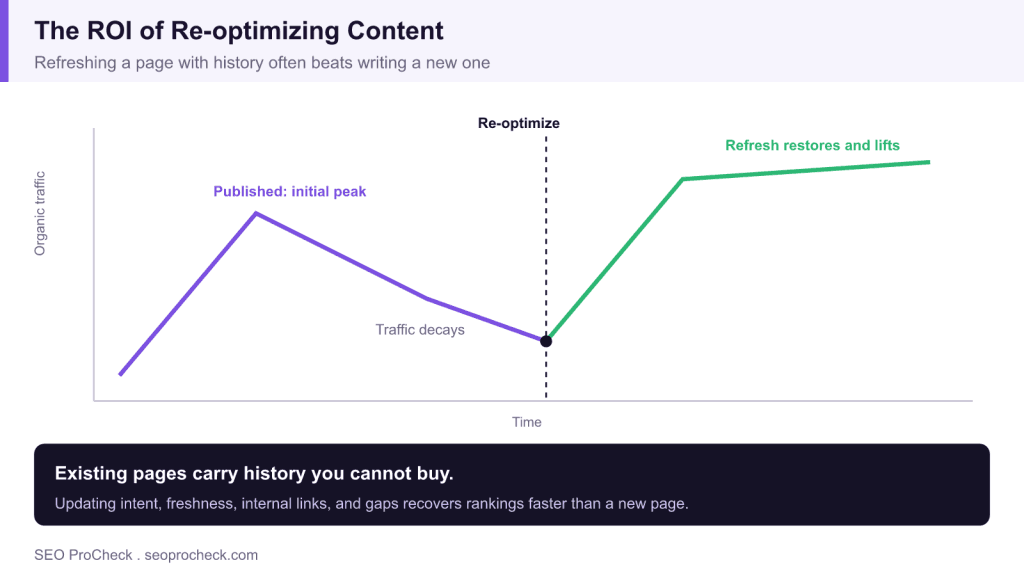
Re-optimizing existing content usually returns more organic traffic per hour of work than publishing something new, because established pages already carry crawl history, links, and ranking signals that a fresh URL has to earn from zero. The highest ROI comes from refreshing pages that once ranked and have since decayed, by realigning them to current intent and closing content gaps.
- Existing pages hold link equity, age, and crawl history that new URLs must build slowly.
- Prioritize pages that decayed from a strong position, not random low traffic URLs.
- The biggest wins come from matching current search intent and closing content gaps.
- Measure lift with before and after clicks and positions on the same URL.
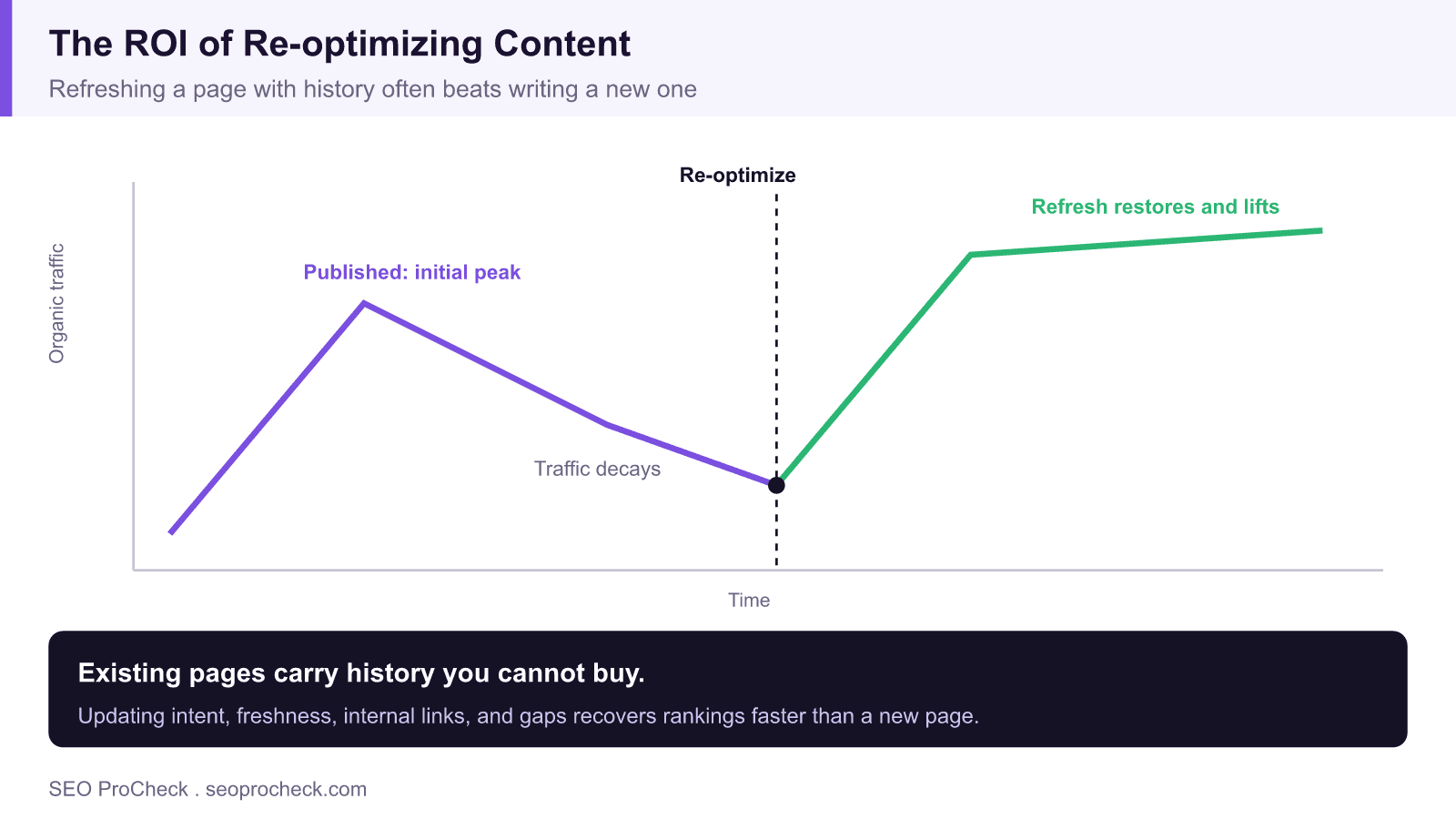
Every content team faces the same allocation question: write something new, or improve something that already exists. The instinct is to chase new topics, but the math usually favors refreshing. A page that once ranked has already earned crawl history, internal and external links, and a track record with search engines. Re-optimizing it starts from that base instead of from zero, which is why the return on a good refresh is often several times higher than the return on a comparable new article.
Why existing pages have a head start
A brand new URL has to be discovered, crawled, indexed, and then slowly trusted before it can compete. An established page skips most of that. It already sits in the index, it already has links pointing at it, and it already has a query history that tells Google what it is about. When you improve that page, the signals attach to an asset that is primed to respond, so gains tend to show up in weeks rather than months.
Content decay is the opportunity
Most pages do not fail suddenly; they fade. Rankings slip as competitors publish fresher, deeper answers and as search intent shifts under the same query. That slow decline is exactly where re-optimization pays. Pull a report of pages whose clicks or average position dropped over the last several months but that still rank on the edge of page one. These are recoverable assets. Rescuing a page from position 11 to position 6 can more than double its clicks without a single new URL.
How to prioritize what to re-optimize
Do not refresh at random. Rank candidates by potential, using data you already have in Search Console and analytics:
- Decayed winners. Pages that lost clicks or positions but once performed well.
- Striking distance. Queries ranking in positions 5 to 15, where small gains unlock large click increases.
- High impressions, low click through. Pages seen often but rarely clicked, usually a title and intent problem.
- Business value. Weight by how much a recovered page contributes to revenue or leads.
What to actually change
A refresh is not a synonym for changing the publish date. Work through a real checklist: rewrite the title and meta description to match how people search now, realign the page to current intent by reading what actually ranks, add the sections and questions the page is missing, update stale facts and examples, prune thin filler, refresh media, and rebuild internal links from newer relevant pages to the refreshed URL. Keep the URL the same so you retain its history, and only redirect if you are genuinely consolidating duplicates.
Measuring the return
Attribution here is unusually clean because you are changing a known URL. Record baseline clicks, impressions, and average position for the target page and its main queries, apply the refresh, annotate the date, then compare a matched window before and after. Because the URL is constant, the before and after difference is a fair read on the refresh itself, which makes re-optimization one of the easiest SEO investments to justify to a stakeholder.
What has changed since: decay is faster now
Content decays more quickly than it used to. Competitors publish at higher volume, and AI overviews absorb some informational clicks at the top of the results, so a page that coasts on an old ranking loses ground sooner. That raises, rather than lowers, the value of a re-optimization habit. Treat refreshing as a recurring program on a schedule, not a one time cleanup, and give priority to depth and genuine expertise that a summary cannot easily replace.
Re-optimizing vs publishing new content
| Factor | Re-optimize existing page | Publish new page |
|---|---|---|
| Existing links and history | Retained | None at start |
| Time to see results | Often weeks | Often months |
| Cost per gain | Lower | Higher |
| Attribution clarity | Clean, same URL | Harder to isolate |
| Best for | Decayed or striking distance pages | Genuine new topics and gaps |
Related reading
- Pogosticking and the click pattern that decides rankings explains the engagement signals a refresh should improve.
- Crawl budget explained covers why fresh, high value pages get recrawled sooner.
- Index bloat helps you decide when to prune rather than refresh a weak page.
Case study summary and source
Content-driven SEO success requires strategic approaches to creation, optimization, and management. This case study demonstrates how content strategy directly drives organic growth when aligned with user needs and search behavior.
Content Strategy Framework
Effective content strategy begins with understanding target audiences, their questions, and the competitive content landscape. This case study outlines the strategic framework that guided content decisions, from topic selection to format choices.
Content Development Process
Moving from strategy to published content requires efficient processes for research, creation, and optimization. This case study documents workflows, quality standards, and production approaches that enabled consistent, high-quality output.
Optimization and Distribution
Published content requires ongoing optimization based on performance data. This case study covers how content was refined post-publication, how internal linking supported content performance, and how distribution amplified content reach.
Results and Attribution
Measuring content ROI requires connecting content efforts to business outcomes. This case study demonstrates the traffic, engagement, and business results achieved through strategic content investment. Attribution methodology helps validate content strategy effectiveness.
Content SEO case studies help practitioners build cases for content investment with documented results.
Source: https://moz.com/blog/roi-of-content-re-optimization
Frequently asked questions
Is re-optimizing content better ROI than writing new content?
Usually, yes. An existing page already has links, age, and crawl history, so improvements attach to an asset primed to respond. New URLs start from zero and take longer to rank, which makes a good refresh return more traffic per hour of work.
Which pages should I re-optimize first?
Start with pages that once ranked well and have decayed, and with queries sitting in positions 5 to 15 where small gains unlock large click increases. Weight the list by business value so recovered pages actually move revenue or leads.
What does re-optimizing a page actually involve?
Rewrite the title and description to match current search behavior, realign the page to current intent, add missing sections and questions, update stale facts, refresh media, and rebuild internal links to the page. Keep the same URL to retain its history.
Should I change the URL or publish date when refreshing?
Keep the URL the same so you retain link equity and history, and only redirect if you are consolidating duplicates. Update the visible date only if the content genuinely changed, since a fake date change alone does not help.
How do I measure the ROI of a content refresh?
Record baseline clicks, impressions, and average position for the URL and its main queries, annotate the refresh date, then compare a matched window before and after. Because the URL is unchanged, the difference is a fair read on the refresh.
How often should I re-optimize content?
Treat it as a recurring program rather than a one time task. Content decays faster now as competitors publish more and AI overviews absorb some clicks, so review priority pages on a schedule and refresh them before they slide too far.
Take this with you
The assistant links open with a question about this page already written. Nothing is sent until you press enter.
Claude Vincent is a technical SEO consultant focused on crawlability, rendering, and AI-search visibility. He writes the field guides and case studies at SEO ProCheck, with a bias toward the durable, unglamorous work that decides whether search engines and AI answer engines can actually read and cite a site.
About SEO ProCheck
Technical SEO consulting and GEO strategy with 20 years of enterprise experience. Case studies, resources, and tools for search and AI visibility.
Work With Me
Technical SEO audits, GEO strategy, site migrations, and international SEO. Hourly consulting for teams who need hands-on support, not just reports.
Subscribe to our newsletter!








Recent Posts
- Most Top Sites Never Say Who They Are in Structured Data October 14, 2026
- Homepage Titles Are Mostly Too Short, Not Too Long October 8, 2026
- Who Actually Serves an llms.txt? 184 Top Sites Measured September 29, 2026