

Index Bloat: Why Deleting Old Website Pages Is Good for SEO
- March 23, 2023
- Crawling and Indexing
AI Summary
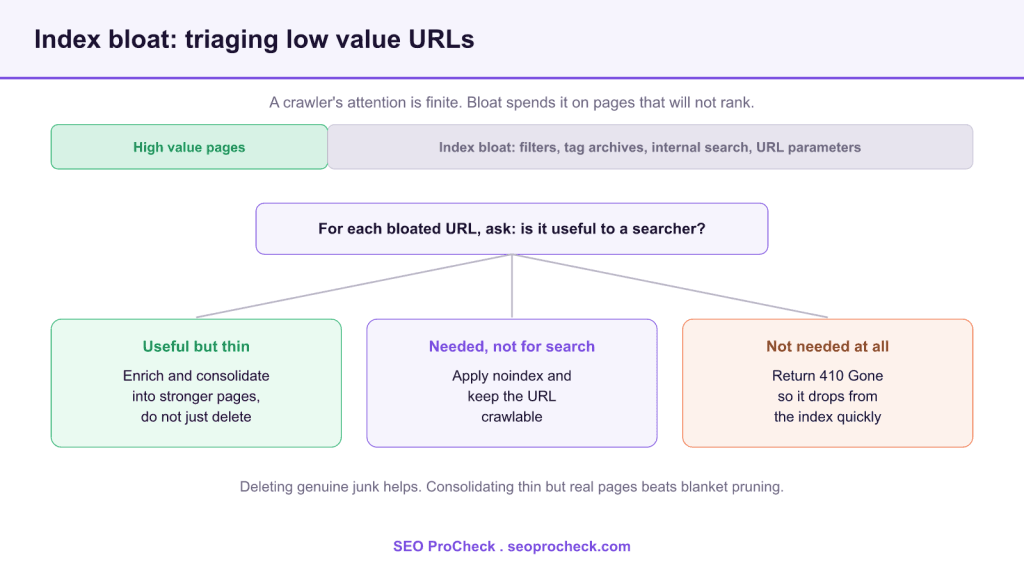
Index bloat is when a large number of low value URLs from your site sit in the search index, diluting crawl efficiency and the quality signals a search engine reads across your domain. Trimming genuine junk helps, but the smarter move is to triage each URL: enrich and consolidate thin but real pages, keep needed utility pages out of the index with noindex, and return a 410 only for pages that truly should be gone.
- Bloat usually comes from filters, tag and date archives, internal search pages, pagination, and URL parameters.
- Find it with a site search, the Search Console Pages report, and a crawl that compares indexable URLs against your sitemap.
- Do not blanket delete. Consolidate thin content into stronger pages and reserve removal for pages with no audience.
- Use noindex for utility URLs that must exist for users but should not compete in search.

The source argues that removing old pages can improve SEO. That is true in the specific sense this page unpacks: a bloated index spreads a crawler thin and blurs how a search engine judges your site. The nuance that matters, and that separates a durable fix from a rankings accident, is knowing which pages to remove, which to keep out of the index, and which to strengthen rather than delete.
What index bloat actually is
Index bloat is a mismatch between the number of URLs a search engine has indexed for your site and the number of URLs that deserve to rank. A shop with 500 real products can end up with tens of thousands of indexed URLs once every color filter, sort order, tag page, and internal search query generates its own crawlable, indexable address. None of those extra URLs earn traffic, but they still consume crawl attention and add thin, near duplicate pages that can drag on the site wide quality signals engines use.
Where bloat comes from
- Faceted navigation: filter and sort combinations multiply URLs, often with query parameters.
- Tag, category, and date archives: auto generated listing pages that repeat snippets of other content.
- Internal search result pages: every query a user or bot runs can become an indexable URL.
- Pagination and session or tracking parameters: deep page 2 onward and IDs appended to URLs.
- Old, thin, or expired content: stubs, expired promotions, and duplicate print or AMP style variants.
How to find your bloat
- Run a
site:yourdomain.comsearch for a rough count, then narrow withsite:yourdomain.com inurl:?or a specific path to expose parameter and archive URLs. - Open the Pages report in Search Console. Read both the indexed pages and the not indexed reasons, since large groups of Crawled, currently not indexed or Duplicate URLs are bloat fingerprints.
- Crawl the site and compare the list of indexable URLs against your XML sitemap. Anything indexable that is not in the sitemap is a candidate for review.
- Sort candidate URLs by organic clicks and impressions. Pages with zero of both over a long window are your working list.
Triage, do not blanket delete
The point the case study makes about deleting pages is right for genuine junk and wrong if you apply it to every thin page. For each low value URL, ask whether it is useful to a searcher, then act:
| URL type | Right action | Why |
|---|---|---|
| Thin but real content with an audience | Enrich, or consolidate into a stronger page and redirect | Keeps the value and the links, removes the thinness |
| Filters, sorts, internal search | noindex, keep crawlable, or canonical to the base page | Users need them, search results do not |
| Parameter and session duplicates | Canonical to the clean URL, avoid linking the parameter version | Consolidates signals onto one address |
| Expired, obsolete, no audience | Return 410 Gone (or 404) | Cleanly drops a page that serves no one |
Reserve deletion for the last row. For thin but genuine pages, enriching or merging keeps the traffic and the earned links while fixing the quality problem, which is a more durable outcome than removing pages and hoping the rest rise.
What changes after you fix bloat
Do not expect an overnight jump. As the engine recrawls, the noindexed and removed URLs fall out of the index, crawl attention concentrates on the pages that matter, and the site wide picture the engine builds gets cleaner. Track the indexed page count in the Pages report, watch that important templates keep or grow impressions, and confirm you did not accidentally noindex or remove a page that was quietly earning traffic. For the mechanisms behind the fixes, see our guides to index bloat, crawl budget, faceted navigation, and the crawled, currently not indexed status.
Frequently asked questions
Index bloat is having many low value URLs from your site in the search index, far more than the pages that actually deserve to rank. It usually comes from filters, tag archives, internal search pages, and URL parameters, and it dilutes crawl efficiency and site wide quality signals.
It can be, but only for pages that serve no audience. For thin pages that still have some value or earned links, consolidating them into a stronger page or enriching them is better than deleting, because it keeps the value while fixing the thinness.
Use a site search to estimate indexed URLs, read the Pages report in Search Console for large groups of duplicate or crawled but not indexed URLs, and crawl the site to compare indexable URLs against your XML sitemap. Then sort candidates by clicks and impressions.
Use noindex on utility URLs that must exist for users but should not appear in search, and keep them crawlable so the directive is read. Use robots.txt only to save crawl on URLs that are already out of the index, never on a URL you are trying to deindex.
Indirectly. Bloat wastes crawl attention on pages that will not rank and adds thin, near duplicate content that can weaken how an engine judges your domain. Fixing it helps the engine spend its attention on the pages you want to rank.
A noindex keeps the page live for users but removes it from search. A 410 Gone tells the engine the page is permanently removed and should drop from the index. Use noindex for useful utility pages and a 410 for pages that no longer serve anyone.
Case study summary and source
This SEO case study documents a successful optimization initiative, providing actionable insights for practitioners. The documented approach demonstrates how strategic SEO implementation drives measurable results.
Initial Situation
Understanding the starting point is essential context for evaluating any case study. This documentation covers the initial challenges, competitive position, and business objectives that shaped the SEO strategy.
Strategy and Approach
The strategic approach combined multiple SEO disciplines to address identified opportunities. Key decisions around prioritization and resource allocation provide a template for similar initiatives.
Implementation
Moving from strategy to execution required specific technical implementations, content development, and process changes. This case study documents the practical steps that translated strategy into action.
Results and Learnings
The outcomes demonstrate effectiveness through measurable improvements in rankings, traffic, and business metrics. Analysis of successes and challenges provides learning value for practitioners.
Case studies like this contribute to the SEO knowledge base, helping practitioners learn from documented real-world experiences.
Claude Vincent is a technical SEO consultant focused on crawlability, rendering, and AI-search visibility. He writes the field guides and case studies at SEO ProCheck, with a bias toward the durable, unglamorous work that decides whether search engines and AI answer engines can actually read and cite a site.
About SEO ProCheck
Technical SEO consulting and GEO strategy with 20 years of enterprise experience. Case studies, resources, and tools for search and AI visibility.
Work With Me
Technical SEO audits, GEO strategy, site migrations, and international SEO. Hourly consulting for teams who need hands-on support, not just reports.
Subscribe to our newsletter!







Recent Posts
- Can AI Crawlers Actually Read Your Site? I Measured 400 of the Biggest September 5, 2026
- The Pre-Publish Quality Gate for AI-Assisted Content August 6, 2026
- AGENTS.md vs llms.txt vs llms-full.txt: Which Agent File Does What July 18, 2026