SEO ProCheck
  • Articles
    & Evergreen
    • Articles
      • Algorithm Updates
      • Analytics & Measurement
      • CMS and Platforms
      • Content Strategy
      • E-commerce SEO
      • General
      • Industry Guides
      • Keyword Research
      • Link Building
      • Local SEO
      • Mobile SEO
      • On-Page SEO
      • SEO Tools
    • Evergreen
      • AI and Search
        • AEO (Answer Engine Optimization)
        • AI Overviews and SGE
        • GEO (Generative Engine Optimization)
        • LLM Citation Optimization
      • Content SEO
        • Content Architecture
        • E-E-A-T Optimization
        • Internal Linking Strategy
      • Python and Automation
      • Technical SEO
        • Core Web Vitals and Performance
        • Crawlability and Indexation
        • International SEO and Hreflang
        • Log File Analysis
        • Schema and Structured Data
        • Site Architecture
        • Site Migrations
  • Case Studies
    & Researches
    • Case Studies
      • Content
      • Crawling and Indexing
      • Growth
      • International SEO
      • JavaScript SEO
      • Metadata
      • Migrations
      • Website Architecture
      • Web Performance
    • Research
      • AI Search
      • Cross-Industry
      • E-commerce
      • Enterprise
      • Local and Listings
      • Publisher
  • Free
    Tools
    • Free SEO & AI Search Tools
    • Free SEO Tools
      • Content Analysis
      • Developer Utilities
      • GEO & AI Visibility
      • Local SEO
      • Schema & Structured Data
      • Social & Meta
      • Technical SEO
    • Browser Extensions
  • Resources
    & Guides
    • Executive Briefings
      • What SEO Actually Is
      • Why SEO Takes Time
      • Technical vs Content SEO
      • What AI Search Changes
      • Is Your SEO Working?
      • Case Studies
      • Is It Worth It?
      • Hiring an Agency
      • SEO vs Paid
      • Resourcing SEO
    • Best Practices
      • Accessibility
      • AMP
      • Content & GEO
      • Duplicates
      • HTML Structure
      • hrefLang
      • Images
      • Indexation
      • Links
      • Mobile
      • On-Page SEO
      • Organic & Analytics
      • Performance
      • Redirections
      • Robots.txt
      • Security
      • Structured Data
      • Technical GEO
      • URLs
      • XML Sitemaps
    • FAQ
      • AI & Search FAQ
      • Technical SEO FAQ
      • Content SEO FAQ
      • Off-Page SEO FAQ
      • Local SEO FAQ
      • E-commerce SEO FAQ
      • Tools and Analytics FAQ
    • Glossary
      • Glossary | Algorithms
      • Glossary | Analytics
      • Glossary | Business
      • Glossary | Content SEO
      • Glossary | E-commerce
      • Glossary | Emerging
      • Glossary | GEO & AI SEO
      • Glossary | International SEO
      • Glossary | Link Building
      • Glossary | Local SEO
      • Glossary | Search Behavior
      • Glossary | Technical SEO
      • Glossary | Tools
  • About
    • About
    • How I work
consulting
Home / Metadata / Can incorporating ‘the best’ into your title tag improve organic traffic?

Can incorporating ‘the best’ into your title tag improve organic traffic?

  • March 23, 2023
  • Metadata
No Comments
Can incorporating ‘the best’ into your title tag improve organic traffic?

AI Summary

Adding a superlative such as the best to a title tag can raise click through and organic traffic on some page templates, but the effect is not guaranteed and can be flat or even negative. The only dependable way to know is a controlled SEO split test on your own pages, which is exactly the method the source experiment used.

  • A title tag modifier changes how a result reads in search, which can shift click through rate.
  • Effects vary by template, query intent, and how competitive the wording already is, so results do not transfer between sites.
  • Run a split test: hold everything else constant, change only the title, and measure organic sessions against a control group.
  • Google often rewrites titles, so treat your title tag as a strong hint and validate changes at template scale.
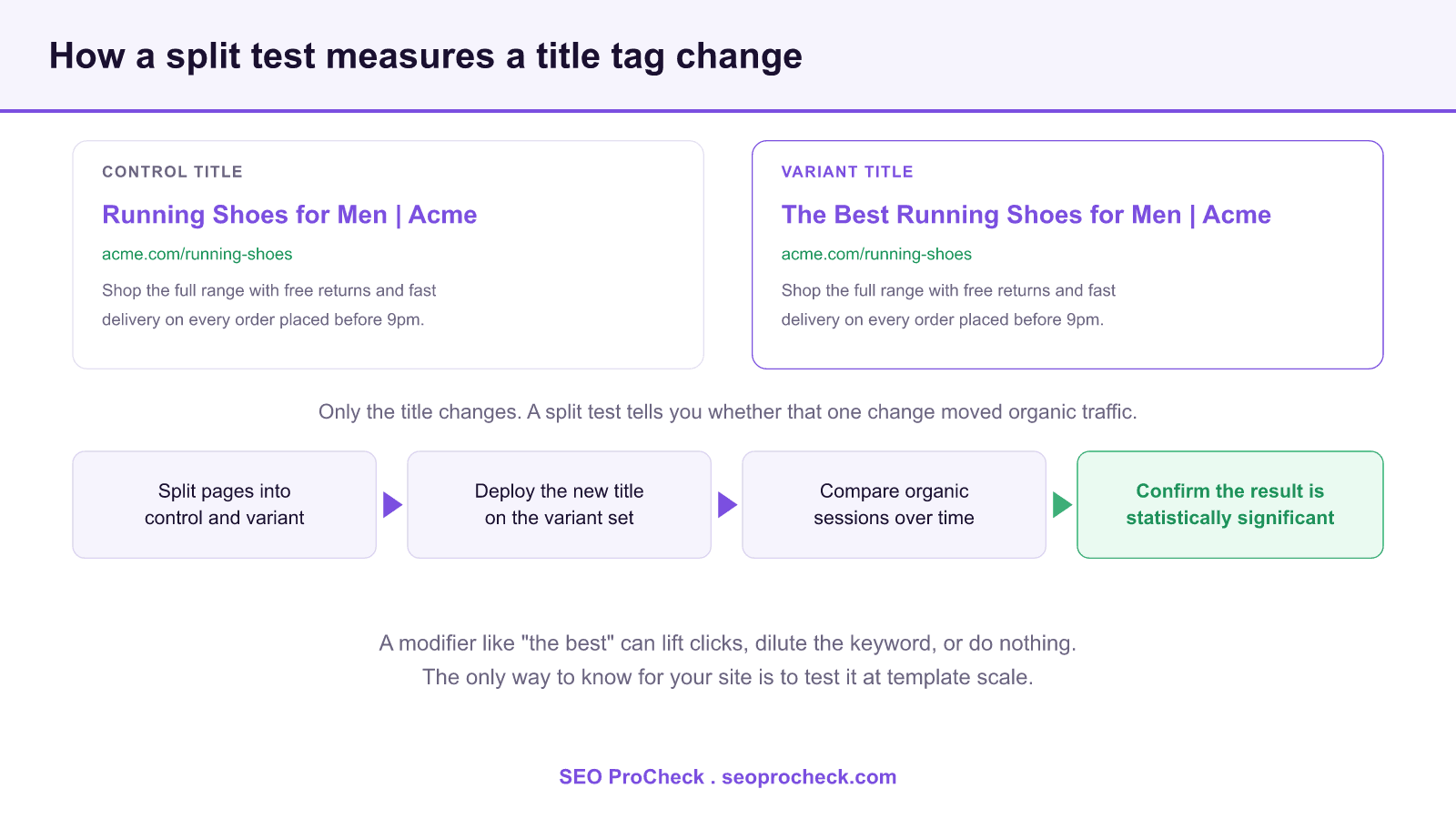
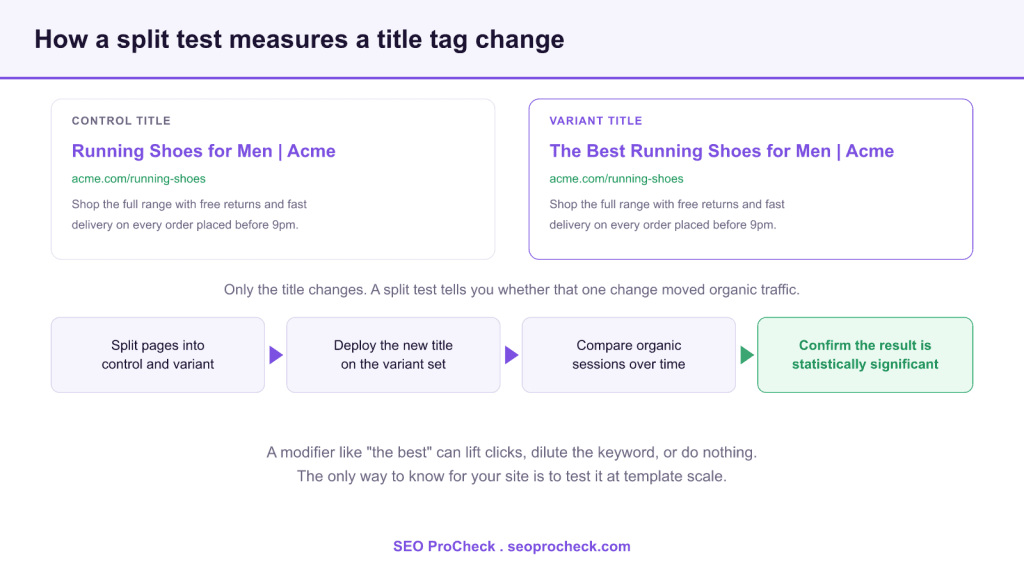
Diagram of an seo split test on a title tag, showing a control title next to a variant that adds the words the best, then the four steps of splitting pages, deploying the variant, comparing organic sessions, and confirming statistical significance.
An SEO split test isolates one title tag change and measures whether adding a modifier like the best moves organic traffic.

The linked experiment asks a narrow, testable question: does inserting the phrase the best into a set of title tags increase organic traffic? This page explains the mechanism behind that kind of test, why the answer depends on your pages rather than on a universal rule, and how to run and read the experiment yourself. We keep the source figures where they belong, in the source, and give you the working method instead.

Why a title modifier can move traffic

The title tag is the clickable headline of your result in search. It rarely changes rankings on its own, but it strongly influences click through rate, and on many templates it also feeds how Google generates the displayed title. A superlative like the best signals a value judgement that can match the intent behind commercial and comparison queries, so a searcher scanning ten results may pick the one that promises the strongest answer. That is the upside. The downside is real too: a superlative pushes your primary keyword further right where it can be truncated, it can read as marketing filler on informational pages, and if every competitor already uses it the word adds no distinction.

Title tag fundamentals the test sits on top of

  • Length: aim for roughly 60 characters or about 600 pixels so the title is not cut off. A modifier eats into that budget.
  • Front loading: put the primary keyword near the start. If a modifier delays the keyword, weigh the click through gain against the relevance signal you move back.
  • Uniqueness: each page needs a distinct title. Bolting the best onto every page in a template can create near duplicate titles that help no one.
  • Intent match: superlatives fit best on category, listicle, and comparison pages, not on transactional or narrow informational pages.

How to run the split test

An SEO split test is not the same as a conversion A/B test. You cannot show two versions to two sets of users at the same URL, because a page has one version for the crawler. Instead you split a group of similar pages, usually within one template, into a control set and a variant set, apply the change to the variant only, and compare organic performance over time while accounting for seasonality and trend. The steps:

  1. Pick a template with enough comparable URLs to reach significance, for example product category pages.
  2. Randomly assign each URL to control or variant so the two groups are balanced.
  3. Change only the title tag on the variant. Leave content, links, and everything else untouched.
  4. Let both groups run through a full set of weekly cycles, then compare organic sessions or clicks, modelling the variant against the expected performance of the control.
  5. Report the result with a confidence interval, not a single number, and only act if the effect is statistically significant.

Reading the result honestly

OutcomeWhat it meansWhat to do next
Significant positiveThe modifier lifted organic traffic on this templateRoll it out to the template, then retest a related modifier
No significant changeThe wording did not matter hereRevert to the cleaner title and test a different lever
Significant negativeThe modifier hurt, often by pushing the keyword or by title rewritesRemove it and note the template as sensitive to length

What has changed for title tags

Since Google began rewriting displayed titles more aggressively, your title tag is a strong suggestion rather than a fixed label. Google may replace a keyword stuffed or oddly long title with text drawn from your heading or content. That makes clean, descriptive, front loaded titles more valuable, and it makes testing more important than opinion, because a modifier you add may not even be shown. Test the change, measure the traffic, and keep only what earns its place. For related pitfalls, see our checks on titles and meta descriptions that duplicate each other and pages with multiple title tags, and our note on pogosticking, the click pattern that can undo a click through win if the page does not deliver.

Frequently asked questions

Does adding the best to a title tag improve SEO?

It can improve click through and organic traffic on some templates, but the effect is not universal and can be flat or negative. Because it depends on your pages and queries, the reliable way to decide is a controlled split test on your own site.

Do title tags affect rankings or just clicks?

Title tags mainly influence click through rate and how your result reads in search. They are a ranking input but a modest one, so most of the traffic effect from a title change comes through clicks rather than position.

How long should a title tag be?

Aim for about 60 characters or roughly 600 pixels so it is not truncated in results. A modifier like the best uses part of that budget, which is one reason to test whether it earns its space.

What is an SEO split test?

It is an experiment that splits a group of similar pages into a control set and a variant set, applies one change to the variant, and compares organic performance over time. It is how you measure the effect of a change like a title modifier without guessing.

Why did Google change my title tag in search results?

Google rewrites displayed titles when it judges its own version more useful, often pulling from your main heading or content. This is why clean, descriptive, front loaded titles perform better and why you should verify that any modifier you add is actually shown.

Should I add the best to every page title?

No. Applying the same modifier across a whole template can create near duplicate titles and push your keyword out of view. Reserve superlatives for category and comparison pages, and confirm with a test before rolling out.

Case study summary and source

This SEO case study documents a successful optimization initiative, providing actionable insights for practitioners. The documented approach demonstrates how strategic SEO implementation drives measurable results.

Initial Situation

Understanding the starting point is essential context for evaluating any case study. This documentation covers the initial challenges, competitive position, and business objectives that shaped the SEO strategy.

Strategy and Approach

The strategic approach combined multiple SEO disciplines to address identified opportunities. Key decisions around prioritization and resource allocation provide a template for similar initiatives.

Implementation

Moving from strategy to execution required specific technical implementations, content development, and process changes. This case study documents the practical steps that translated strategy into action.

Results and Learnings

The outcomes demonstrate effectiveness through measurable improvements in rankings, traffic, and business metrics. Analysis of successes and challenges provides learning value for practitioners.

Case studies like this contribute to the SEO knowledge base, helping practitioners learn from documented real-world experiences.

Source: https://www.searchpilot.com/resources/case-studies/the-best-title-tag-experiment/

Take this with you

Ask ChatGPTAsk ClaudeAsk PerplexityShare on LinkedInShare on Reddit

The assistant links open with a question about this page already written.

  • Claude Vincent

Claude Vincent is a technical SEO consultant focused on crawlability, rendering, and AI-search visibility. He writes the field guides and case studies at SEO ProCheck, with a bias toward the durable, unglamorous work that decides whether search engines and AI answer engines can actually read and cite a site.

  • Title Tags

About SEO ProCheck

Technical SEO consulting and GEO strategy with 20 years of enterprise experience. Case studies, resources, and tools for search and AI visibility.

Learn more about me

Work With Me

Technical SEO audits, GEO strategy, site migrations, and international SEO. Hourly consulting for teams who need hands-on support, not just reports.

Contact now

Subscribe to our newsletter!

More from our blog


Bar chart of where product items lead on mobile: Germany 90% comparison sites and 10% Google Shopping, Austria 46% and 54%, Switzerland and the UK 0% and 100%. Straight to a shop: under 1%. One person's report.

Google's EEA Product Search Changes: What Moved Since September 2026

Free product listings left EEA search in September 2026. What Google documents,…
Continue reading
Timeline of Google's 4 spam updates of 2026: March 19 hours 30 minutes, June 2 days 1 hour, August 2 days 16 hours, September 13 days 16 hours, with 33 days and no listed ranking update between August 22 and September 23.

Google August 2026 Spam Update: Dates, Duration and How to Read Your Data

Google's August 2026 spam update ran August 18 to 21, about 2…
Continue reading
Bar chart of Google algorithm updates per year from 2003 to 2026, split into confirmed by Google and only reported

Google Algorithm Updates: The Dated List Since 2003, and What to Do After Each

Searchable list of Google algorithm updates since 2003, each with its date…
Continue reading
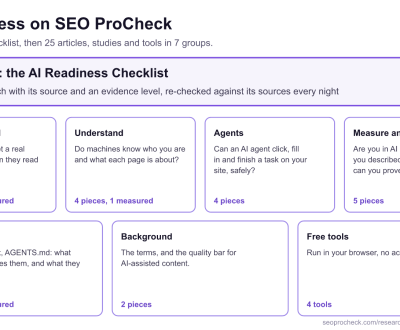
Map of the AI Readiness hub on SEO ProCheck: start with the 51-check AI readiness checklist, then 25 articles, studies and tools in 7 groups: Reach and read, Understand, Agents, Measure and get cited, Optional files, Background and Free tools.

AI Readiness: The Checklist, the Research and the Free Tools

AI readiness on SEO ProCheck: a sourced checklist that stays current, measurements…
Continue reading
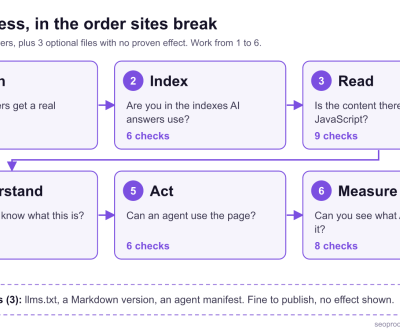
Diagram of the AI readiness checklist: 6 layers in order, Reach, Index, Read, Understand, Act and Measure, with 48 checks, plus optional files with no proven effect.

AI Readiness Checklist (2026): 51 Checks, Each With Its Source

51 AI readiness checks for AI search and AI agents, each with…
Continue reading
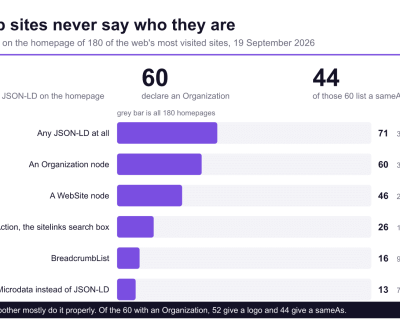
Bar chart of structured data on 180 of the web's most visited homepages. 71 carry any JSON-LD, 60 declare an Organization, 46 a WebSite node, 26 a SearchAction, 16 a BreadcrumbList and 13 use microdata.

Most Top Sites Never Say Who They Are in Structured Data

I read the homepage of 180 of the most visited sites on…
Continue reading
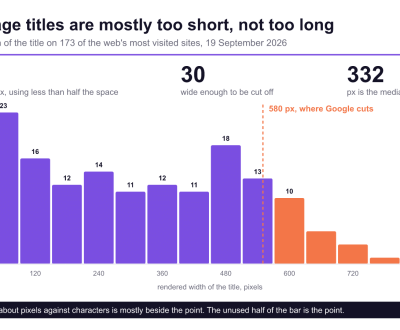
Histogram of homepage title pixel widths across 173 of the web's most visited sites. The distribution is spread widely below the 580 pixel cutoff with a large cluster under 300 pixels, and a thin tail of 30 titles beyond it.

Homepage Titles Are Mostly Too Short, Not Too Long

I measured the rendered width of the title on 173 of the…
Continue reading
Bar chart of how many of 184 of the web's most visited sites serve each agent-facing text file. llms.txt 31 sites, llms-full.txt 6, AGENTS.md 1, and neither well-known llms.txt nor ai.txt on any site.

Who Actually Serves an llms.txt? 184 Top Sites Measured

I asked 184 of the most visited sites on the web for…
Continue reading
Prev. Post
Next Post

Recent Posts

  • Google's EEA Product Search Changes: What Moved Since September 2026 November 4, 2026
  • Google August 2026 Spam Update: Dates, Duration and How to Read Your Data November 2, 2026
  • Google Algorithm Updates: The Dated List Since 2003, and What to Do After Each October 31, 2026

All Website Tags

AI SEO Analytics B2B Batch Check Content Analysis Content Quality Content Strategy Core Web Vitals Crawl Budget Crawling DOM Parsing E-commerce E-E-A-T Enterprise FAQ GEO Googlebot Google Search Console High Priority Hreflang HTTP Requests Indexing Internal Linking International SEO JavaScript SEO Keyword Research Link Building Live Check Local SEO Low Priority Medium Priority Multiple APIs On-Page SEO Page Speed PageSpeed API Rich Results SaaS Schema Validation SEO Tools SERP Features Site Architecture Site Migrations Structured Data Technical SEO Title Tags

Case studies, research, best practices and free tools for technical SEO, GEO and AI search.

Free tools: SEO & AI search tools · GitHub · browser extensions

SEO Geek since 2004. © SEO ProCheck, operated by Neova Consulting LLC. All Rights Reserved.

SEO ProCheck

About Me  |  Sitemap for Humans  |  Privacy  |  Terms