

AI Summary
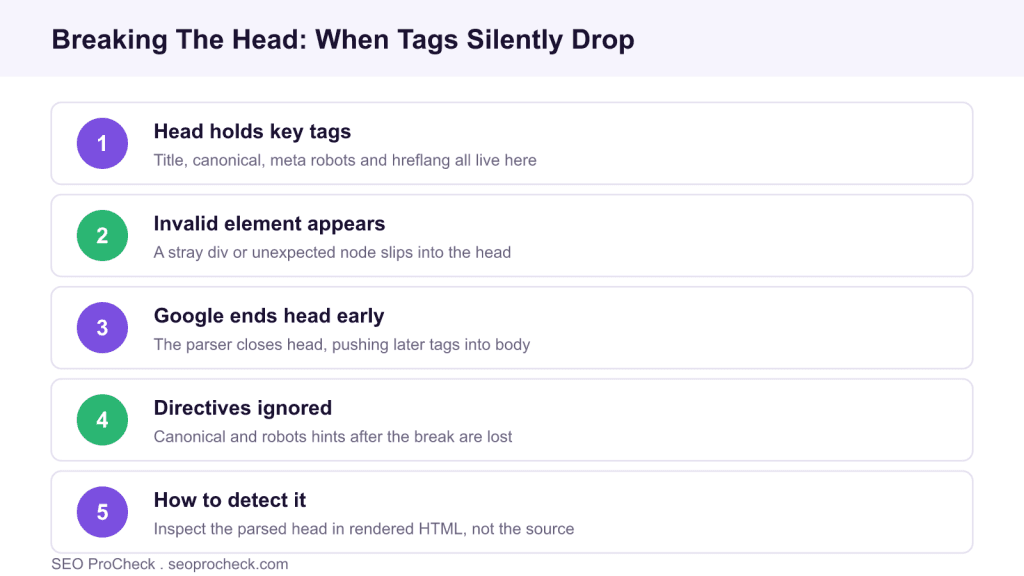
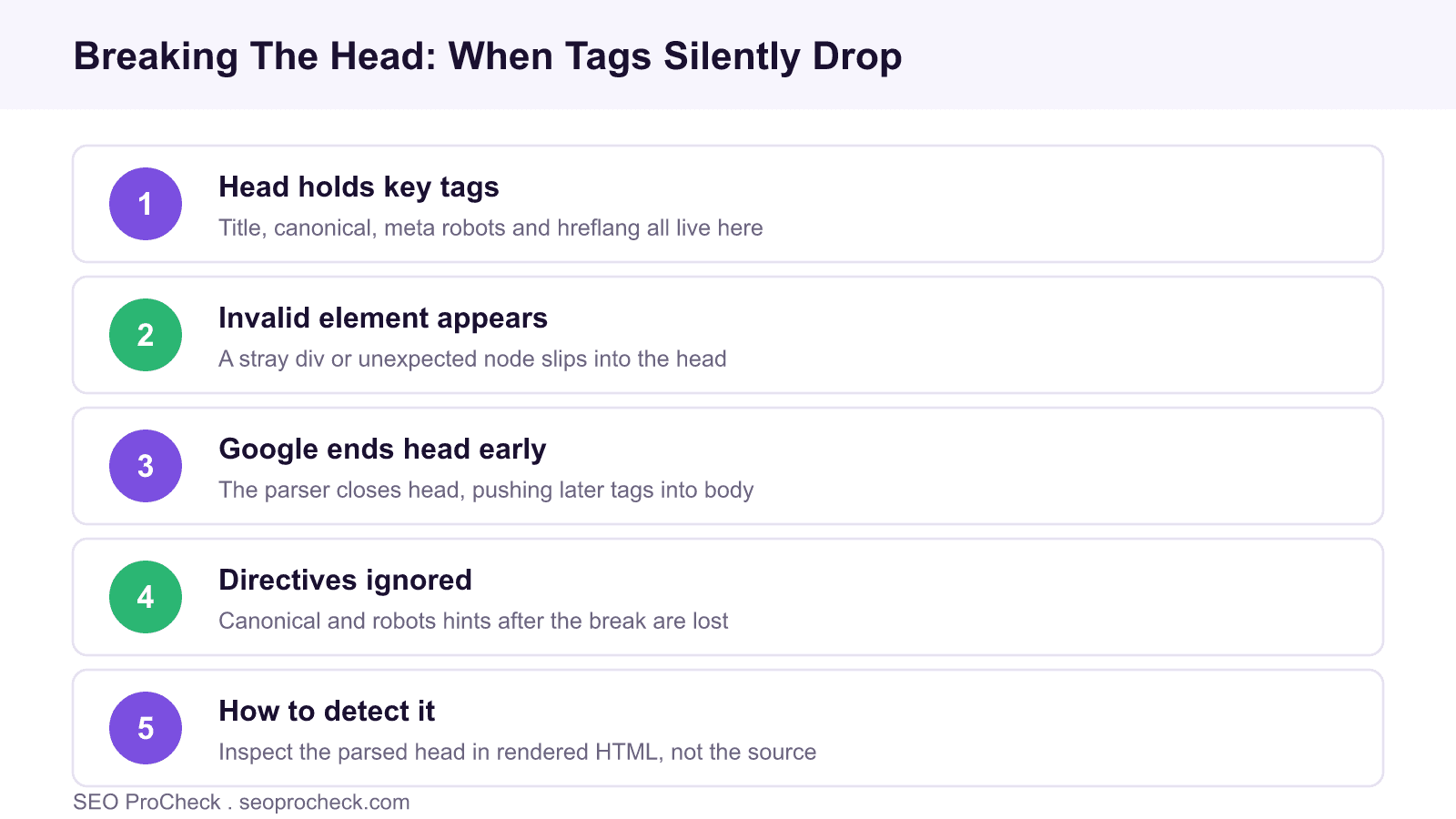
An invalid or unexpected element inside the HTML head can make the browser and Googlebot close the head early, which pushes every tag after it into the body where it is ignored. That silently drops canonical links and hreflang, so the page behaves as if those tags were never there, though Google still respects a meta robots tag in the body.
- Only a small set of elements are valid in the head, and an unexpected one ends the head implicitly.
- Canonical and hreflang placed after the break are moved to the body and lost; Google still respects meta robots in the body (documented March 24, 2026).
- The source looks fine, so you must inspect the parsed or rendered head, not the raw HTML.
- Put critical SEO tags early in the head and keep injected or invalid nodes out of it.
This case study is based on the write up by Oliver Mason at ohgm, which shows how easily a broken head can sabotage technical SEO without any visible error. We keep the original summary and source below, then add detection steps and a prevention checklist you can apply during audits.
This SEO case study documents a successful optimization initiative, providing actionable insights for practitioners. The documented approach demonstrates how strategic SEO implementation drives measurable results.
Initial Situation
Understanding the starting point is essential context for evaluating any case study. This documentation covers the initial challenges, competitive position, and business objectives that shaped the SEO strategy.
Strategy and Approach
The strategic approach combined multiple SEO disciplines to address identified opportunities. Key decisions around prioritization and resource allocation provide a template for similar initiatives.
Implementation
Moving from strategy to execution required specific technical implementations, content development, and process changes. This case study documents the practical steps that translated strategy into action.
Results and Learnings
The outcomes demonstrate effectiveness through measurable improvements in rankings, traffic, and business metrics. Analysis of successes and challenges provides learning value for practitioners.
Case studies like this contribute to the SEO knowledge base, helping practitioners learn from documented real-world experiences.
Source: https://ohgm.co.uk/breaking-head-quietly/
Why the head is fragile
The HTML specification only permits a specific set of elements inside the head: title, base, link, meta, style, script, noscript and template. When a parser meets something that does not belong there, such as a stray div, an image, an iframe or unescaped text, it treats that as the start of the body and implicitly closes the head. Everything you placed after the offending node is now body content. Browsers still render the page, so nothing looks wrong to a human, but any SEO relevant tag that got relocated is no longer read as a head directive.
What actually gets lost
The casualties are the tags SEOs care about most. A rel canonical link after the break stops consolidating signals, so Google may pick its own canonical, a scenario we explore in a curious case of canonicalization. A meta robots noindex or nofollow after the break is still respected by Google, which reads robots meta tags in the body (documented March 24, 2026). Displaced hreflang breaks your international targeting. Because the effect is silent, these issues often persist for months until someone checks the parsed head.
| Element in the head | Valid there | Effect if it appears unexpectedly |
|---|---|---|
| title, meta, link | Yes | Normal, these belong in the head |
| base, style, noscript | Yes | Valid, though keep noscript content minimal |
| div or section | No | Implicitly ends the head, relocating later tags |
| img or iframe | No | Starts the body, dropping following directives |
| Unescaped text or comment noise | No | Can terminate the head before your canonical loads |
How to detect and prevent it
Do not trust view source alone, because the raw markup can look correct while the parser disagrees. Open developer tools and inspect the live DOM, or use the URL Inspection tool in Search Console to view the rendered HTML, then confirm your canonical, robots and hreflang tags are still inside head. A quick habit is to place the most important tags, title and canonical and meta robots, as early in the head as possible, so that even if something breaks lower down those signals survive. Watch out for third party scripts and tag managers that inject nodes into the head, and for content management templates that emit an unclosed tag. Client side rendering adds another layer, since injected markup can move the boundary after hydration, which connects to the questions raised in whether worker rendered content will index.
What has changed since this was written
Browsers and Googlebot still parse the head the same way, so the failure mode is as relevant as ever. What has improved is visibility: the URL Inspection tool now returns the rendered HTML, which makes a broken head much easier to catch than it used to be, and automated site auditors increasingly flag canonical or robots tags found outside the head. The defence has not changed, keep the head valid, put critical tags first, and verify the parsed head rather than the source.
Frequently asked questions
Why do my canonical or robots tags get ignored?
A common cause is an invalid element earlier in the head that implicitly closes it, which pushes your canonical or robots tag into the body. Google ignores a canonical in the body, though it does respect a robots meta tag there (documented March 24, 2026).
How do I check whether my head is broken?
Inspect the live DOM in developer tools or view the rendered HTML in the Search Console URL Inspection tool, then confirm your title, canonical, meta robots and hreflang are still inside the head element rather than in the body.
What elements are allowed in the head?
title, base, link, meta, style, script, noscript and template. Anything else, including a div, an image or unescaped text, can trigger the implicit end of the head and relocate the tags that follow.
Can a tag manager break my head?
Yes. Scripts and tag managers that inject nodes into the head can introduce invalid markup or move the boundary, especially after client side rendering. Test the rendered head with your tags and scripts active, not just the static template.
Does placing tags early really help?
It does. If your title, canonical and meta robots appear before any risky or injected markup, they are read correctly even when something further down the head breaks, which limits the damage.
Will Google report this problem to me?
Not directly as a broken head warning. You may see it indirectly as an unexpected canonical choice, so proactive inspection of the rendered head is the reliable way to catch it.
Take this with you
The assistant links open with a question about this page already written. Nothing is sent until you press enter.
Claude Vincent is a technical SEO consultant focused on crawlability, rendering, and AI-search visibility. He writes the field guides and case studies at SEO ProCheck, with a bias toward the durable, unglamorous work that decides whether search engines and AI answer engines can actually read and cite a site.
About SEO ProCheck
Technical SEO consulting and GEO strategy with 20 years of enterprise experience. Case studies, resources, and tools for search and AI visibility.
Work With Me
Technical SEO audits, GEO strategy, site migrations, and international SEO. Hourly consulting for teams who need hands-on support, not just reports.
Subscribe to our newsletter!








Recent Posts
- Most Top Sites Never Say Who They Are in Structured Data October 14, 2026
- Homepage Titles Are Mostly Too Short, Not Too Long October 8, 2026
- Who Actually Serves an llms.txt? 184 Top Sites Measured September 29, 2026