

AI Summary
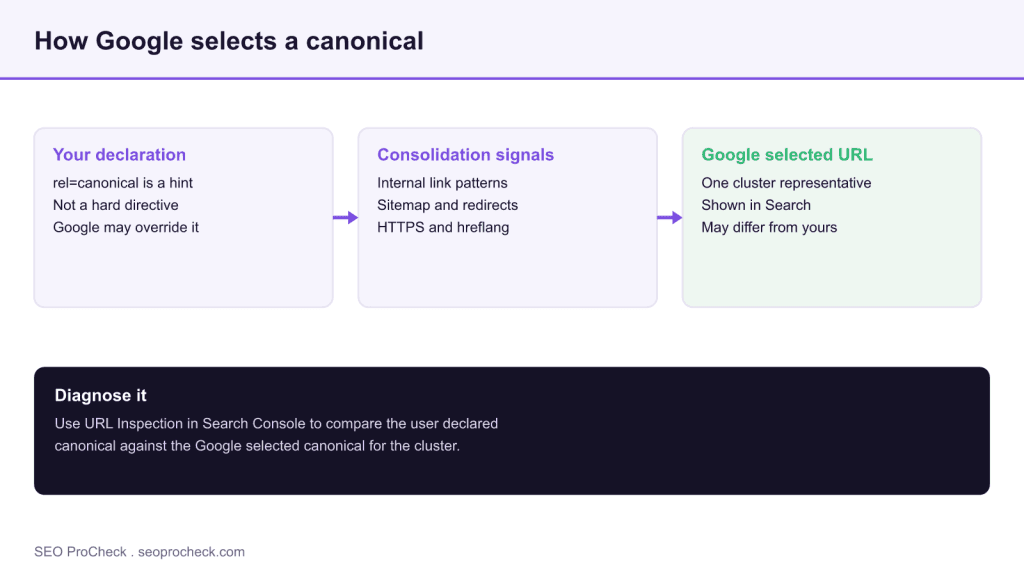
Google treats rel canonical as a hint, not a command, so it can and sometimes does select a different canonical than the one you declare. When that happens, the fix is to align your consolidation signals, internal links, sitemaps, redirects, and hreflang, so they all point at the URL you actually want indexed.
- rel canonical is a suggestion; Google can override it based on other signals.
- Check the Google selected canonical in the URL Inspection tool.
- Conflicting internal links or sitemaps are the most common override cause.
- The Page Indexing report flags duplicate, Google chose different canonical.
Canonicalization looks simple until the day Google ignores the canonical you set. This case captures that exact moment: a page declares a clear rel="canonical", everything appears correct, and yet Search Console reports that Google picked a different URL as the representative of the cluster. Understanding why turns a frustrating mystery into a routine diagnosis.
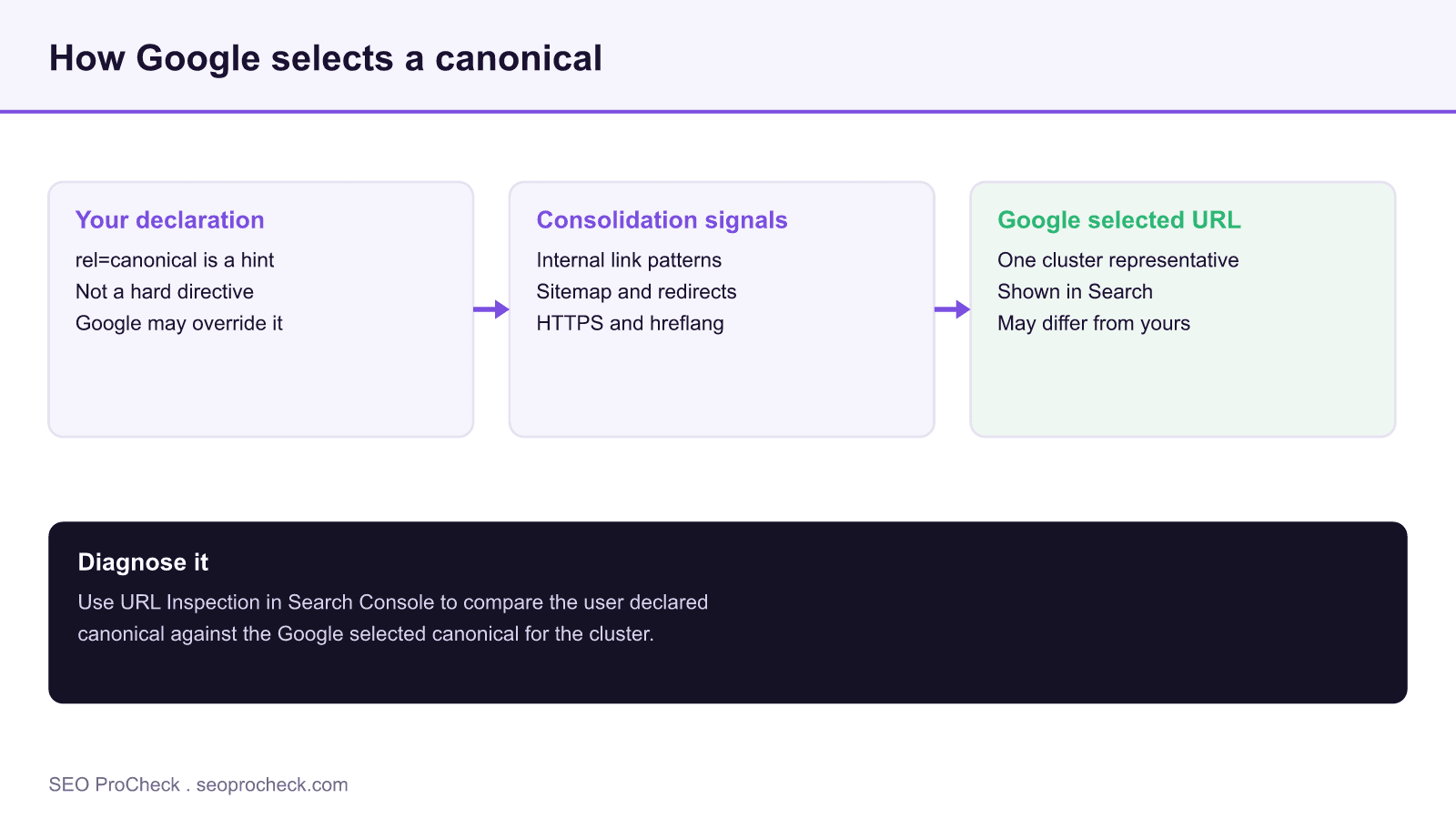
The core idea to internalize is that a canonical tag is a hint. Google collects every URL that serves near identical content, treats them as one cluster, and chooses a single representative to index and rank. Your declared canonical is a strong signal in that decision, but it competes with several others. When those other signals disagree with your tag, Google can and will override it.
The signals that outweigh your tag
Several inputs feed canonical selection. Internal linking is one of the loudest: if most of your internal links point at version A while your canonical tag points at version B, you are sending mixed messages and Google may favor the URL that the site itself links to most. Your XML sitemap is another vote. Redirects, especially a stray 301, can settle the matter entirely. HTTPS is preferred over HTTP, a shorter cleaner URL is often favored over a parameter laden one, and hreflang annotations tie language variants together. When your canonical tag fights the weight of these combined signals, it tends to lose.
How to diagnose it
Start in the URL Inspection tool. It shows both the user declared canonical, which is your tag, and the Google selected canonical, which is the URL Google actually chose. If they differ, you have your answer and your target. In the Page Indexing report, the status labeled duplicate, Google chose different canonical than user groups these cases so you can work them in bulk rather than one at a time.
Once you know the mismatch, audit the signals in order. Confirm the page is not being redirected anywhere unexpected. Confirm your internal links, navigation, breadcrumbs, and in body links consistently reference the intended URL. Confirm the sitemap lists only the canonical version. Confirm there is no conflicting canonical injected by a plugin or a template. Small inconsistencies compound, and a single template that links to a tracking parameter version can quietly outvote a correct tag across thousands of pages.
What has changed since
The mechanics have been stable, but the reporting has improved. The Page Indexing report now surfaces canonical conflicts clearly, and the URL Inspection live test makes it fast to confirm a fix. The rise of faceted commerce and parameter heavy URLs means canonical conflicts are more common than ever, so treating canonical selection as a set of aligned signals rather than a single tag is the durable approach. If Google keeps choosing a different URL, that is feedback that your signals are inconsistent, not that the tag is broken.
Canonicalization also connects to delivery mechanics: the study on the rel canonical HTTP header versus the HTML tag explains when a header is the more reliable channel, and the broader lessons on quality indexation for large sites show why clean canonical clusters protect crawl budget.
Signals that influence canonical selection
| Signal | Typical influence | How to align it |
|---|---|---|
| rel canonical tag | Strong hint | Point every duplicate at one URL |
| Internal links | Very strong | Link consistently to the canonical |
| XML sitemap | Moderate | List only the canonical version |
| 301 redirects | Decisive | Remove strays, keep intended target live |
| HTTPS vs HTTP | Preference | Serve and canonicalize the HTTPS URL |
| hreflang | Cluster level | Reference canonical URLs in annotations |
Frequently asked questions
Why did Google choose a different canonical than mine?
Because rel canonical is a hint, not a directive. If your internal links, sitemap, or redirects point at another URL, Google can weigh those signals more heavily and pick a different representative for the cluster.
How do I see the Google selected canonical?
Open the URL Inspection tool in Search Console for the page. It reports both the user declared canonical, which is your tag, and the Google selected canonical, which is the URL Google actually indexed.
Is a canonical tag a directive?
No. It is one of several consolidation signals. Google may honor it or override it depending on how consistent your other signals are.
What most often overrides a canonical tag?
Inconsistent internal linking is the most common cause, followed by conflicting sitemap entries and stray redirects that point at a different URL than the tag.
How do I fix a canonical mismatch?
Align every signal on one target: consistent internal links, a sitemap listing only the canonical, no conflicting redirects, and a single canonical tag per page. Then request validation in the Page Indexing report.
This SEO case study documents a successful optimization initiative, providing actionable insights for practitioners. The documented approach demonstrates how strategic SEO implementation drives measurable results.
Initial Situation
Understanding the starting point is essential context for evaluating any case study. This documentation covers the initial challenges, competitive position, and business objectives that shaped the SEO strategy.
Strategy and Approach
The strategic approach combined multiple SEO disciplines to address identified opportunities. Key decisions around prioritization and resource allocation provide a template for similar initiatives.
Implementation
Moving from strategy to execution required specific technical implementations, content development, and process changes. This case study documents the practical steps that translated strategy into action.
Results and Learnings
The outcomes demonstrate effectiveness through measurable improvements in rankings, traffic, and business metrics. Analysis of successes and challenges provides learning value for practitioners.
Case studies like this contribute to the SEO knowledge base, helping practitioners learn from documented real-world experiences.
Source: https://gentofsearch.com/blog/when-google-gets-canonicalization-wrong/
Claude Vincent is a technical SEO consultant focused on crawlability, rendering, and AI-search visibility. He writes the field guides and case studies at SEO ProCheck, with a bias toward the durable, unglamorous work that decides whether search engines and AI answer engines can actually read and cite a site.
About SEO ProCheck
Technical SEO consulting and GEO strategy with 20 years of enterprise experience. Case studies, resources, and tools for search and AI visibility.
Work With Me
Technical SEO audits, GEO strategy, site migrations, and international SEO. Hourly consulting for teams who need hands-on support, not just reports.
Subscribe to our newsletter!







Recent Posts
- Can AI Crawlers Actually Read Your Site? I Measured 400 of the Biggest September 5, 2026
- The Pre-Publish Quality Gate for AI-Assisted Content August 6, 2026
- AGENTS.md vs llms.txt vs llms-full.txt: Which Agent File Does What July 18, 2026