

AI Summary
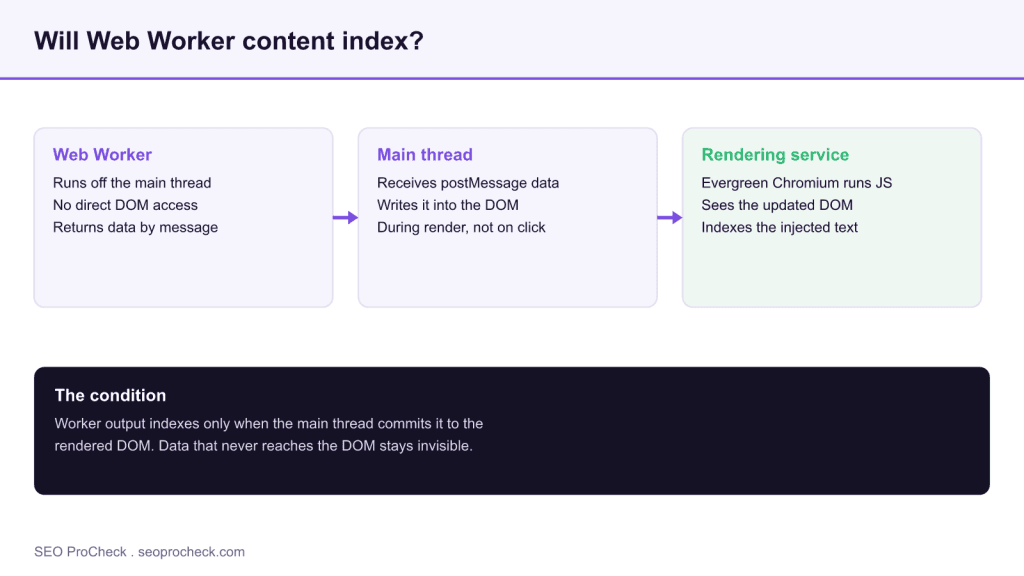
Content generated inside a web worker can be indexed, but only if the main thread writes that output into the DOM during rendering rather than after a user action. Web workers cannot touch the DOM themselves, so what matters for indexing is whether their result reaches the rendered HTML that Google evaluates.
- Web workers run off the main thread and have no direct DOM access.
- Data returns to the main thread by postMessage, which then updates the DOM.
- If the update lands in the rendered DOM, Google indexes it.
- Content that never reaches the DOM stays invisible to the crawler.
Web workers are a performance tool: they run JavaScript on a background thread so heavy computation does not block the interface. That architecture raises a fair technical question for anyone who cares about organic visibility. If a worker generates text or markup, will Google index it? This case works through the mechanics and lands on a clear rule.
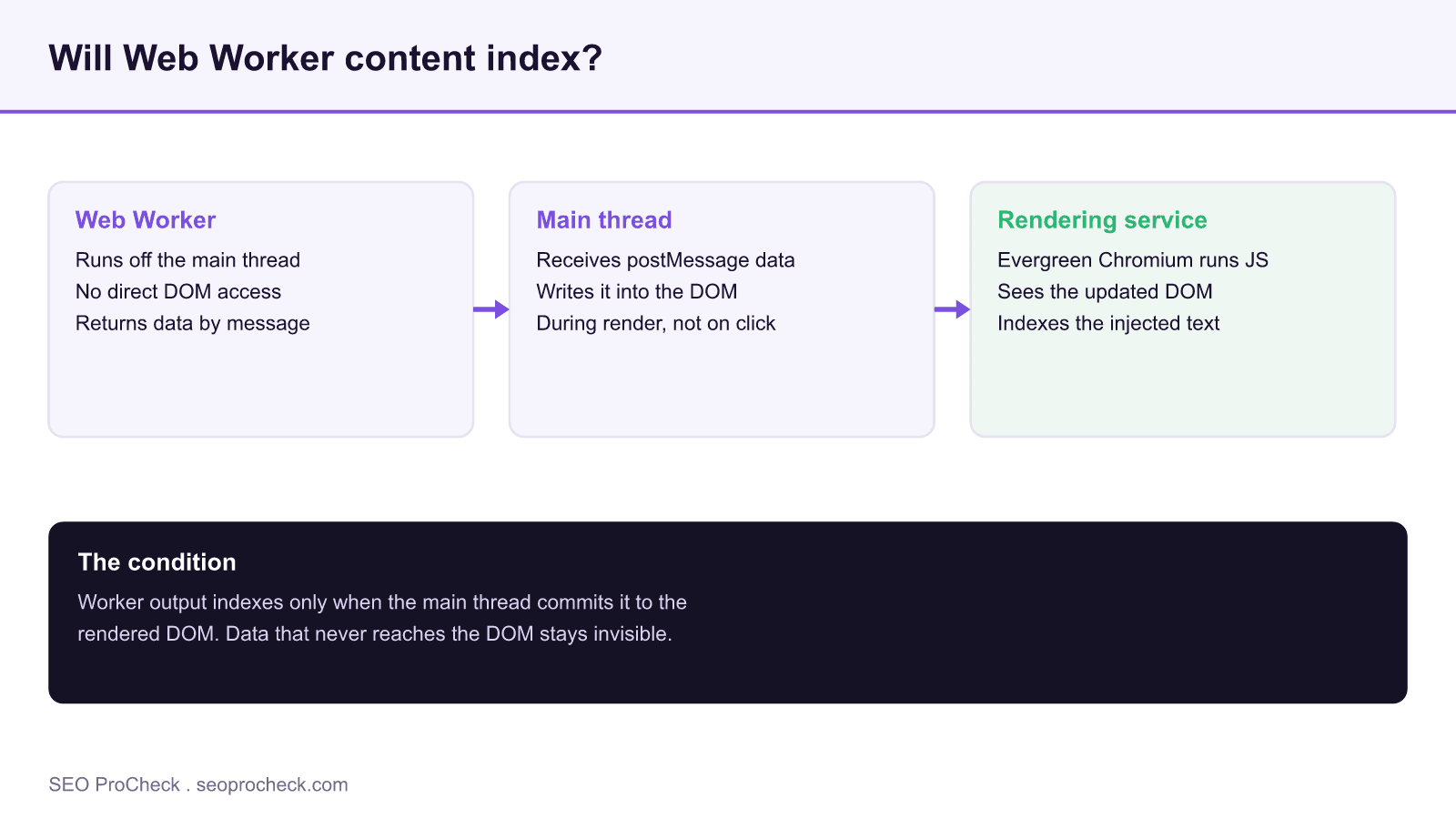
The first fact that governs the answer is that a web worker cannot access the DOM. By design it has no document object and cannot write to the page directly. It communicates with the main thread through messages, typically postMessage and an onmessage handler. So a worker never indexes anything on its own. What actually gets indexed is whatever the main thread does with the worker result.
How Google renders modern JavaScript
Google uses a rendering service built on an evergreen, up to date Chromium. It fetches the HTML, then executes JavaScript in a headless browser, and indexes the resulting rendered DOM. Because that engine is a current Chromium, it supports web workers just like a normal browser does. The worker runs, posts its data back, and the main thread can act on it. There is nothing about the worker itself that blocks indexing.
The condition that decides indexing
Everything hinges on whether the worker output reaches the rendered DOM during rendering. If the main thread receives the message and writes the result into the page as part of the normal load, the text becomes part of the rendered HTML and is indexed like any other JavaScript generated content. If, instead, the main thread only injects that content after a click, a hover, or another interaction the headless renderer does not perform, the content never appears in the rendered DOM and is not indexed. The worker is not the deciding factor. The DOM commit is.
How to test it on a real page
Use the URL Inspection tool, run a live test, and read the rendered HTML. If the worker produced text is present there, you are indexable. You can reproduce the crawler perspective locally by loading the page, letting it settle without interacting, and checking the DOM in developer tools. If the content only shows up after you click, that is a warning that a passive crawler will miss it. A production confirmation is a site search for a unique phrase once the page has been recrawled.
What has changed since
Because Google moved to an evergreen rendering engine, the platform features a worker relies on are well supported, which removes a whole category of old worries about whether the runtime even ran the code. The durable guidance is unchanged and simple: treat web workers as a way to compute faster, not as a way to deliver primary content, and always make sure the main thread writes anything that must rank into the DOM on load. If ranking copy depends on a worker, verify it in the rendered HTML rather than assume the pipeline delivered it.
For related rendering and indexing edge cases, the study on content hidden behind accordions covers the same DOM versus interaction boundary, and how Google selects a canonical is useful once your rendered pages start to overlap.
Web worker delivery and indexing outcome
| Scenario | Reaches rendered DOM? | Indexed? |
|---|---|---|
| Worker result written to DOM on load | Yes | Yes |
| Worker result injected only after click | No | No |
| Worker computes, main thread renders text | Yes | Yes |
| Worker data kept in memory only | No | No |
| Worker output added on scroll or observer | Usually no | Risky |
Frequently asked questions
Can a web worker write to the page directly?
No. Web workers have no DOM access and no document object. They return data to the main thread through messages, and the main thread updates the page.
Will content made by a web worker get indexed?
It can. If the main thread writes the worker output into the DOM during rendering, Google indexes it. If the output never reaches the rendered DOM, it is not indexed.
Does Googlebot run web workers?
Yes. Google renders with an evergreen Chromium that supports web workers, so the worker code executes during rendering just as it would in a modern browser.
Why might worker content fail to index?
Because it only appears after a user interaction the crawler does not perform, or because the result stays in memory and is never committed to the DOM.
How do I confirm worker content is indexable?
Run a live test in the URL Inspection tool and read the rendered HTML. If the worker generated text is present there, it is indexable.
This SEO case study documents a successful optimization initiative, providing actionable insights for practitioners. The documented approach demonstrates how strategic SEO implementation drives measurable results.
Initial Situation
Understanding the starting point is essential context for evaluating any case study. This documentation covers the initial challenges, competitive position, and business objectives that shaped the SEO strategy.
Strategy and Approach
The strategic approach combined multiple SEO disciplines to address identified opportunities. Key decisions around prioritization and resource allocation provide a template for similar initiatives.
Implementation
Moving from strategy to execution required specific technical implementations, content development, and process changes. This case study documents the practical steps that translated strategy into action.
Results and Learnings
The outcomes demonstrate effectiveness through measurable improvements in rankings, traffic, and business metrics. Analysis of successes and challenges provides learning value for practitioners.
Case studies like this contribute to the SEO knowledge base, helping practitioners learn from documented real-world experiences.
Source: https://tamethebots.com/blog-n-bits/will-web-worker-contents-index
Take this with you
The assistant links open with a question about this page already written. Nothing is sent until you press enter.
Claude Vincent is a technical SEO consultant focused on crawlability, rendering, and AI-search visibility. He writes the field guides and case studies at SEO ProCheck, with a bias toward the durable, unglamorous work that decides whether search engines and AI answer engines can actually read and cite a site.
About SEO ProCheck
Technical SEO consulting and GEO strategy with 20 years of enterprise experience. Case studies, resources, and tools for search and AI visibility.
Work With Me
Technical SEO audits, GEO strategy, site migrations, and international SEO. Hourly consulting for teams who need hands-on support, not just reports.
Subscribe to our newsletter!








Recent Posts
- Most Top Sites Never Say Who They Are in Structured Data October 14, 2026
- Homepage Titles Are Mostly Too Short, Not Too Long October 8, 2026
- Who Actually Serves an llms.txt? 184 Top Sites Measured September 29, 2026