AI Summary
This case study, based on work by Dejan Marketing, documents the negative impact that careless 301 redirects can have on rankings and crawl efficiency. Redirect chains, mismatched targets and accidental loops all dilute signals and waste crawl budget, so the fix is to flatten every redirect to a single clean hop that points at a genuinely relevant destination.
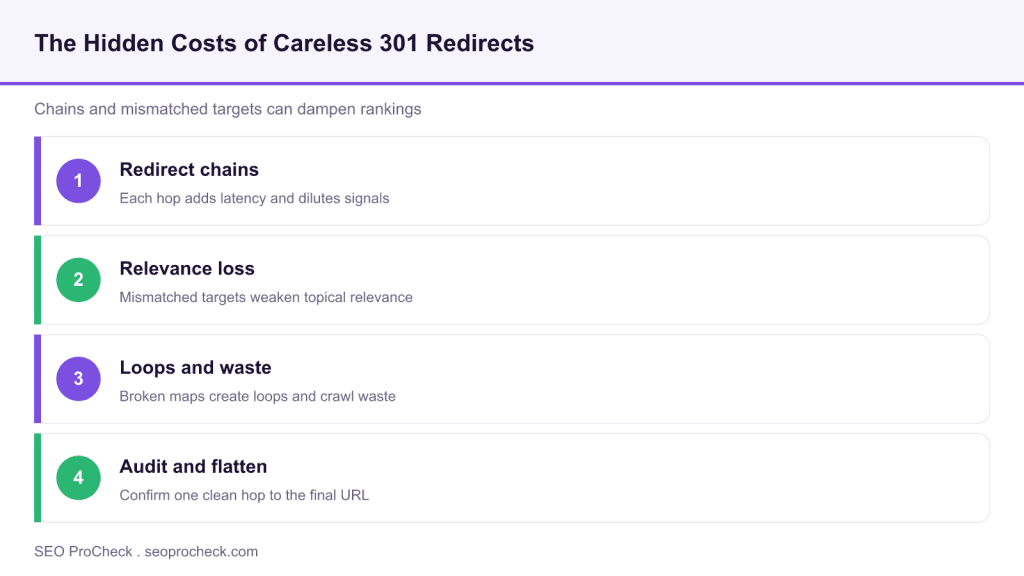
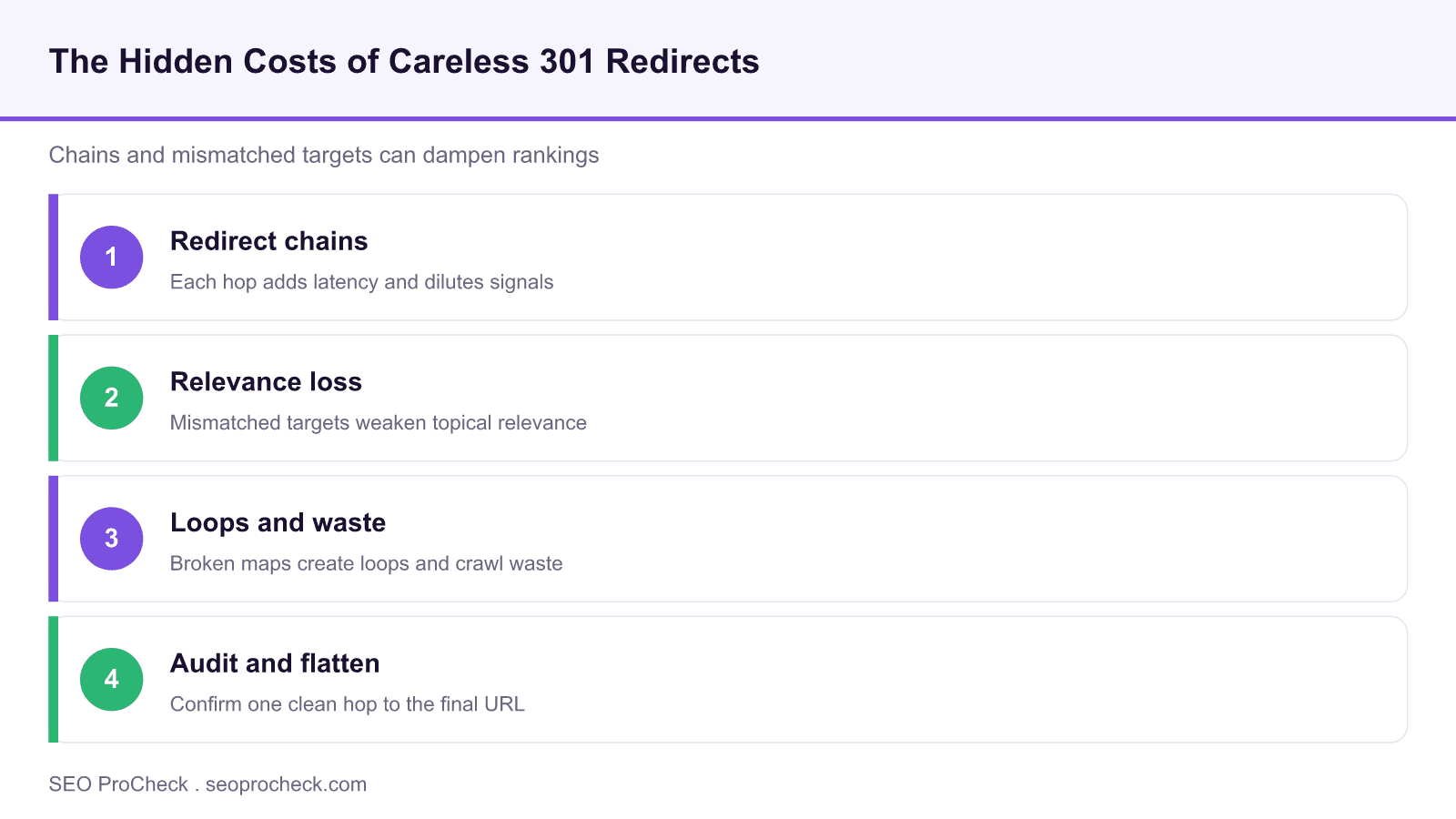
- Redirect chains add latency and can dilute the signals passed to the final URL.
- Mismatched targets weaken topical relevance and can be treated as soft 404s.
- Broken mapping creates loops that trap crawlers and waste crawl budget.
- Flattening to one hop toward a relevant page restores clean signal flow.
This SEO case study documents a successful optimization initiative, providing actionable insights for practitioners. The documented approach demonstrates how strategic SEO implementation drives measurable results.
Initial Situation
Understanding the starting point is essential context for evaluating any case study. This documentation covers the initial challenges, competitive position, and business objectives that shaped the SEO strategy.
Strategy and Approach
The strategic approach combined multiple SEO disciplines to address identified opportunities. Key decisions around prioritization and resource allocation provide a template for similar initiatives.
Implementation
Moving from strategy to execution required specific technical implementations, content development, and process changes. This case study documents the practical steps that translated strategy into action.
Results and Learnings
The outcomes demonstrate effectiveness through measurable improvements in rankings, traffic, and business metrics. Analysis of successes and challenges provides learning value for practitioners.
Case studies like this contribute to the SEO knowledge base, helping practitioners learn from documented real-world experiences.
Source: https://dejanmarketing.com/negative-impact-of-301-redirects/
The quiet ways redirects cost you rankings
Redirects feel like a solved problem, which is exactly why they cause trouble. Over years of site changes, a single URL can end up redirecting to a URL that redirects to another URL, forming a chain. Each hop adds latency, gives search engines another chance to drop or transform signals, and slows the crawler down. When enough URLs sit behind chains, the cumulative drag shows up as softer rankings and slower recrawling.
Relevance is the second failure mode. A redirect that lands on a page unrelated to the original can be treated as a soft 404, a pattern documented in detail in the companion proof that irrelevant redirects are seen as soft 404s. The worst case is a loop, where a broken mapping sends the crawler in a circle, wasting budget that should go to pages that can rank.
How I audit and flatten a redirect map
Crawl the site and export every redirect with its full hop path, then sort by number of hops. Rewrite each multi hop chain so the original URL points directly at the final destination in one step, and confirm that destination returns a 200 status and is topically relevant. Delete redirects that serve no purpose, and repair any loop immediately because loops waste crawl budget on every visit.
Keep the map relevant, not just short. Aligning redirect targets with the original intent supports the same goal as disciplined quality indexation: every URL that stays in play should earn its place. Re crawl after the changes to verify that chains are gone and that no new loops crept in.
| Problem | Why it hurts | Fix |
|---|---|---|
| Redirect chain | Latency plus signal loss at each hop | Point the original URL to the final target in one hop |
| Mismatched target | Weak relevance, possible soft 404 | Redirect to the closest relevant page |
| Redirect loop | Traps crawlers and wastes budget | Repair the mapping so it resolves to a 200 |
| Orphaned redirect | Adds noise and maintenance cost | Remove it and update internal links |
What's changed since
The mechanics still hold, and modern crawlers make chains and loops easy to find, so there is less excuse for leaving them in place. Google has said it will follow several redirect hops, but every extra hop is still latency and still a chance for signals to weaken, so one hop remains the target.
The clearest change is expectation. Flattening chains and validating relevant targets is now considered baseline migration hygiene rather than an advanced tactic, and it pairs with the settled understanding that irrelevant redirects behave like soft 404s. Audit regularly, because redirect debt accumulates quietly with every site change.
Frequently asked questions
What is a redirect chain?
A redirect chain is when one URL redirects to a second URL that itself redirects to a third, and so on before reaching the final page. Each hop adds latency and gives search engines another opportunity to drop or weaken the signals being passed.
How many redirect hops will Google follow?
Google will follow several hops, but relying on that tolerance is risky. Extra hops slow both users and crawlers and can dilute signals, so the safe standard is a single hop from the original URL to the final destination.
Do redirect chains really affect rankings?
They can, both directly through weakened signal transfer and indirectly by slowing crawling and adding latency for users. On large sites the cumulative effect of many chained URLs is meaningful, which is what this case study documents.
What is a redirect loop and why is it bad?
A redirect loop is a broken mapping where URLs point back at each other so the destination is never reached. Loops trap crawlers, waste crawl budget on every visit, and leave users stuck, so they should be fixed immediately.
How often should I audit redirects?
Audit after every migration or major site change, and on a periodic schedule for large sites. Redirect debt builds up quietly over time, so regular crawls to catch new chains and loops are cheap insurance.
Should mismatched redirects be repointed or removed?
Repoint them to the closest relevant page whenever a good equivalent exists, since that preserves the most value. If no relevant target exists and the URL has no equity worth keeping, removing the redirect and returning a clean 404 or 410 is acceptable.
Claude Vincent is a technical SEO consultant focused on crawlability, rendering, and AI-search visibility. He writes the field guides and case studies at SEO ProCheck, with a bias toward the durable, unglamorous work that decides whether search engines and AI answer engines can actually read and cite a site.
About SEO ProCheck
Technical SEO consulting and GEO strategy with 20 years of enterprise experience. Case studies, resources, and tools for search and AI visibility.
Work With Me
Technical SEO audits, GEO strategy, site migrations, and international SEO. Hourly consulting for teams who need hands-on support, not just reports.
Subscribe to our newsletter!