SEO ProCheck
  • Articles
    & Evergreen
    • Articles
      • Algorithm Updates
      • Analytics & Measurement
      • CMS and Platforms
      • Content Strategy
      • E-commerce SEO
      • General
      • Industry Guides
      • Keyword Research
      • Link Building
      • Local SEO
      • Mobile SEO
      • On-Page SEO
      • SEO Tools
    • Evergreen
      • AI and Search
        • AEO (Answer Engine Optimization)
        • AI Overviews and SGE
        • GEO (Generative Engine Optimization)
        • LLM Citation Optimization
      • Content SEO
        • Content Architecture
        • E-E-A-T Optimization
        • Internal Linking Strategy
      • Python and Automation
      • Technical SEO
        • Core Web Vitals and Performance
        • Crawlability and Indexation
        • International SEO and Hreflang
        • Log File Analysis
        • Schema and Structured Data
        • Site Architecture
        • Site Migrations
  • Case Studies
    & Researches
    • Case Studies
      • Content
      • Crawling and Indexing
      • Growth
      • International SEO
      • JavaScript SEO
      • Metadata
      • Migrations
      • Website Architecture
      • Web Performance
    • Research
      • AI Search
      • Cross-Industry
      • E-commerce
      • Enterprise
      • Local and Listings
      • Publisher
  • Free
    Tools
    • Free SEO & AI Search Tools
    • Free SEO Tools
      • Content Analysis
      • Developer Utilities
      • GEO & AI Visibility
      • Local SEO
      • Schema & Structured Data
      • Social & Meta
      • Technical SEO
    • Browser Extensions
  • Resources
    & Guides
    • Executive Briefings
      • What SEO Actually Is
      • Why SEO Takes Time
      • Technical vs Content SEO
      • What AI Search Changes
      • Is Your SEO Working?
      • Case Studies
      • Is It Worth It?
      • Hiring an Agency
      • SEO vs Paid
      • Resourcing SEO
    • Best Practices
      • Accessibility
      • AMP
      • Content & GEO
      • Duplicates
      • HTML Structure
      • hrefLang
      • Images
      • Indexation
      • Links
      • Mobile
      • On-Page SEO
      • Organic & Analytics
      • Performance
      • Redirections
      • Robots.txt
      • Security
      • Structured Data
      • Technical GEO
      • URLs
      • XML Sitemaps
    • FAQ
      • AI & Search FAQ
      • Technical SEO FAQ
      • Content SEO FAQ
      • Off-Page SEO FAQ
      • Local SEO FAQ
      • E-commerce SEO FAQ
      • Tools and Analytics FAQ
    • Glossary
      • Glossary | Algorithms
      • Glossary | Analytics
      • Glossary | Business
      • Glossary | Content SEO
      • Glossary | E-commerce
      • Glossary | Emerging
      • Glossary | GEO & AI SEO
      • Glossary | International SEO
      • Glossary | Link Building
      • Glossary | Local SEO
      • Glossary | Search Behavior
      • Glossary | Technical SEO
      • Glossary | Tools
  • About
    • About
    • How I work
consulting
Home / Metadata / Does adding the ‘dateModified’ attribute to schema improve organic traffic?

Does adding the ‘dateModified’ attribute to schema improve organic traffic?

  • October 20, 2022
  • Metadata
No Comments
Does adding the ‘datemodified’ attribute to schema improve organic traffic?

AI Summary

The dateModified property in Article schema tells Google when a page was last meaningfully updated, which can feed the freshness date shown in the search result. This test asks whether adding that single field, with no change to the visible content, moves organic traffic, and the honest answer is that it helps most when the update is real and reflected on the page.

  • dateModified is a freshness signal, not a ranking shortcut.
  • It works only when the update is genuine and mirrored in the visible content.
  • Keep dateModified, the sitemap lastmod, and any visible date in agreement.
  • Faking recent dates on unchanged pages risks looking manipulative to Google.
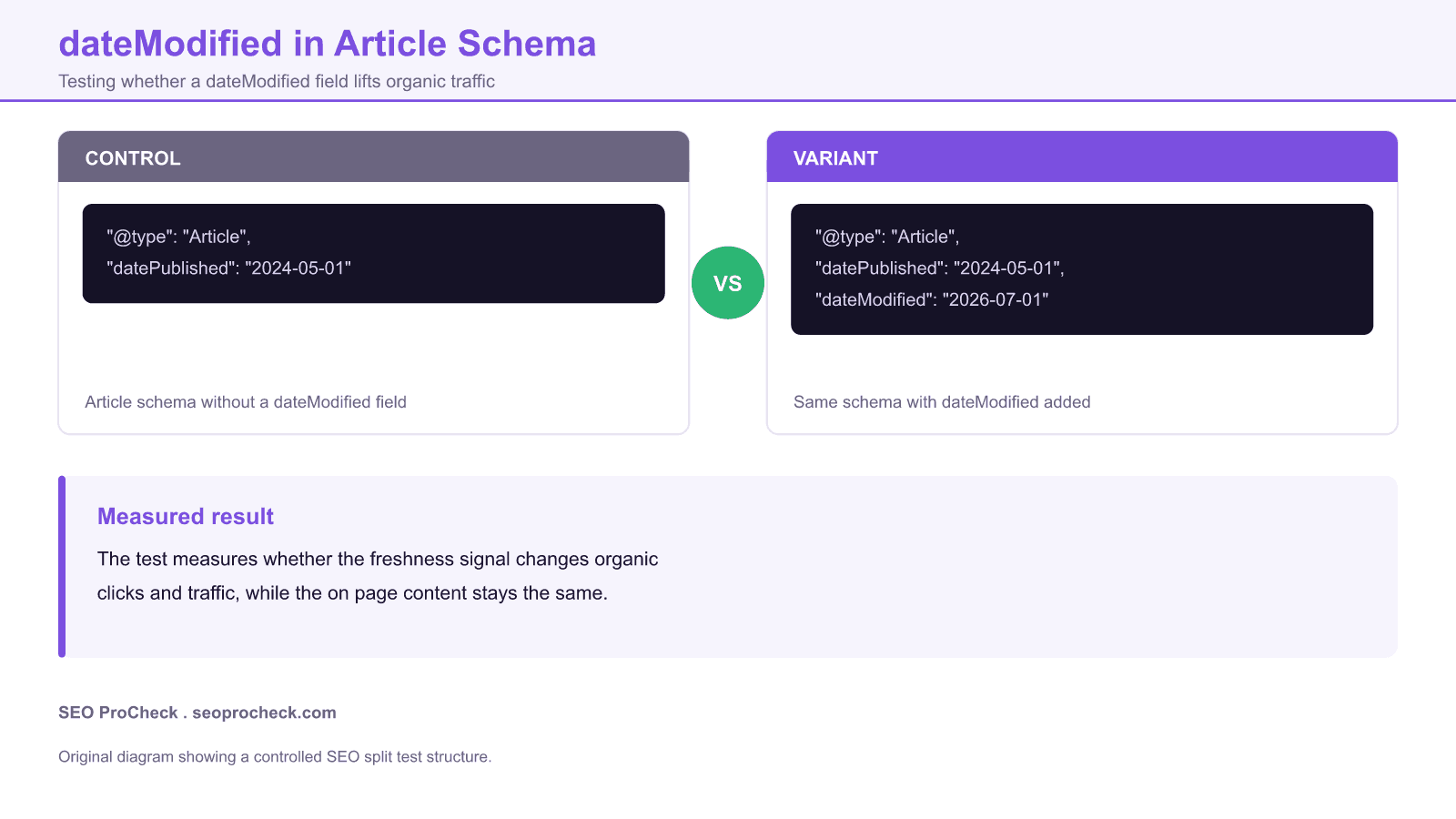
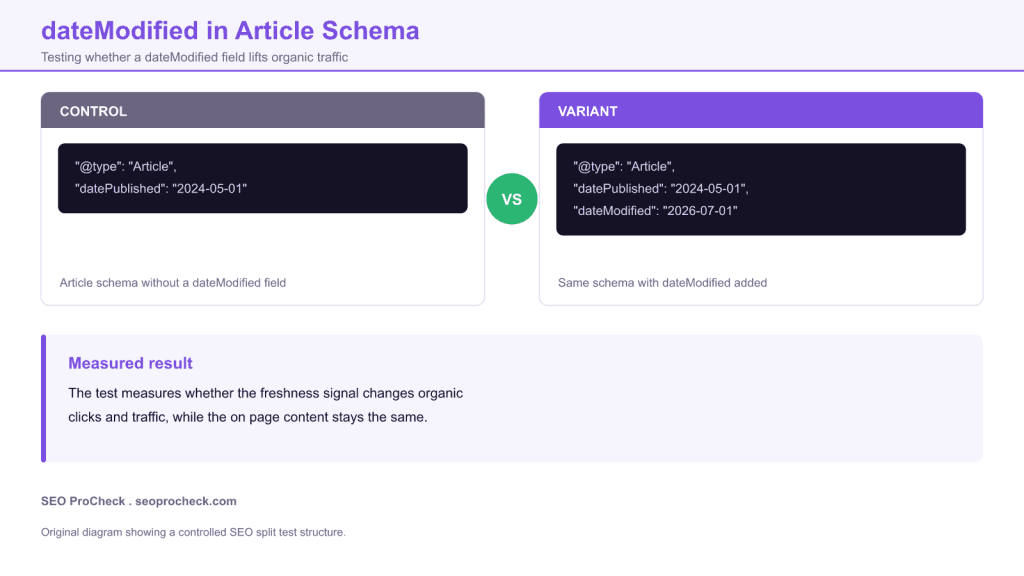
Diagram of an seo split test comparing article schema without a datemodified field against the same schema with a datemodified freshness field added.
A split test compares Article schema with and without a dateModified field to measure the effect of the freshness signal on organic traffic.

This page documents a structured data experiment: does adding the dateModified attribute to Article schema improve organic traffic on its own? Below the original summary we add a practitioner guide to what the field actually signals, how to implement it without tripping quality filters, and how to measure the effect.

This SEO case study documents a successful optimization initiative, providing actionable insights for practitioners. The documented approach demonstrates how strategic SEO implementation drives measurable results.

Initial Situation

Understanding the starting point is essential context for evaluating any case study. This documentation covers the initial challenges, competitive position, and business objectives that shaped the SEO strategy.

Strategy and Approach

The strategic approach combined multiple SEO disciplines to address identified opportunities. Key decisions around prioritization and resource allocation provide a template for similar initiatives.

Implementation

Moving from strategy to execution required specific technical implementations, content development, and process changes. This case study documents the practical steps that translated strategy into action.

Results and Learnings

The outcomes demonstrate effectiveness through measurable improvements in rankings, traffic, and business metrics. Analysis of successes and challenges provides learning value for practitioners.

What dateModified does and does not do

The dateModified property sits inside your Article or NewsArticle structured data and records an ISO 8601 timestamp for the last substantive update. Google can use it to display a freshness date in the result, and a recent, credible date can lift click through rate on queries where users prefer current information. What it does not do is act as a standalone ranking boost. Google has said repeatedly that changing the date without changing the content is not a freshness strategy. The field describes an update, it does not create one, so the value it delivers is bounded by whether a real update exists behind it.

Where the freshness signals live

SignalWhere it livesPurpose
datePublishedArticle schemaWhen the page first went live.
dateModifiedArticle schemaWhen the content was last meaningfully updated.
Visible dateOn page bylineConfirms the update to users and to Google.
lastmodXML sitemapHints to crawlers that a URL changed and should be recrawled.
Last-ModifiedHTTP headerServer level freshness hint for conditional requests.

The rule that ties these together is agreement. When the schema dateModified, the visible byline, and the sitemap lastmod all point to the same recent update, Google has a consistent story to trust. When they disagree, for example a schema date from today over content that has not changed in a year, you invite the engine to ignore the signal or treat it as noise.

How to implement dateModified correctly

  1. Set dateModified from your content management system, driven by the real last edit, not a nightly cron.
  2. Use a full ISO 8601 timestamp with a timezone offset so the value is unambiguous.
  3. Mirror the date in a visible on page byline so users and Google see the same claim.
  4. Update the sitemap lastmod at the same time so recrawl hints stay consistent.
  5. Only bump the date when you make a substantive edit, not for a typo or a plugin update.

For adjacent structured data experiments, see our note on adding top brands to FAQ markup and the wider title tag testing case study. The complete set lives in our metadata case studies.

Running the test

To measure dateModified in isolation, split a template of similar articles into control and variant, add dateModified only to the variant, and change nothing else. Run the test two to six weeks, then model the click and impression difference with a causal method. Watch for the freshness date appearing in the results page for variant URLs, because if the date never surfaces, a flat result tells you nothing about the field itself. Pair the schema change with a genuine content refresh when you want the largest, most durable effect.

What has changed since this test

Google has grown more skeptical of dates that do not match the content, and its documentation now stresses that structured data must reflect what is visible on the page. Automated date bumping on unchanged pages is a known manipulation pattern and can erode trust. In the AI Overviews era freshness still matters, since models prefer to cite current information, but they cross check the claimed date against the actual text. Treat dateModified as the label on a real update, keep every date signal in agreement, and retest legacy assumptions against current guidance.

Case studies like this contribute to the SEO knowledge base, helping practitioners learn from documented real-world experiences.

Source: https://www.searchpilot.com/resources/case-studies/does-adding-datemodified-schema-improve-organic-traffic/

Frequently asked questions

Does adding dateModified schema improve rankings?

Not by itself. It is a freshness signal that can surface a recent date in the results and help click through rate, but Google does not treat the field as a ranking boost when the content has not actually changed.

What is the difference between datePublished and dateModified?

datePublished records when the page first went live, while dateModified records when it was last meaningfully updated. Both belong in Article schema and should reflect real events.

Should dateModified match the visible date on the page?

Yes. Google expects structured data to reflect what users see, so the schema dateModified, the visible byline, and the sitemap lastmod should all point to the same update.

Can I update dateModified automatically every day?

You should not bump it for trivial or automated changes. Setting a fresh date on unchanged content is a manipulation pattern that can reduce trust rather than help.

Does dateModified help with AI Overviews?

It can, because AI systems prefer current information, but they cross check the claimed date against the actual content. A real update behind the date is what earns the benefit.

How do I test the impact of dateModified?

Split a group of similar articles into control and variant, add the field only to the variant, change nothing else, run it for two to six weeks, and model the click difference with a causal method.

Take this with you

Ask ChatGPTAsk ClaudeAsk PerplexityShare on LinkedInShare on Reddit

The assistant links open with a question about this page already written.

  • Claude Vincent

Claude Vincent is a technical SEO consultant focused on crawlability, rendering, and AI-search visibility. He writes the field guides and case studies at SEO ProCheck, with a bias toward the durable, unglamorous work that decides whether search engines and AI answer engines can actually read and cite a site.

  • Local SEO, Structured Data

About SEO ProCheck

Technical SEO consulting and GEO strategy with 20 years of enterprise experience. Case studies, resources, and tools for search and AI visibility.

Learn more about me

Work With Me

Technical SEO audits, GEO strategy, site migrations, and international SEO. Hourly consulting for teams who need hands-on support, not just reports.

Contact now

Subscribe to our newsletter!

More from our blog


Timeline of Google's 4 spam updates of 2026: March 19 hours 30 minutes, June 2 days 1 hour, August 2 days 16 hours, September 13 days 16 hours, with 33 days and no listed ranking update between August 22 and September 23.

Google August 2026 Spam Update: Dates, Duration and How to Read Your Data

Google's August 2026 spam update ran August 18 to 21, about 2…
Continue reading
Bar chart of Google algorithm updates per year from 2003 to 2026, split into confirmed by Google and only reported

Google Algorithm Updates: The Dated List Since 2003, and What to Do After Each

Searchable list of Google algorithm updates since 2003, each with its date…
Continue reading
Map of the AI Readiness hub on SEO ProCheck: start with the 51-check AI readiness checklist, then 25 articles, studies and tools in 7 groups: Reach and read, Understand, Agents, Measure and get cited, Optional files, Background and Free tools.

AI Readiness: The Checklist, the Research and the Free Tools

AI readiness on SEO ProCheck: a sourced checklist that stays current, measurements…
Continue reading
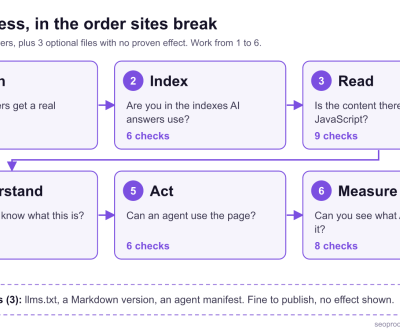
Diagram of the AI readiness checklist: 6 layers in order, Reach, Index, Read, Understand, Act and Measure, with 48 checks, plus optional files with no proven effect.

AI Readiness Checklist (2026): 51 Checks, Each With Its Source

51 AI readiness checks for AI search and AI agents, each with…
Continue reading
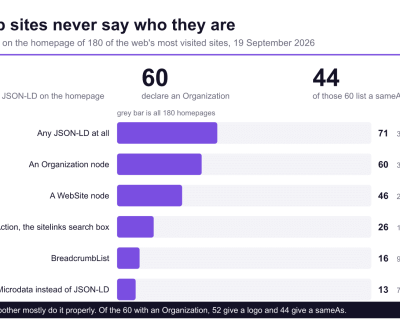
Bar chart of structured data on 180 of the web's most visited homepages. 71 carry any JSON-LD, 60 declare an Organization, 46 a WebSite node, 26 a SearchAction, 16 a BreadcrumbList and 13 use microdata.

Most Top Sites Never Say Who They Are in Structured Data

I read the homepage of 180 of the most visited sites on…
Continue reading
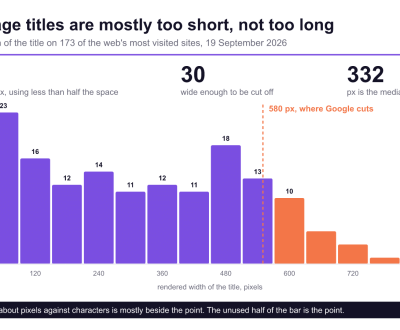
Histogram of homepage title pixel widths across 173 of the web's most visited sites. The distribution is spread widely below the 580 pixel cutoff with a large cluster under 300 pixels, and a thin tail of 30 titles beyond it.

Homepage Titles Are Mostly Too Short, Not Too Long

I measured the rendered width of the title on 173 of the…
Continue reading
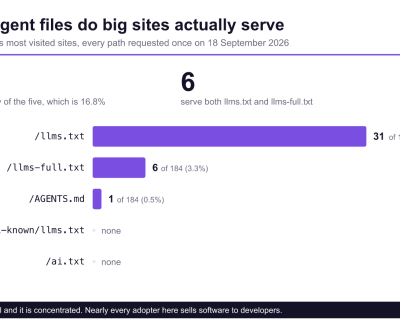
Bar chart of how many of 184 of the web's most visited sites serve each agent-facing text file. llms.txt 31 sites, llms-full.txt 6, AGENTS.md 1, and neither well-known llms.txt nor ai.txt on any site.

Who Actually Serves an llms.txt? 184 Top Sites Measured

I asked 184 of the most visited sites on the web for…
Continue reading
Stacked bar of 184 of the web's most visited sites showing where an XML sitemap can be found. 78 sites by guessing the usual path, 38 more only by reading the Sitemap line in robots.txt, and 68 by neither route.

Finding a Competitor's Sitemap, and Turning It Into a Change Log

A competitor's XML sitemap is a change log they publish without meaning…
Continue reading
Prev. Post
Next Post

Recent Posts

  • Google August 2026 Spam Update: Dates, Duration and How to Read Your Data November 2, 2026
  • Google Algorithm Updates: The Dated List Since 2003, and What to Do After Each October 31, 2026
  • AI Readiness: The Checklist, the Research and the Free Tools October 28, 2026

All Website Tags

AI SEO Analytics B2B Batch Check Content Analysis Content Quality Content Strategy Core Web Vitals Crawl Budget Crawling DOM Parsing E-commerce E-E-A-T Enterprise FAQ GEO Googlebot Google Search Console High Priority Hreflang HTTP Requests Indexing Internal Linking International SEO JavaScript SEO Keyword Research Link Building Live Check Local SEO Low Priority Medium Priority Multiple APIs On-Page SEO Page Speed PageSpeed API Rich Results SaaS Schema Validation SEO Tools SERP Features Site Architecture Site Migrations Structured Data Technical SEO Title Tags

Case studies, research, best practices and free tools for technical SEO, GEO and AI search.

Free tools: SEO & AI search tools · GitHub · browser extensions

SEO Geek since 2004. © All Rights Reserved.

SEO ProCheck

About Me  |  Sitemap for Humans  |  Privacy  |  Terms