
• Articles
    & Evergreen
    • Articles
      • Algorithm Updates
      • Analytics & Measurement
      • CMS and Platforms
      • Content Strategy
      • E-commerce SEO
      • General
      • Industry Guides
      • Keyword Research
      • Link Building
      • Local SEO
      • Mobile SEO
      • On-Page SEO
      • SEO Tools
    • Evergreen
      • AI and Search
        • AEO (Answer Engine Optimization)
        • AI Overviews and SGE
        • GEO (Generative Engine Optimization)
        • LLM Citation Optimization
      • Content SEO
        • Content Architecture
        • E-E-A-T Optimization
        • Internal Linking Strategy
      • Python and Automation
      • Technical SEO
        • Core Web Vitals and Performance
        • Crawlability and Indexation
        • International SEO and Hreflang
        • Log File Analysis
        • Schema and Structured Data
        • Site Architecture
        • Site Migrations
  • Case Studies
    & Researches
    • Case Studies
      • Content
      • Crawling and Indexing
      • Growth
      • International SEO
      • JavaScript SEO
      • Metadata
      • Migrations
      • Website Architecture
      • Web Performance
    • Research
      • AI Search
      • Cross-Industry
      • E-commerce
      • Enterprise
      • Local and Listings
      • Publisher
  • Free
    Tools
    • Free SEO & AI Search Tools
    • Free SEO Tools
      • Content Analysis
      • Developer Utilities
      • GEO & AI Visibility
      • Local SEO
      • Schema & Structured Data
      • Social & Meta
      • Technical SEO
    • Browser Extensions
  • Resources
    & Guides
    • Executive Briefings
      • What SEO Actually Is
      • Why SEO Takes Time
      • Technical vs Content SEO
      • What AI Search Changes
      • Is Your SEO Working?
      • Case Studies
      • Is It Worth It?
      • Hiring an Agency
      • SEO vs Paid
      • Resourcing SEO
    • Best Practices
      • Accessibility
      • AMP
      • Content & GEO
      • Duplicates
      • HTML Structure
      • hrefLang
      • Images
      • Indexation
      • Links
      • Mobile
      • On-Page SEO
      • Organic & Analytics
      • Performance
      • Redirections
      • Robots.txt
      • Security
      • Structured Data
      • Technical GEO
      • URLs
      • XML Sitemaps
    • FAQ
      • AI & Search FAQ
      • Technical SEO FAQ
      • Content SEO FAQ
      • Off-Page SEO FAQ
      • Local SEO FAQ
      • E-commerce SEO FAQ
      • Tools and Analytics FAQ
    • Glossary
      • Glossary | Algorithms
      • Glossary | Analytics
      • Glossary | Business
      • Glossary | Content SEO
      • Glossary | E-commerce
      • Glossary | Emerging
      • Glossary | GEO & AI SEO
      • Glossary | International SEO
      • Glossary | Link Building
      • Glossary | Local SEO
      • Glossary | Search Behavior
      • Glossary | Technical SEO
      • Glossary | Tools
  • Articles
    & Evergreen
    • Articles
      • Algorithm Updates
      • Analytics & Measurement
      • CMS and Platforms
      • Content Strategy
      • E-commerce SEO
      • General
      • Industry Guides
      • Keyword Research
      • Link Building
      • Local SEO
      • Mobile SEO
      • On-Page SEO
      • SEO Tools
    • Evergreen
      • AI and Search
        • AEO (Answer Engine Optimization)
        • AI Overviews and SGE
        • GEO (Generative Engine Optimization)
        • LLM Citation Optimization
      • Content SEO
        • Content Architecture
        • E-E-A-T Optimization
        • Internal Linking Strategy
      • Python and Automation
      • Technical SEO
        • Core Web Vitals and Performance
        • Crawlability and Indexation
        • International SEO and Hreflang
        • Log File Analysis
        • Schema and Structured Data
        • Site Architecture
        • Site Migrations
  • Case Studies
    & Researches
    • Case Studies
      • Content
      • Crawling and Indexing
      • Growth
      • International SEO
      • JavaScript SEO
      • Metadata
      • Migrations
      • Website Architecture
      • Web Performance
    • Research
      • AI Search
      • Cross-Industry
      • E-commerce
      • Enterprise
      • Local and Listings
      • Publisher
  • Free
    Tools
    • Free SEO & AI Search Tools
    • Free SEO Tools
      • Content Analysis
      • Developer Utilities
      • GEO & AI Visibility
      • Local SEO
      • Schema & Structured Data
      • Social & Meta
      • Technical SEO
    • Browser Extensions
  • Resources
    & Guides
    • Executive Briefings
      • What SEO Actually Is
      • Why SEO Takes Time
      • Technical vs Content SEO
      • What AI Search Changes
      • Is Your SEO Working?
      • Case Studies
      • Is It Worth It?
      • Hiring an Agency
      • SEO vs Paid
      • Resourcing SEO
    • Best Practices
      • Accessibility
      • AMP
      • Content & GEO
      • Duplicates
      • HTML Structure
      • hrefLang
      • Images
      • Indexation
      • Links
      • Mobile
      • On-Page SEO
      • Organic & Analytics
      • Performance
      • Redirections
      • Robots.txt
      • Security
      • Structured Data
      • Technical GEO
      • URLs
      • XML Sitemaps
    • FAQ
      • AI & Search FAQ
      • Technical SEO FAQ
      • Content SEO FAQ
      • Off-Page SEO FAQ
      • Local SEO FAQ
      • E-commerce SEO FAQ
      • Tools and Analytics FAQ
    • Glossary
      • Glossary | Algorithms
      • Glossary | Analytics
      • Glossary | Business
      • Glossary | Content SEO
      • Glossary | E-commerce
      • Glossary | Emerging
      • Glossary | GEO & AI SEO
      • Glossary | International SEO
      • Glossary | Link Building
      • Glossary | Local SEO
      • Glossary | Search Behavior
      • Glossary | Technical SEO
      • Glossary | Tools
consulting
Home / Metadata / Changing microdata to JSON+LD: SEO Split Testing Lessons From SearchPilot

Changing microdata to JSON+LD: SEO Split Testing Lessons From SearchPilot

  • November 4, 2020
  • Metadata
No Comments
Changing microdata to json+ld: seo split testing lessons from searchpilot

AI Summary

Migrating structured data from microdata to JSON-LD keeps the same rich result eligibility when the data is identical, so the benefit is maintainability and resilience rather than a direct ranking boost. Validate parity in the Rich Results Test before and after, and migrate one schema type at a time.

  • Google supports both formats and recommends JSON-LD
  • JSON-LD lives in a self contained script block that resists layout breakage
  • A format swap alone does not lift rankings
  • Validate with the Rich Results Test and Search Console before rollout
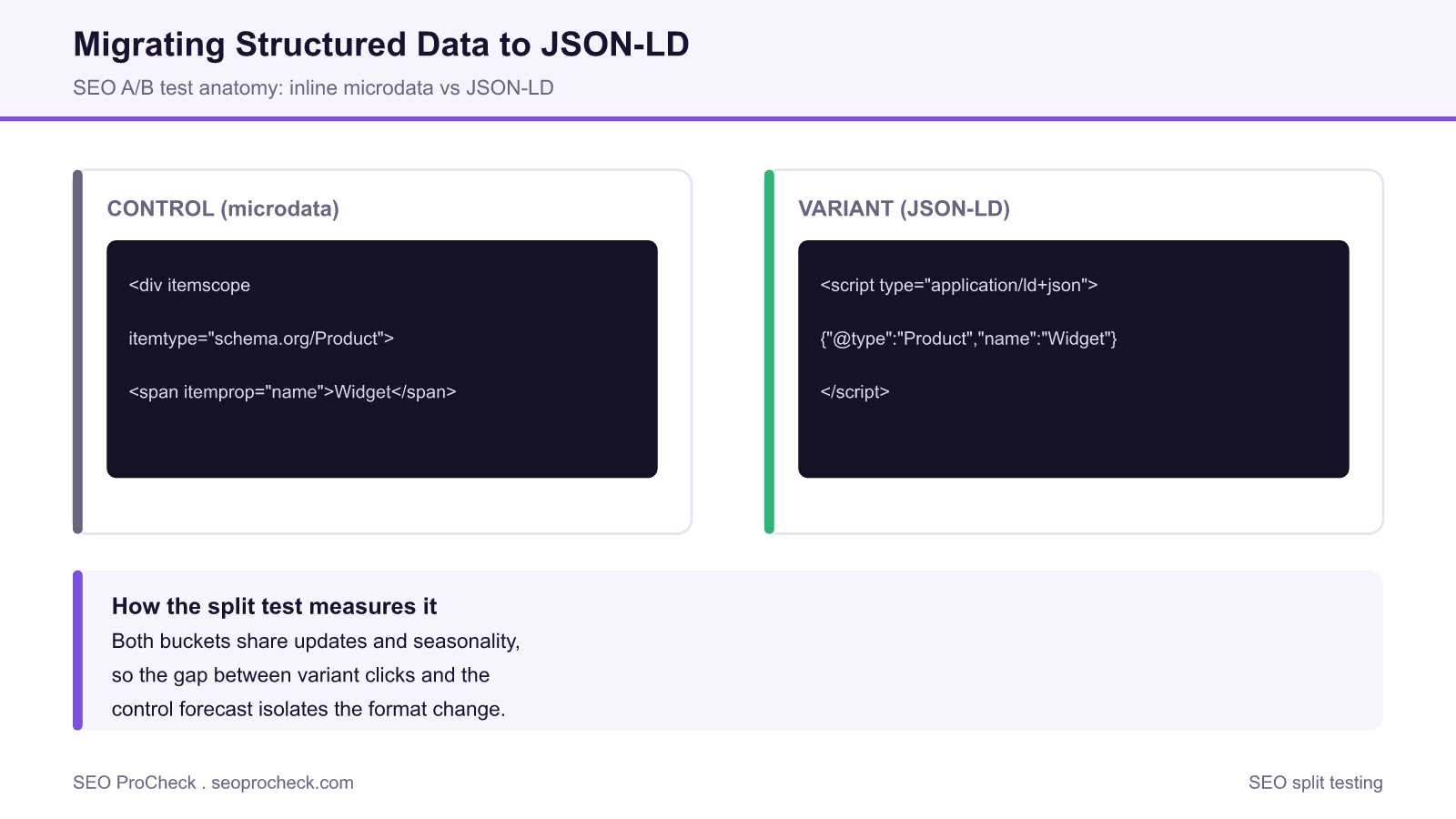
Diagram comparing inline microdata markup with an equivalent json-ld script block for the same product structured data.
The same Product data expressed as inline microdata and as JSON-LD.

This SEO case study documents a successful optimization initiative, providing actionable insights for practitioners. The documented approach demonstrates how strategic SEO implementation drives measurable results.

Initial Situation

Understanding the starting point is essential context for evaluating any case study. This documentation covers the initial challenges, competitive position, and business objectives that shaped the SEO strategy.

Strategy and Approach

The strategic approach combined multiple SEO disciplines to address identified opportunities. Key decisions around prioritization and resource allocation provide a template for similar initiatives.

Implementation

Moving from strategy to execution required specific technical implementations, content development, and process changes. This case study documents the practical steps that translated strategy into action.

Results and Learnings

The outcomes demonstrate effectiveness through measurable improvements in rankings, traffic, and business metrics. Analysis of successes and challenges provides learning value for practitioners.

Case studies like this contribute to the SEO knowledge base, helping practitioners learn from documented real-world experiences.

Source: https://www.searchpilot.com/resources/case-studies/seo-split-test-lessons-changing-microdata-to-jsonld/

Practitioner commentary

Google recommends JSON-LD as the format for structured data, yet many older sites still ship inline microdata woven through the HTML. This case study tests whether migrating the same schema from microdata to JSON-LD, with no change to the underlying facts, moves organic performance.

Why the format can matter even when the data does not change

Microdata and JSON-LD can describe identical entities, so in theory a migration is a no op for meaning. In practice the format affects reliability. Inline microdata is entangled with the visible markup, which makes it fragile: a template change, a redesign, or a stray wrapper can break the itemscope nesting and silently invalidate the data. JSON-LD lives in a self contained script block, decoupled from the DOM, which is easier to generate, easier to validate, and far less likely to break when the presentation layer changes.

Google parses both, so a correct microdata block and a correct JSON-LD block should be eligible for the same rich results. The realistic upside of migrating is not a ranking boost from the format itself, it is fewer broken markup incidents over time, cleaner validation, and simpler maintenance, all of which protect the rich results you already earn.

How to test a format migration responsibly

Assign templated pages to control and variant buckets. The variant swaps microdata for equivalent JSON-LD while keeping every property value identical, and the control keeps the microdata. Because the facts are unchanged, a click through rate difference would point to a change in rich result eligibility or presentation, which is exactly what you want to detect before a full rollout. Measure the variant against the control forecast over the same window.

Before you trust any traffic number, validate. Run both versions through the Rich Results Test and Search Console to confirm the JSON-LD produces the same detected items and the same eligible rich results as the microdata it replaced. A migration that quietly drops a required property will lose a rich result, and that loss, not the format, would be what moved the metric. Validation first, measurement second.

What to actually ship

For most sites the recommendation is to migrate to JSON-LD, but to do it as a controlled, validated change rather than a big bang. Move one schema type at a time, confirm parity in the Rich Results Test, watch the rich result reports in Search Console for errors and impressions, and only then expand. Keep the JSON-LD generated from the same data source that renders the page so the markup and the visible content never drift apart, which is a requirement for structured data eligibility.

The durable lesson is that JSON-LD wins on maintainability and resilience rather than on a direct ranking effect. Treat the migration as technical debt reduction that protects your existing rich results, measure to confirm you did not regress, and do not expect the format swap alone to lift rankings.

Microdata versus JSON-LD for structured data

DimensionInline microdataJSON-LD
Google supportSupportedSupported and recommended
Coupling to HTMLTightly coupled to the DOMSelf contained script block
Fragility on redesignHigh, nesting can breakLow, independent of layout
Ease of validationHarder, interleaved with markupEasier, one block to test
Maintenance costHigher over timeLower over time

What has changed since this test

Google has recommended JSON-LD as the preferred structured data format for years and continues to do so, while still supporting microdata and RDFa. The direction of travel is clear, so new implementations should default to JSON-LD.

The set of structured data types that produce visible rich results has narrowed over time, most notably the 2023 reduction of FAQ and HowTo rich results. Migrating format does not change eligibility, so validate against the current rich result documentation rather than assuming a type still earns an enhancement.

Related reading

  • adding FAQ schema
  • adding ratings and reviews structured data
  • metadata case studies

Frequently asked questions

Is JSON-LD better than microdata for SEO?

Google supports both and recommends JSON-LD. The advantage of JSON-LD is maintainability and resilience rather than a direct ranking boost, because it lives in a self contained script block that does not break when the page layout changes.

Will migrating from microdata to JSON-LD improve rankings?

Not by itself. If the data is identical, both formats are eligible for the same rich results, so the realistic benefit is fewer broken markup incidents and cleaner validation. Any traffic change usually traces to a difference in rich result eligibility, not to the format.

Can microdata and JSON-LD coexist on the same page?

They can be present together, but you should avoid describing the same entity twice in conflicting ways. During a migration it is cleaner to replace the microdata with equivalent JSON-LD and validate parity rather than run both indefinitely.

How do I confirm the migration did not break anything?

Run both versions through the Rich Results Test and monitor the enhancement reports in Search Console. Confirm the JSON-LD produces the same detected items and eligible rich results as the microdata, and watch for new errors after rollout.

Why does microdata break more easily?

Because it is interleaved with the visible HTML through itemscope and itemprop attributes, so a template change, redesign, or stray wrapper can break the nesting and invalidate the data without any obvious visible symptom.

Should I migrate everything at once?

No. Move one schema type at a time, confirm parity in the Rich Results Test, watch Search Console, and expand only after each type validates cleanly, so any regression is easy to isolate and reverse.

  • Claude Vincent

Claude Vincent is a technical SEO consultant focused on crawlability, rendering, and AI-search visibility. He writes the field guides and case studies at SEO ProCheck, with a bias toward the durable, unglamorous work that decides whether search engines and AI answer engines can actually read and cite a site.

  • Structured Data, Travel

About SEO ProCheck

Technical SEO consulting and GEO strategy with 20 years of enterprise experience. Case studies, resources, and tools for search and AI visibility.

Learn more about me

Work With Me

Technical SEO audits, GEO strategy, site migrations, and international SEO. Hourly consulting for teams who need hands-on support, not just reports.

Contact now

Subscribe to our newsletter!

More from our blog


Flowchart of the five check pre-publish quality gate for AI-assisted content: the anyone test, the no-AI test, says something new, the first screen, and the recommend test. All five passing leads to ship it; any failure leads back to editing.

The Pre-Publish Quality Gate for AI-Assisted Content

The five check gate we run on every AI-assisted page, built after…
Continue reading
Diagram of the agent-readable file stack showing AGENTS.md in the code repository read by coding agents, llms.txt and llms-full.txt at the website root read by answer engines, and robots.txt plus RSL as the access and licensing layer beneath both.

AGENTS.md vs llms.txt vs llms-full.txt: Which Agent File Does What

AGENTS.md, llms.txt and llms-full.txt look alike but serve different readers. What each…
Continue reading

Profound vs Semrush and Ahrefs: What an AI-Search Tool Actually Replaces (and What It Doesn't)

Profound vs Semrush and Ahrefs don't measure the same thing. A practitioner's…
Continue reading
SEO is the foundation everything is built on; AEO (be the answer) and GEO (get cited) are what it makes possible

SEO vs AEO vs GEO: What Each One Means and How They Actually Differ

SEO, AEO, and GEO are three different jobs: rank in search results,…
Continue reading
Google May 2026 Core Update: What We Learned After the Dust Settled

Google May 2026 Core Update: What We Learned After the Dust Settled

The May 2026 Core Update rolled out from May 21 to June…
Continue reading
Pogosticking: The Click Pattern That Quietly Decides Who Ranks

Pogosticking: The Click Pattern That Quietly Decides Who Ranks

Pogosticking is when a searcher clicks your result, bounces back to Google,…
Continue reading
Interaction to Next Paint (INP): The Complete Guide

Interaction to Next Paint (INP): The Complete Guide

Interaction to Next Paint (INP) is the Core Web Vital that replaced…
Continue reading
SSR vs CSR: Why Rendering Decides Whether AI Can Read Your Site

SSR vs CSR: Why Rendering Decides Whether AI Can Read Your Site

AI crawlers mostly don't run JavaScript, so client-side rendering hides your content…
Continue reading
Prev. Post
Next Post

Recent Posts

  • The Pre-Publish Quality Gate for AI-Assisted Content August 6, 2026
  • AGENTS.md vs llms.txt vs llms-full.txt: Which Agent File Does What July 18, 2026
  • Profound vs Semrush and Ahrefs: What an AI-Search Tool Actually Replaces (and What It Doesn't) June 19, 2026

All Website Tags

AI SEO Analytics B2B Batch Check Content Analysis Content Quality Content Strategy Core Web Vitals Crawl Budget Crawling DOM Parsing E-commerce E-E-A-T Enterprise FAQ GEO Googlebot Google Search Console High Priority Hreflang HTTP Requests Indexing Internal Linking International SEO JavaScript SEO Keyword Research Link Building Live Check Local SEO Low Priority Medium Priority Multiple APIs On-Page SEO Page Speed PageSpeed API Rich Results SaaS Schema Validation SEO Tools SERP Features Site Architecture Site Migrations Structured Data Technical SEO Title Tags

Case studies, research, best practices and free tools for technical SEO, GEO and AI search.

Free tools: SEO & AI search tools · GitHub · browser extensions

SEO Geek since 2004. © All Rights Reserved.

About Me  |  Sitemap for Humans  |  Privacy  |  Terms







