

AI Summary
A content brief is a one to two page specification handed to a writer before drafting starts: the target query and its intent, the working title, a required outline, the entities and questions to cover, the internal links to include, and the measurable goal the page serves. It front loads the SEO thinking so the writer can spend their effort on substance and voice.
- Ten fields cover it. If you cut anything, cut length last, because writers guess worst at scope.
- Read the live SERP before writing a single field. The page types that rank are the intent verdict, and a keyword list alone cannot tell you that.
- The outline should be what ranks plus one deliberate gap. A pure SERP average produces a page with no reason to outrank anything.
- When AI writes the draft, the brief becomes the prompt, so the differentiated angle and evidence requirements become the most valuable lines in it.

Quick answer: A content brief is a one-to-two-page specification handed to a writer before drafting begins: the target query and intent, the working title, a required outline, entities and questions to cover, internal links to include, and the measurable goal the page serves. A good brief front-loads the SEO thinking so the writer can spend their effort on substance and voice, and it's the single highest-leverage document for making freelance or AI-assisted content rank consistently.
Understanding Content Briefs Within Content Strategy
Content Strategy represents a critical component of modern SEO strategy. As search engines continue to evolve and user expectations shift, understanding the nuances of content strategy becomes essential for maintaining and improving organic visibility. This guide covers the key concepts, implementation approaches, and strategic considerations that SEO practitioners need to master.
The brief is where strategy touches production. The glossary definition covers the short version, and the SEO content briefs guide has a fillable version of the template below. Without one, every article is a fresh negotiation between what the writer finds interesting and what the SERP demands; with one, the strategist decides the target and structure once, and the writer executes with full context. In practice the brief also becomes your quality-control instrument: reviews turn from "I don't love this" into "section 3 in the brief isn't covered," which is a conversation writers can actually act on.
Key Considerations for Content Briefs
When approaching content strategy, several factors require careful attention. Technical implementation must align with broader SEO objectives while maintaining site performance and user experience. The balance between optimization and over-optimization requires ongoing monitoring and adjustment based on performance data and algorithm changes. Industry benchmarks and competitor analysis provide context for evaluating your own implementation.
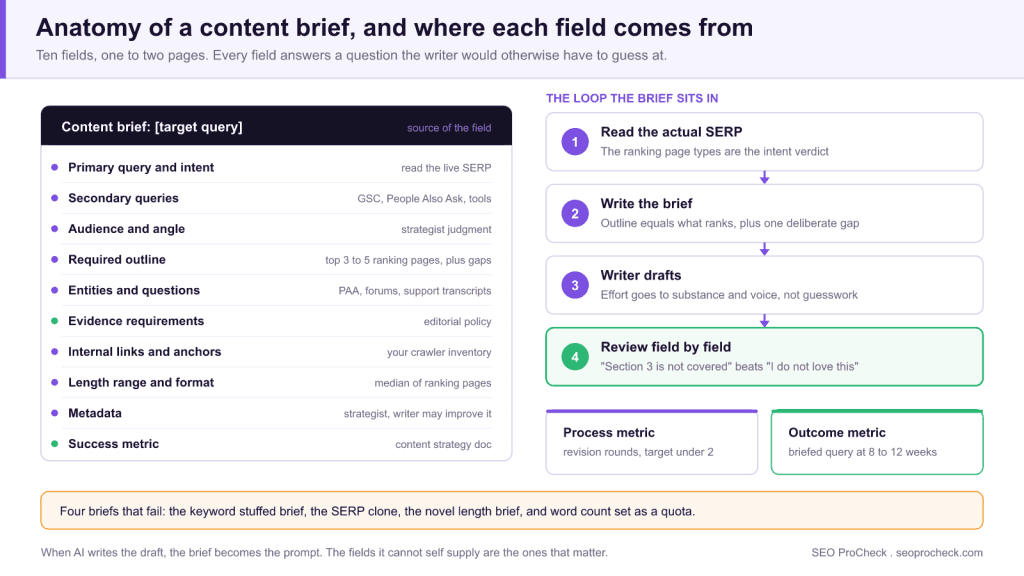
Every field in a brief should answer a question the writer would otherwise guess at. The working template:
| Brief field | What goes in it | Where the data comes from |
|---|---|---|
| Primary query + intent | One target query and its dominant intent (informational / comparison / transactional), stated in a sentence | Read the live SERP for the query: the ranking page types are the intent verdict |
| Secondary queries | 3 to 8 variants and subtopic queries the page should also capture | GSC query data for existing pages; keyword tool variants; People Also Ask |
| Audience + angle | Who is reading and what they already know; the one-line take that differentiates the piece | Strategist judgment: this is the field templates can't fill for you |
| Required outline | H2/H3 skeleton with a sentence per section on what it must establish | Synthesized from the top 3 to 5 ranking pages plus gaps they all share |
| Entities and questions to cover | Named tools, concepts, standards, and the specific questions users ask | PAA boxes, Reddit/forum threads, sales and support transcripts |
| Evidence requirements | Which claims need sources; original data or examples to include | Editorial policy: this field is what keeps AI-assisted drafts honest |
| Internal links | 3 to 5 existing URLs to link, with suggested anchors, plus which hub pages should link back (this is where a topic cluster either gets wired up or quietly does not) | Site search site:domain.com topic or your crawler's inventory |
| Length range + format notes | A range (e.g. 1,200 to 1,800 words), plus required tables, examples, or FAQ | Median of ranking pages, adjusted for your angle: a range, never a quota |
| Metadata | Working title (≤60 chars), meta description draft, target URL slug | Strategist; writer may improve the title within constraints |
| Success metric | What this page is for: rankings for X, assisted conversions, link acquisition | Content strategy doc: forces every brief to justify its slot in the calendar |
Implementation Best Practices
Successful implementation begins with thorough auditing of current state and clear goal definition. Document baseline metrics before making changes to enable accurate impact measurement. Prioritize changes based on potential impact and implementation effort, focusing on high-impact items first. Test changes in staging environments when possible, and monitor closely after deployment to production. Maintain documentation of changes for future reference and troubleshooting.
For briefs specifically, the workflow that holds up at scale: (1) the strategist reads the actual SERP before writing a single field: never brief from a keyword list alone, because "content briefs" the template product and "content briefs" the strategy concept produce different SERPs; (2) the outline is derived from what ranks plus one deliberate gap the competition missed: a brief that's purely a SERP average produces a page with no reason to outrank anything; (3) the brief is reviewed against the draft at submission, field by field, before any line editing; (4) every brief lives in the same system as the calendar (Notion, Airtable, a Doc template; the tool matters less than the consistency), so performance can later be traced back to brief quality.
A worked example for the query "content audit template": the SERP shows two listicles of downloadable templates, two how-to guides with embedded templates, and a tool vendor's landing page: mixed intent leaning toward "give me the file." A sound brief therefore specifies: title promising a template, an H2 delivering the download within the first screenful, a how-to-use section (that's the secondary intent), secondary queries like "content audit spreadsheet" and "content audit checklist," an FAQ answering "what should a content audit include," and internal links to the site's content auditing guide. Length range 1,200 to 1,600: the ranking pages are practical, not encyclopedic.
Reviewing a draft against the brief
The brief only pays off if the review is mechanical. Run the draft against these checks before any line editing, because every one of them is cheaper to fix at the structure stage:
| Brief field | What a failing draft looks like | The correction to request |
|---|---|---|
| Primary query and intent | The opening paragraph explains background instead of answering | Rewrite the first two sentences as a direct answer to the query |
| Required outline | Sections present but reordered, or one H2 quietly dropped | Restore the order. It came from what currently ranks, not from taste |
| Entities and questions | Named tools, standards or competitors are missing entirely | Add the missing entities in the sections where a reader expects them |
| Evidence requirements | Confident numbers with no source, or invented studies | Cite it or cut it. Unsourced statistics are the single fastest trust loss |
| Internal links | Zero links, or all of them stacked in a closing paragraph | Place each link in the sentence where the linked idea is discussed |
| Length range and format | Range met by padding, or the required table is missing | Cut the padding, add the artifact. The range was a scope signal, not a target |
| Audience and angle | Reads like the other ten results, with no distinct claim | Ask for the one sentence only this author could write, then build around it |
Common Mistakes to Avoid
Several patterns consistently cause problems in content strategy implementations. Rushing implementation without proper planning leads to errors that can be costly to fix. Ignoring the interplay between different SEO factors creates conflicts that undermine results. Failing to monitor and iterate based on performance data means missing optimization opportunities. Over-optimization signals can trigger algorithmic penalties that take months to recover from.
The brief-specific failure modes are predictable. The keyword-stuffed brief (twenty "must-use phrases") produces robotic copy and, at scale, exactly the pattern quality systems suppress. The SERP-clone brief produces the eleventh version of the same article. The novel-length brief doesn't get read; past roughly two pages, compliance drops sharply. The word-count-as-quota brief gets padding, because writers hit numbers they're paid to hit. And the brief with no differentiation field outsources the hardest question ("why does this page deserve to exist?") to whoever has the least context.
Measuring Success
Effective measurement requires defining appropriate KPIs aligned with business objectives. Track both leading indicators (rankings, impressions, technical metrics) and lagging indicators (traffic, conversions, revenue) to build a complete picture. Establish reasonable timeframes for evaluation, as SEO changes often take weeks or months to fully manifest in results. Compare performance against historical baselines and competitor benchmarks to contextualize results.
Measure briefs on two axes. Process: revision rounds per article and editing time per draft: a working brief system cuts both within two or three cycles. Outcome: for each published URL, check GSC (Performance > Search results, filter to the exact page, Queries tab) 8 to 12 weeks post-publish and ask two questions: is it getting impressions for the primary query in the brief, and which brief-listed secondary queries is it missing? Pages ranking for none of their briefed queries mean the brief misread the SERP; pages ranking for briefed queries at position 8 to 15 are optimization candidates, not brief failures.
Strategic Recommendations
Approach content strategy as an ongoing program rather than a one-time project. Build processes for regular auditing, monitoring, and optimization. Stay current with industry developments and algorithm changes that may affect your strategy. Invest in education for team members to build internal capabilities. Consider how content strategy fits within your broader digital marketing and business strategy for maximum impact.
Two current realities should shape your template. First, AI-assisted drafting makes the evidence-requirements and differentiation fields the most important lines in the brief: structure is now cheap, and firsthand specifics are the scarce input. Second, answer engines quote pages that state answers plainly, so brief a two-to-three-sentence direct answer at the top of every informational piece. It costs the writer five minutes and it's what both featured snippets and LLMs lift.
Frequently Asked Questions
What should a content brief include?
Ten fields cover it: primary query and intent, secondary queries, audience and angle, a required H2/H3 outline, entities and questions to cover, evidence requirements, internal links with anchors, a length range, working metadata, and the success metric. If you cut anything, cut length last: writers guess worst at scope.
How long should a content brief be?
One to two pages. Under one page, the writer is guessing at structure; past two, compliance collapses and the brief stops being read. The brief should take the strategist 45 to 90 minutes with SERP research included: meaningfully less than that usually means the SERP wasn't actually read.
Who should write content briefs: the SEO or the writer?
The person with SERP and strategy context drafts it; the writer gets veto power on feasibility and angle. Writer-authored briefs drift toward what's interesting to write; SEO-authored briefs with no writer input drift toward unwritable outlines. The 15-minute alignment call on contested briefs pays for itself in saved revision rounds.
Should content briefs specify word count?
Specify a range derived from what currently ranks, and label it a scope signal, not a target. Word count is not a ranking factor; the range exists to communicate depth expectations. When a writer covers the full outline under the range, the correct response is publishing it, not padding it.
Do content briefs still matter when AI writes the draft?
More than before. An AI draft inherits every ambiguity in its instructions, so the brief effectively becomes the prompt, and the fields AI can't self-supply (differentiated angle, firsthand examples, claims that need sourcing, internal-link map) are precisely what separates publishable output from generic filler. Teams that feed thin briefs to AI produce scaled thin content, which is the fastest current route to sitewide suppression.
How do I know if my briefs are working?
Track revision rounds per article (should fall below two), then audit outcomes quarterly: for each URL, does it earn impressions for its briefed primary query within 8 to 12 weeks? Sort the misses by pattern: consistent misses on one intent type (e.g. comparison pages) point to a briefing blind spot; scattered misses point to execution or domain-authority limits rather than the briefs.
Take this with you
The assistant links open with a question about this page already written. Nothing is sent until you press enter.
Claude Vincent is a technical SEO consultant focused on crawlability, rendering, and AI-search visibility. He writes the field guides and case studies at SEO ProCheck, with a bias toward the durable, unglamorous work that decides whether search engines and AI answer engines can actually read and cite a site.
About SEO ProCheck
Technical SEO consulting and GEO strategy with 20 years of enterprise experience. Case studies, resources, and tools for search and AI visibility.
Work With Me
Technical SEO audits, GEO strategy, site migrations, and international SEO. Hourly consulting for teams who need hands-on support, not just reports.
Subscribe to our newsletter!








Recent Posts
- Most Top Sites Never Say Who They Are in Structured Data October 14, 2026
- Homepage Titles Are Mostly Too Short, Not Too Long October 8, 2026
- Who Actually Serves an llms.txt? 184 Top Sites Measured September 29, 2026