

Content Auditing Guide: Evaluating and Improving Your Content
- August 30, 2024
- Content Architecture, Content SEO
AI Summary
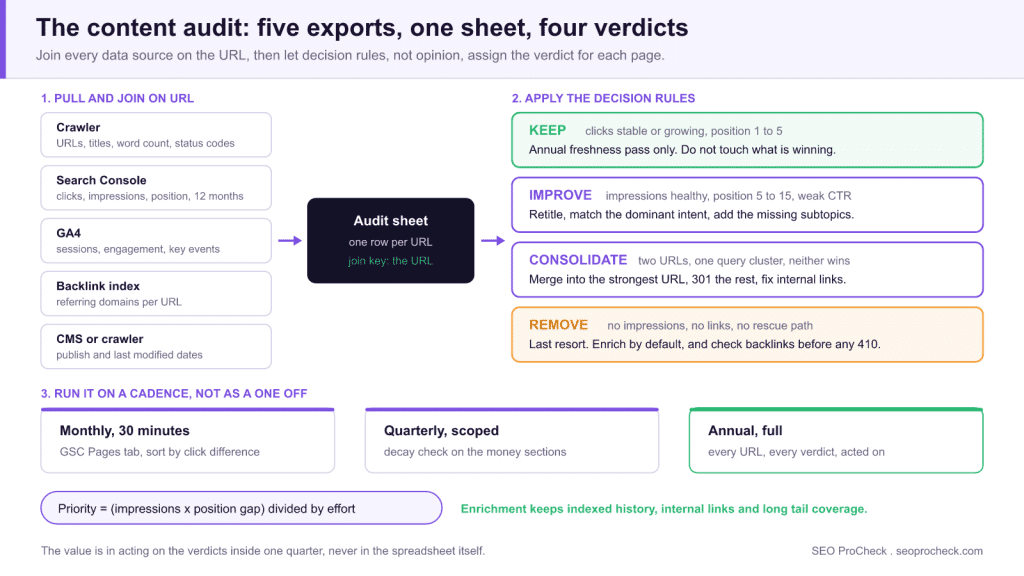
A content audit is a URL by URL inventory of your site, scored against traffic, ranking, backlink and quality data, that ends in one of four verdicts per page: keep, improve, consolidate, or remove. The mechanics are simple, and all of the value sits in acting on the verdicts within the following quarter rather than in the spreadsheet itself.
- Join crawl data, Search Console, GA4 and a backlink index in one sheet, keyed on the URL. That join is the whole technical difficulty.
- Prioritise the improve list by impressions multiplied by position gap, divided by effort. A page at position 8 with 20,000 impressions beats one at position 40 every time.
- Removal is the last resort, not the default. Enriching a thin page keeps its indexed history, internal links and long tail queries.
- Run it on a cadence: 30 minutes monthly on decliners, a scoped quarterly check, and one full annual pass.
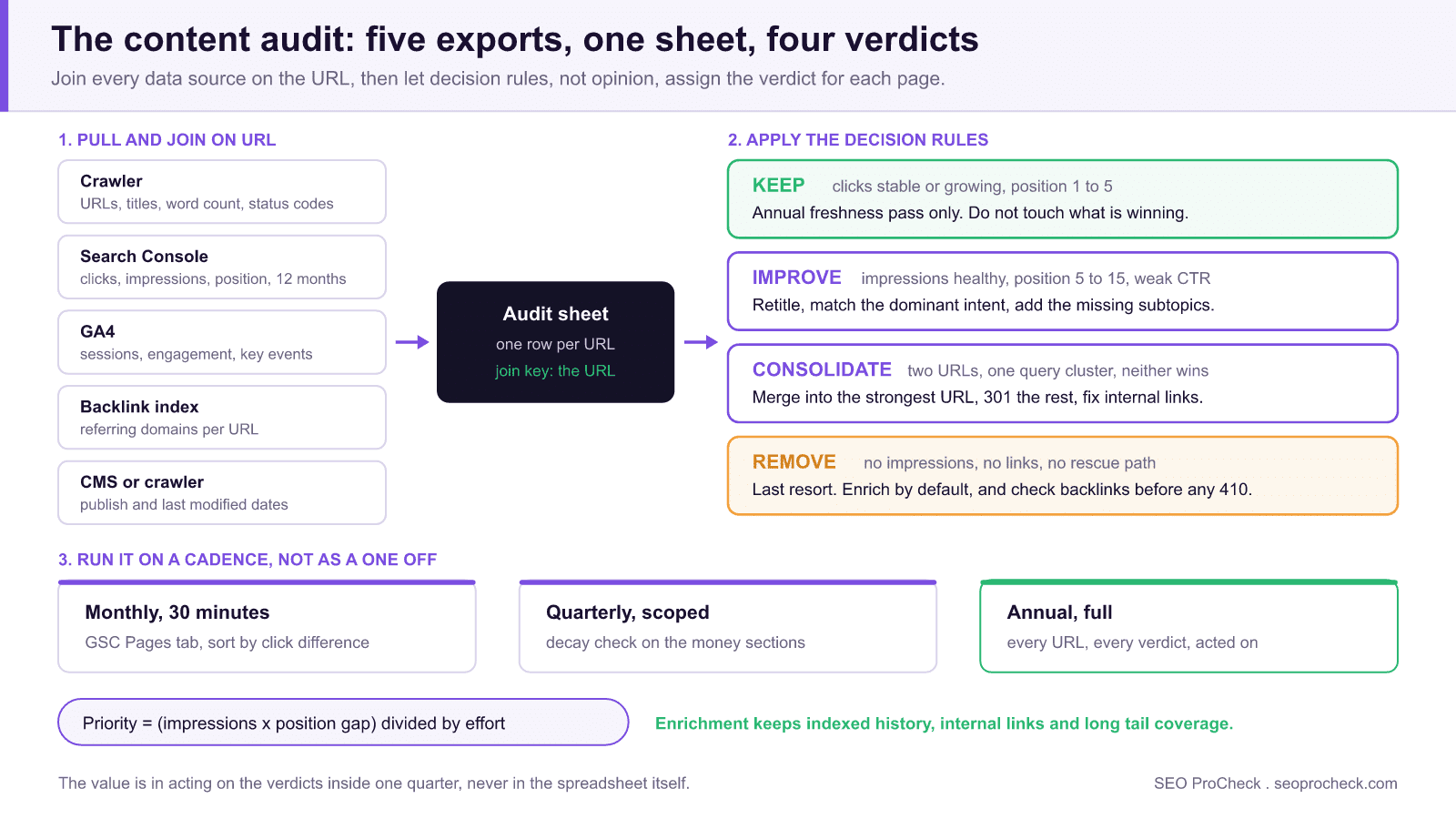
Quick answer: A content audit is a URL-by-URL inventory of your site scored against traffic, ranking, backlink, and quality data, ending in one of four verdicts per page: keep, improve, consolidate, or remove. The mechanics are simple: crawl the site, join the crawl to GSC and GA4 data in a spreadsheet, apply decision rules. The value is entirely in acting on the verdicts within the following quarter, not in the spreadsheet itself.
Content auditing systematically evaluates existing content to identify improvement opportunities, consolidation candidates, and removal targets. Regular audits prevent content decay, improve site quality signals, and focus resources on high-potential content.
Planning Your Content Audit
Define audit goals before beginning. Are you identifying underperforming content for improvement? Finding duplicate or thin content to consolidate? Evaluating content freshness? Different goals require different metrics and evaluation criteria. Scope appropriately; large sites may require phased audits focusing on specific sections.
Gather necessary data including organic traffic, rankings, backlinks, engagement metrics, content age, and word count. Export data from Google Analytics, Search Console, and SEO tools into a spreadsheet for analysis. Include qualitative factors you'll assess manually like content quality and relevance.
Here is the exact assembly, tool by tool. Build one sheet with URL as the key column and VLOOKUP/XLOOKUP everything else onto it:
| Data point | Source | Exact pull |
|---|---|---|
| Full URL inventory, titles, word count, status codes | Screaming Frog (or any crawler) | Crawl the domain, export Internal > HTML; enable the GSC and GA4 API integrations to merge steps |
| Clicks, impressions, avg. position (12 mo + prior 12 mo) | Google Search Console | Performance > Search results, date = last 12 months, Pages tab, Export. Repeat with the Compare tab for year-over-year deltas; the API or a connector lifts the 1,000-row export cap |
| Sessions, engagement rate, key events per landing page | GA4 | Reports > Engagement > Landing page, add filter Session default channel group = Organic Search, set 12-month range, Export |
| Referring domains per URL | Ahrefs / Semrush / Moz | Ahrefs Site Explorer > Best by links or Semrush Backlink Analytics > Indexed Pages, export |
| Publish / last-modified date | CMS or crawler | WordPress: export post dates via WP-CLI or a plugin; or extract article:modified_time during the crawl |
| Index status | GSC | Indexing > Pages report; spot-check anomalies with URL Inspection |
The columns the sheet actually needs
Most audits stall because the sheet carries forty columns and no verdict. These are the columns that change a decision. Anything else is decoration:
| Column | Type | Why it changes a verdict |
|---|---|---|
url | Key | The join key for every other export. Normalise trailing slashes and protocol first, or the lookups silently fail |
clicks_12mo and clicks_prior_12mo | Number | The year-over-year delta is what separates decay from a page that never worked |
impressions_12mo | Number | High impressions with low clicks is the quick win signal: the page ranks but does not earn the click |
avg_position | Number | Position 5 to 15 is the improve band. Position 40 plus usually means the intent was wrong, not the execution |
referring_domains | Number | Any value above zero moves a remove verdict to consolidate or rebuild |
last_modified | Date | Separates genuinely stale pages from recently refreshed ones that simply have not recovered yet |
index_status | Enum | A page excluded from the index is a technical problem, not a content problem. Fix it before scoring quality |
primary_query | Text | Two rows sharing a primary query is the cannibalisation flag that triggers a consolidate verdict |
verdict and owner | Enum, text | An audit with no owner column becomes a document nobody actions, which is the usual failure mode |
Categorizing Audit Results
Sort content into action categories based on performance and potential. High-performing content may need only minor updates to maintain position. Underperforming content with potential should be prioritized for improvement. Thin or duplicate content should be consolidated or removed. Outdated content needs refresh or removal decisions.
Consider traffic trends, not just current performance. Content showing declining traffic signals potential decay requiring attention. Content with stable traffic but low overall performance may need significant updates. Rising content should be monitored but may not need immediate action.
Turn the judgment call into repeatable rules. A decision matrix that works on most content sites:
| Signal pattern (last 12 mo) | Verdict | Typical action |
|---|---|---|
| Clicks stable or growing, position 1 to 5 | Keep | Annual freshness pass only; don't touch what's winning |
| Impressions healthy, position 5 to 15, CTR below average | Improve (quick win) | Retitle, sharpen the intro to match dominant intent, add the missing subtopics GSC queries reveal |
| Clicks down >30% year-over-year, rankings slipping | Improve (decay) | Full refresh: update facts, restructure to current SERP intent, re-promote internally |
| Two or more URLs ranking for the same query cluster, none well | Consolidate | Merge into the strongest URL, 301 the others, update internal links |
| Near-zero impressions, no backlinks, off-topic or unsalvageable | Remove, but see below | Default to enriching into something useful; remove only genuine dead weight |
Prioritize the improve list by (impressions × position gap) divided by effort: a page at position 8 with 20,000 monthly impressions outranks-in-priority a page at position 40 with 200, every time.
The mechanics of each verdict, including how to pick the survivor URL in a merge, are covered step by step in the content audit process walkthrough, and the ongoing version of this work is documented in the refresh, prune and merge system.
Content Improvement Strategies
Refresh outdated information including statistics, examples, and references. Add sections to improve comprehensiveness where competitors offer more thorough coverage. Enhance with visual content, examples, or expert quotes. Update publication dates only when changes are substantial.
Consolidation combines multiple weak pages into single strong pages. Identify pages competing for similar keywords or covering overlapping topics. Combine the best elements into one comprehensive page. Redirect consolidated URLs to preserve any existing authority.
A worked example: suppose the audit sheet shows three posts: "email subject line tips," "email subject line examples," and "how to write email subject lines," each pulling 5 to 20 clicks a month, each stuck between positions 12 and 30 for overlapping queries. GSC's Pages report confirms all three receive impressions for "email subject lines," which is the textbook signature of cannibalisation. The play: pick the URL with the most referring domains as the survivor, merge the unique examples and advice from the other two into it, 301 the losers, update every internal link to point at the survivor, and resubmit it via URL Inspection. Expect the consolidated page to settle over 4 to 8 weeks, typically above where any of the three sat alone: cannibalization was suppressing all of them.
Content Removal Decisions
Remove content that cannot be improved to competitive quality, targets keywords no longer relevant to business goals, creates duplicate content issues, or reflects outdated approaches that could harm credibility. Use 410 status for removed content; redirect only if genuinely relevant replacement exists.
Treat removal as the last resort, not the default: a lesson many sites learned the hard way during "content pruning" fads. Deleting pages does not itself improve the rest of the site; enriching a thin page into a genuinely useful one preserves its indexed history, internal links, and any long-tail queries it already earns. Reserve removal for pages with no strategic relevance, no links, no impressions, and no realistic enrichment path (expired event announcements, discontinued-product stubs, auto-generated boilerplate). Before any 410, check the URL's backlinks: a linked page should almost always be redirected or rebuilt rather than dropped.
Ongoing Audit Processes
Establish regular audit cadences rather than one-time projects. Quarterly reviews of key content areas catch decay early. Annual comprehensive audits evaluate entire content libraries. Monitor key metrics between audits to identify urgent issues requiring immediate attention.
Between full audits, a 30-minute monthly check catches most decay: open GSC Performance > Search results, compare the last 3 months to the previous 3 months on the Pages tab, sort by click difference ascending, and investigate the top ten decliners. Log every content change with its date in an annotations sheet: when a page moves, you want to know whether you touched it, Google shipped an update, or the SERP itself changed.
Frequently Asked Questions
How often should you do a content audit?
Full audit annually; a scoped decay check quarterly on your money sections; a 30-minute GSC decliner review monthly. Sites publishing daily, or sites recovering from a core-update hit, should run the scoped version quarterly at minimum: decay compounds, and a page that slipped from position 4 to 9 is far easier to rescue than one that fell off page two.
What tools do I need for a content audit?
Minimum viable stack: a crawler (Screaming Frog's free tier handles 500 URLs), Google Search Console, GA4, and a spreadsheet. A backlink index (Ahrefs, Semrush, or Moz) is strongly recommended because link data changes consolidation and removal verdicts. All-in-one audit tools exist, but the spreadsheet approach forces you to actually look at the pages, which is where the real judgments happen.
How do I audit a site with tens of thousands of URLs?
Don't audit URL-by-URL: audit by template and directory first. Aggregate GSC data by path prefix (regex page filters like ^https://site.com/blog/ work in the Performance report), find which sections carry weight, then sample within weak sections instead of scoring every page. Most large-site audits end with decisions about templates and sections, not individual posts.
Should I delete old blog posts that get no traffic?
Not as a first move. Zero-traffic posts with salvageable topics should be improved or consolidated; deletion is for content with no topic relevance, no links, and no rescue path. Mass-deleting "underperforming" content rarely produces the sitewide lift people expect, and it destroys long-tail coverage and internal-link context you can't easily rebuild.
How long until audit changes show results?
Refreshed pages typically show movement in 2 to 6 weeks once recrawled: request indexing via URL Inspection to shorten the lag. Consolidations take 4 to 8 weeks as redirect signals pass. Sitewide quality effects, the kind that matter after a core update, are only assessable across months and usually across the next update cycle. Annotate change dates so you can attribute movement honestly.
What's the difference between a content audit and a technical SEO audit?
A content audit evaluates what pages say and earn: quality, relevance, performance, overlap. A technical audit evaluates whether pages can be crawled, rendered, and indexed at all. They intersect (index-status data feeds both), and a content audit on a site with unresolved technical blockers will mislead you: fix crawlability first, or at least check the GSC Indexing > Pages report before trusting your traffic columns.
Take this with you
The assistant links open with a question about this page already written. Nothing is sent until you press enter.
Claude Vincent is a technical SEO consultant focused on crawlability, rendering, and AI-search visibility. He writes the field guides and case studies at SEO ProCheck, with a bias toward the durable, unglamorous work that decides whether search engines and AI answer engines can actually read and cite a site.
About SEO ProCheck
Technical SEO consulting and GEO strategy with 20 years of enterprise experience. Case studies, resources, and tools for search and AI visibility.
Work With Me
Technical SEO audits, GEO strategy, site migrations, and international SEO. Hourly consulting for teams who need hands-on support, not just reports.
Subscribe to our newsletter!








Recent Posts
- Most Top Sites Never Say Who They Are in Structured Data October 14, 2026
- Homepage Titles Are Mostly Too Short, Not Too Long October 8, 2026
- Who Actually Serves an llms.txt? 184 Top Sites Measured September 29, 2026