

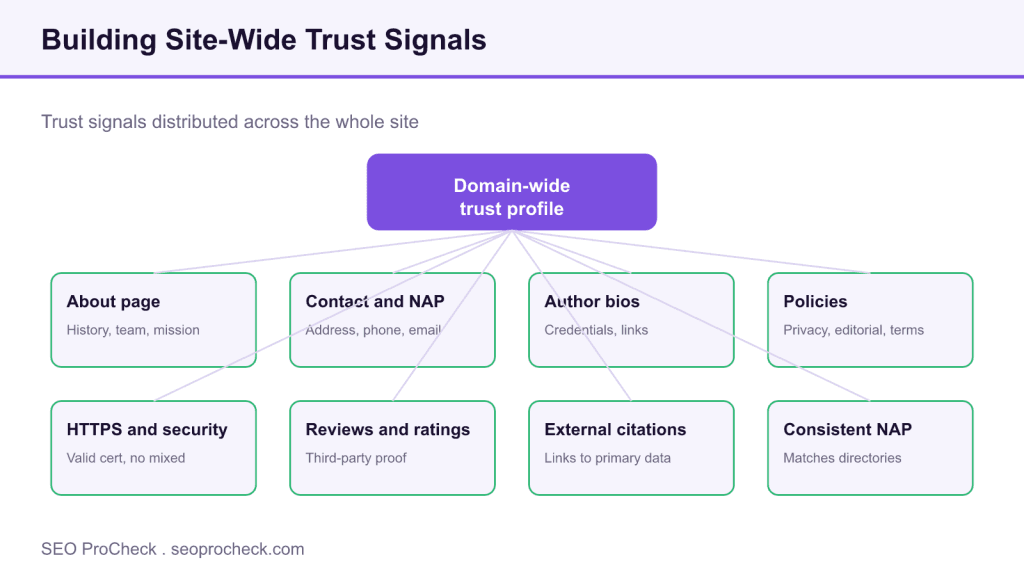
AI Summary
Site-wide trust signals are the domain level elements, About page, contact details, author bios, policies, HTTPS, reviews, and consistent business data, that prove a real and accountable organization runs the site. Build them once at the template and footer level so every page inherits the same credibility, then reinforce them with Organization schema and consistent NAP.
- Trust is judged at the domain level, so single strong pages cannot compensate for a hollow About or contact section
- Consistent name, address, and phone across the site and directories reinforces a legitimate business identity
- Organization schema with logo, contactPoint, and sameAs ties your pages to a recognized entity
- Privacy, terms, and editorial policy pages are baseline trust markers quality raters check for
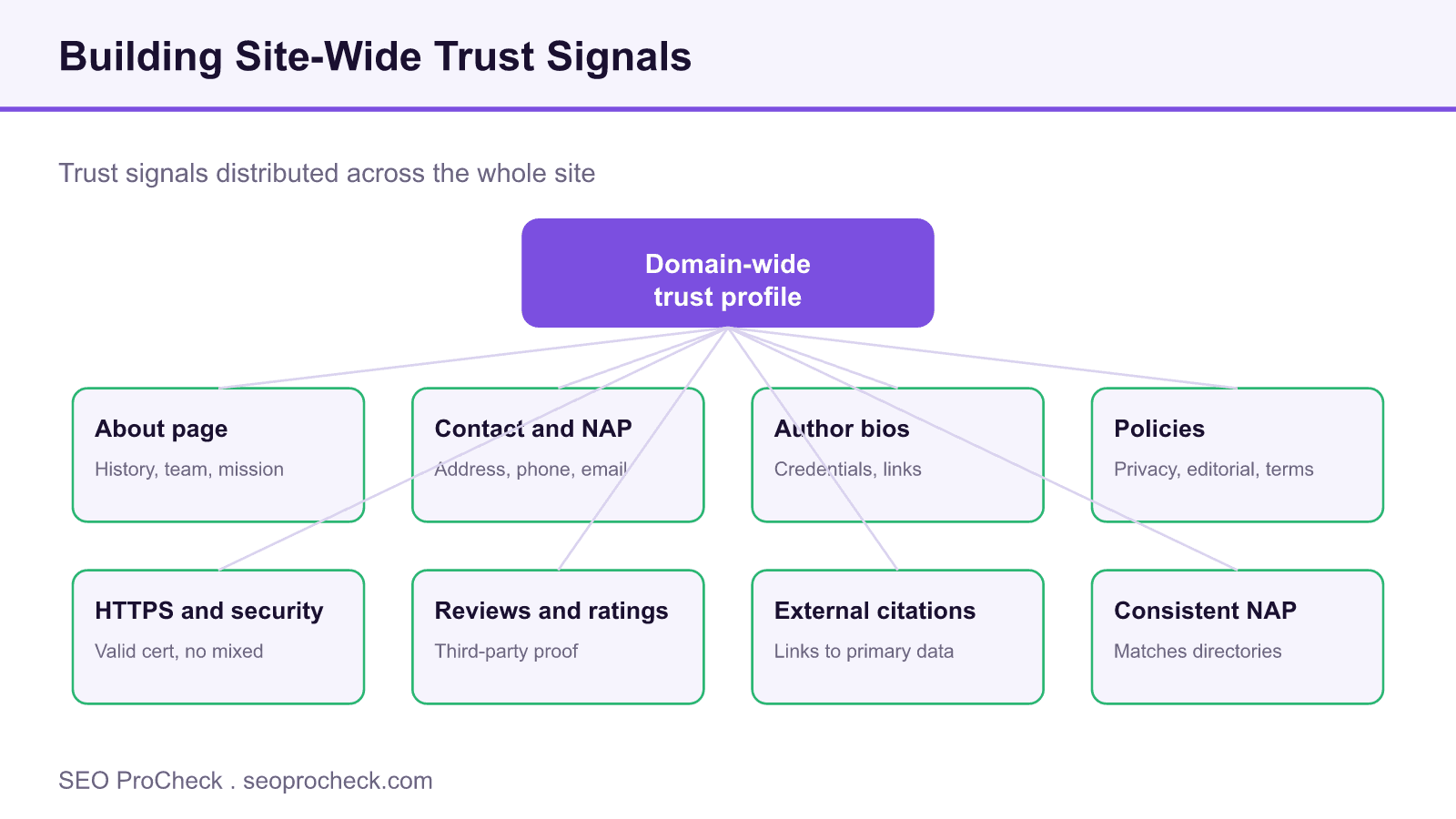
Individual pages earn rankings, but trust is assessed across the whole domain. A brilliant article on a site with no About page, no visible ownership, and no contact route starts from a deficit, because Google's raters and cautious users both ask the same question first: who is behind this, and can they be held accountable? Site-wide trust signals answer that question consistently on every URL. Because they live in shared templates and the footer, you build them once and every page benefits.
The core trust surfaces
Six surfaces do most of the work. Treat them as a checklist for any site you own or audit:
- About page. Name the organization, its history, its people, and its mission. This is where raters go to judge responsibility, so vague filler undermines you. Include real names, roles, and photos where possible.
- Contact and NAP. Provide a genuine way to reach a human: address, phone, and email or a monitored form. Keep the name, address, and phone identical everywhere they appear.
- Author bios. Attribute content to real people with credentials and links, not a faceless admin account.
- Policy pages. Privacy policy, terms of service, and an editorial policy at minimum; add refund and shipping policies for commerce.
- HTTPS and security. Serve every page over a valid certificate with no mixed content warnings.
- Third-party proof. Reviews and ratings on independent platforms that you do not control.
Anchor the entity with Organization schema
State your identity in a form machines can read. Place Organization schema on the home page and reference it site wide:
{"@type":"Organization","name":"Acme Insights","url":"https://acme.example","logo":"https://acme.example/logo.png","contactPoint":{"@type":"ContactPoint","telephone":"+1-555-0100","contactType":"customer support"},"sameAs":["https://www.linkedin.com/company/acme","https://www.crunchbase.com/organization/acme"]}
The sameAs array is the connective tissue: it links your site to independent, verifiable profiles and supports knowledge panel eligibility, which in turn reinforces perceived legitimacy.
Keep business information consistent
Inconsistent details quietly erode trust. If your footer says one phone number, your contact page another, and your Google Business Profile a third, you look careless at best. Audit your name, address, and phone across the site, your profile, and major directories, and standardize on one exact format. For businesses that collect local feedback, thin or absent reviews are a gap worth closing; see our guide on the problem of having no local reviews.
Make trust pages easy to find
Link About, Contact, and policy pages from the global footer so they are one click from anywhere. This is both a usability expectation and a signal: raters specifically note whether standard trust pages are present and reachable. Do not bury them.
Site-wide trust surfaces and how to implement them
| Trust surface | What to include | Where it lives |
|---|---|---|
| About page | People, history, mission, sameAs links | Dedicated page, linked in footer and nav |
| Contact and NAP | Address, phone, email or form | Contact page, footer, schema |
| Author bios | Credentials, photo, external links | Bio pages, article bylines |
| Policy pages | Privacy, terms, editorial policy | Footer links |
| HTTPS | Valid cert, no mixed content | Server configuration, every URL |
| Third-party reviews | Independent ratings, review markup | Testimonials page, external profiles |
Site-wide trust is the foundation that individual page tactics build on. For the bigger picture, read our complete guide to E-E-A-T and browse the E-E-A-T optimization hub. To encode author identity properly, use our Person schema reference.
Frequently asked questions
What are site-wide trust signals?
They are the elements that establish credibility across an entire domain rather than a single article: a real About page, contact details, author bios, policy pages, HTTPS, third-party reviews, and consistent business information. Together they tell users and search engines that a real, accountable organization stands behind the content.
Does an About page really affect SEO?
Indirectly but meaningfully. A detailed About page that names the team, history, and mission is one of the primary places Google's raters look to judge who is responsible for a site. It also anchors your Organization entity and is a natural home for sameAs links to verified profiles.
What is NAP consistency and why does it matter?
NAP stands for name, address, and phone number. Keeping these identical across your site, Google Business Profile, and directories reinforces that you are a legitimate, locatable business. Inconsistent NAP data dilutes trust and, for local search, can suppress rankings.
How does Organization schema build trust?
Organization schema states your brand's identity in a machine readable form, including logo, contact points, and sameAs links to authoritative profiles. It helps Google connect your site to a known entity and supports knowledge panel eligibility, which reinforces perceived legitimacy.
Which policy pages should every site have?
At minimum a privacy policy, terms of service, and, for publishers, an editorial policy. Sites that handle transactions should add refund and shipping policies. These pages are standard trust markers that raters explicitly check for.
Do third-party reviews help site-wide trust?
Yes. Reviews on independent platforms such as Google, Trustpilot, or G2 provide external validation you do not control, which carries more weight than self-praise. Linking to them and, where appropriate, using valid review markup surfaces that proof to search users.
Take this with you
The assistant links open with a question about this page already written. Nothing is sent until you press enter.
Claude Vincent is a technical SEO consultant focused on crawlability, rendering, and AI-search visibility. He writes the field guides and case studies at SEO ProCheck, with a bias toward the durable, unglamorous work that decides whether search engines and AI answer engines can actually read and cite a site.
About SEO ProCheck
Technical SEO consulting and GEO strategy with 20 years of enterprise experience. Case studies, resources, and tools for search and AI visibility.
Work With Me
Technical SEO audits, GEO strategy, site migrations, and international SEO. Hourly consulting for teams who need hands-on support, not just reports.
Subscribe to our newsletter!








Recent Posts
- Most Top Sites Never Say Who They Are in Structured Data October 14, 2026
- Homepage Titles Are Mostly Too Short, Not Too Long October 8, 2026
- Who Actually Serves an llms.txt? 184 Top Sites Measured September 29, 2026