

AI Summary
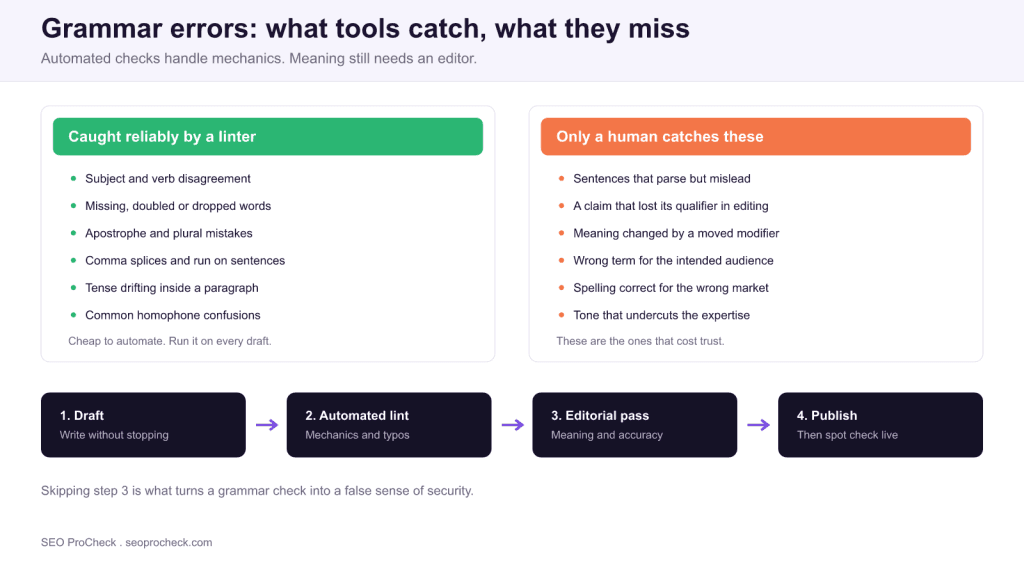
Grammar errors are not a direct ranking factor, but they degrade the readability and trust signals that quality systems and AI extraction both depend on. The fix is a two layer process: an automated linter for mechanics, then a human editorial pass for the errors that parse correctly but still mislead.
- Linters catch structure. Only an editor catches meaning.
- Errors cluster in four places: user generated text, bulk imports, machine translation and unreviewed AI drafts.
- Garbled sentences usually cost you absence from an AI answer, not a visible misquote.
- Set the locale explicitly, because mixed British and American spelling reads as carelessness.

- Element Code: CQ
- Issue: Grammatical errors in published content
- Impact: Quality / trust / clarity
- Fix: Automated lint, then an editorial pass
- Detection: Crawler, manual review
What this issue means
Grammatical errors such as broken sentences, agreement mistakes and run-ons in your published content. Beyond looking unprofessional, they make content harder for people and machines to parse.
The check is deliberately broad, so it helps to know which specific faults it covers and which are stylistic preferences rather than errors. The table below separates the two, because arguing about serial commas while genuine agreement errors ship is a common way to waste an editorial process.
| Fault | Example | Why it costs you | Caught by |
|---|---|---|---|
| Subject and verb disagreement | "The list of results are updated daily" | Signals an unedited draft | Any linter |
| Comma splice | "The tool is free, it needs an account" | Two claims merge into one ambiguous unit | Most linters |
| Run-on sentence | Three clauses with no punctuation | Extraction cannot isolate the claim | Readability tools |
| Dangling modifier | "After updating the sitemap, crawl errors dropped" | Attributes the action to the wrong subject | Human review |
| Homophone error | "effect" for "affect", "its" for "it's" | Reads as carelessness to an informed audience | Better linters, context dependent |
| Tense drift | Present tense sliding into past mid paragraph | Makes the timeline of a claim unclear | Human review |
| Locale mismatch | "optimise" and "optimize" on one page | Suggests stitched together sources | Linter with locale set |
| Serial comma preference | "a, b and c" versus "a, b, and c" | Not an error. A style guide decision | Style guide, not a check |
Why it matters
Clean grammar supports readability and trust, both of which feed modern quality systems and AI summarization. Garbled sentences also make it harder for an LLM to confidently extract and cite your content. Good grammar is not a ranking factor on its own, but it is a quality signal that compounds.
Worth being precise about the mechanism, because "grammar is not a ranking factor" gets used to justify shipping sloppy work. The cost is real but indirect, and it lands in three places.
Human trust, which is measurable. On pages where a reader is being asked to believe something or buy something, visible errors compete directly with the credibility the page is trying to establish. This is most acute on exactly the pages where accuracy matters most: medical, financial and legal content, where the reader has no way to verify the substance and uses surface quality as a proxy.
Extraction confidence. An answer engine deciding whether to repeat your sentence needs to parse it unambiguously. When a sentence is garbled, the realistic outcome is not a mangled citation, it is that a competitor's cleaner sentence gets used instead. The failure is invisible, which is what makes it easy to ignore.
Aggregate quality perception. Isolated typos are noise. A site where errors appear consistently across templates reads as unmaintained, and that impression is formed at the site level rather than page by page. This is the sense in which the original point about compounding is correct: no single error matters, the pattern does. The related trust signals are covered in the E-E-A-T FAQ and in the complete E-E-A-T guide.
How to fix it
- Edit before publishing: a dedicated editing pass, not just writing.
- Use a grammar tool as a safety net.
- Read it aloud: for the errors tools miss.
- Set an editorial standard so quality is consistent across authors.
Those four steps are the whole method. What follows is how to make each one survive contact with a real publishing schedule, because the reason grammar checks fail is almost never that nobody knew to edit.
Put the automated layer where it cannot be skipped. A check that depends on an author remembering to run it will be skipped under deadline. Browser and editor integrations such as Grammarly or LanguageTool catch problems while writing, which is the right place for author facing checks. For teams publishing from a repository or a headless CMS, a prose linter such as Vale runs in the build alongside code linting and can enforce a house style guide as well as grammar, which means the check runs whether anyone remembers it or not.
Configure the locale explicitly. Most tools default to American English regardless of where the writer or the audience sits. Set it once, at the tool or repository level, so the check is enforcing your standard rather than its default.
Keep the editorial pass focused on meaning. Once mechanics are automated, the human pass should be spent on the faults in the right hand column of the diagram: claims that lost a qualifier during editing, modifiers that migrated and changed the subject, terminology wrong for the audience. These require someone who understands the subject, which is a different skill from proofreading.
Make the standard concrete. "Set an editorial standard" fails when it stays a value rather than a document. A one page style sheet naming the locale, the serial comma decision, heading capitalisation, how numbers and dates are written, and the preferred term for each product concept resolves most recurring disputes and makes the check reviewable by someone other than its author.
Where grammar errors actually cluster
On any site past a few hundred pages, errors are not evenly distributed. They concentrate in content that no editorial process was ever designed to cover, which is why a site can have a rigorous blog workflow and still fail this check badly.
- User generated content. Reviews, comments, community answers and Q and A. Usually the largest body of unedited text a site owns, and the one nobody has a policy for.
- Bulk imported descriptions. Product copy from supplier feeds, syndicated listings, catalogue data. Imported once, reviewed never.
- Machine translated pages. Output that is grammatically plausible and idiomatically wrong, which passes a linter cleanly while reading as obviously non native to the target market.
- Unreviewed AI drafts. Typically clean on mechanics and weak on specificity, so a grammar check gives a false all clear on text that needs a subject matter pass rather than a proofread.
Auditing these is a sampling exercise, not a full read. Pull twenty pages per category and read them properly. If a category is clean, move on; if it is not, the problem is systemic and needs a process change rather than a round of fixes. Site wide readability signals are covered in the AI readability check, and you can spot check individual pages with the readability checker.
What not to do
Two overcorrections are worth naming. The first is chasing a perfect tool score. Grammar checkers flag stylistic preferences alongside genuine errors, and accepting every suggestion produces flattened, oddly formal prose that reads worse than the original. Fix errors, consider suggestions, ignore anything that damages a sentence that was working.
The second is treating dialect and register as faults. Contractions, sentence fragments used deliberately, and starting a sentence with a conjunction are all legitimate choices that some tools flag. A house style sheet is what lets you make those calls once instead of relitigating them per article. The goal is content that is clear and credible, not content that satisfies a linter.
Frequently asked questions
Not directly. Google has consistently framed spelling and grammar as part of overall quality rather than as an independent ranking signal, and pages with minor errors rank perfectly well every day. The effect is indirect: sustained sloppiness undermines the trust signals that quality systems and human readers both respond to.
They can, because extraction depends on parsing a sentence confidently enough to repeat it. A garbled or ambiguous sentence is more likely to be skipped than misquoted, which means the practical cost is absence from an answer rather than a visible error. Clear sentence construction is the cheapest thing you can do to stay quotable.
Pick based on where the check needs to run. Grammarly and LanguageTool are strong for authors working in a browser or editor, while Vale is designed to run in a build pipeline and enforce a house style guide alongside grammar. Teams publishing at volume usually end up with one of each, because author time checks and pipeline checks catch different failures.
No, and treating it as a replacement is the common failure. Linters catch mechanical faults reliably but they validate structure, not meaning, so a sentence that is grammatically perfect and factually wrong passes cleanly. The errors that actually cost credibility are usually the ones that parse correctly.
Both are correct, but only one is correct for a given audience, and mixing them within a page reads as carelessness. Set the locale explicitly in your tooling rather than relying on defaults, which are frequently American regardless of where the writer sits. This matters most on translated or localised pages where a single template can serve several markets.
Start with content nobody edits: user generated text, bulk imported product descriptions, machine translated pages and unreviewed AI drafts. Those four categories account for the overwhelming majority of grammar issues on large sites, and they are also the categories where nobody currently owns quality.
Related: E-E-A-T FAQ
Claude Vincent is a technical SEO consultant focused on crawlability, rendering, and AI-search visibility. He writes the field guides and case studies at SEO ProCheck, with a bias toward the durable, unglamorous work that decides whether search engines and AI answer engines can actually read and cite a site.
About SEO ProCheck
Technical SEO consulting and GEO strategy with 20 years of enterprise experience. Case studies, resources, and tools for search and AI visibility.
Work With Me
Technical SEO audits, GEO strategy, site migrations, and international SEO. Hourly consulting for teams who need hands-on support, not just reports.
Subscribe to our newsletter!







Recent Posts
- Can AI Crawlers Actually Read Your Site? I Measured 400 of the Biggest September 5, 2026
- The Pre-Publish Quality Gate for AI-Assisted Content August 6, 2026
- AGENTS.md vs llms.txt vs llms-full.txt: Which Agent File Does What July 18, 2026