

E-E-A-T FAQ: Experience, Expertise, Authority & Trust for SEO
- December 4, 2020
- Content SEO FAQ
AI Summary
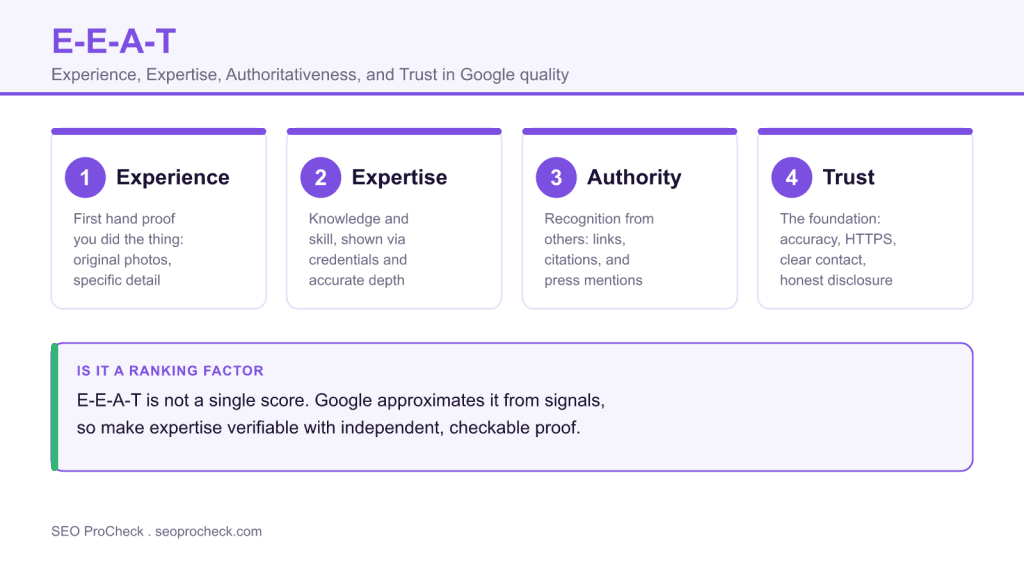
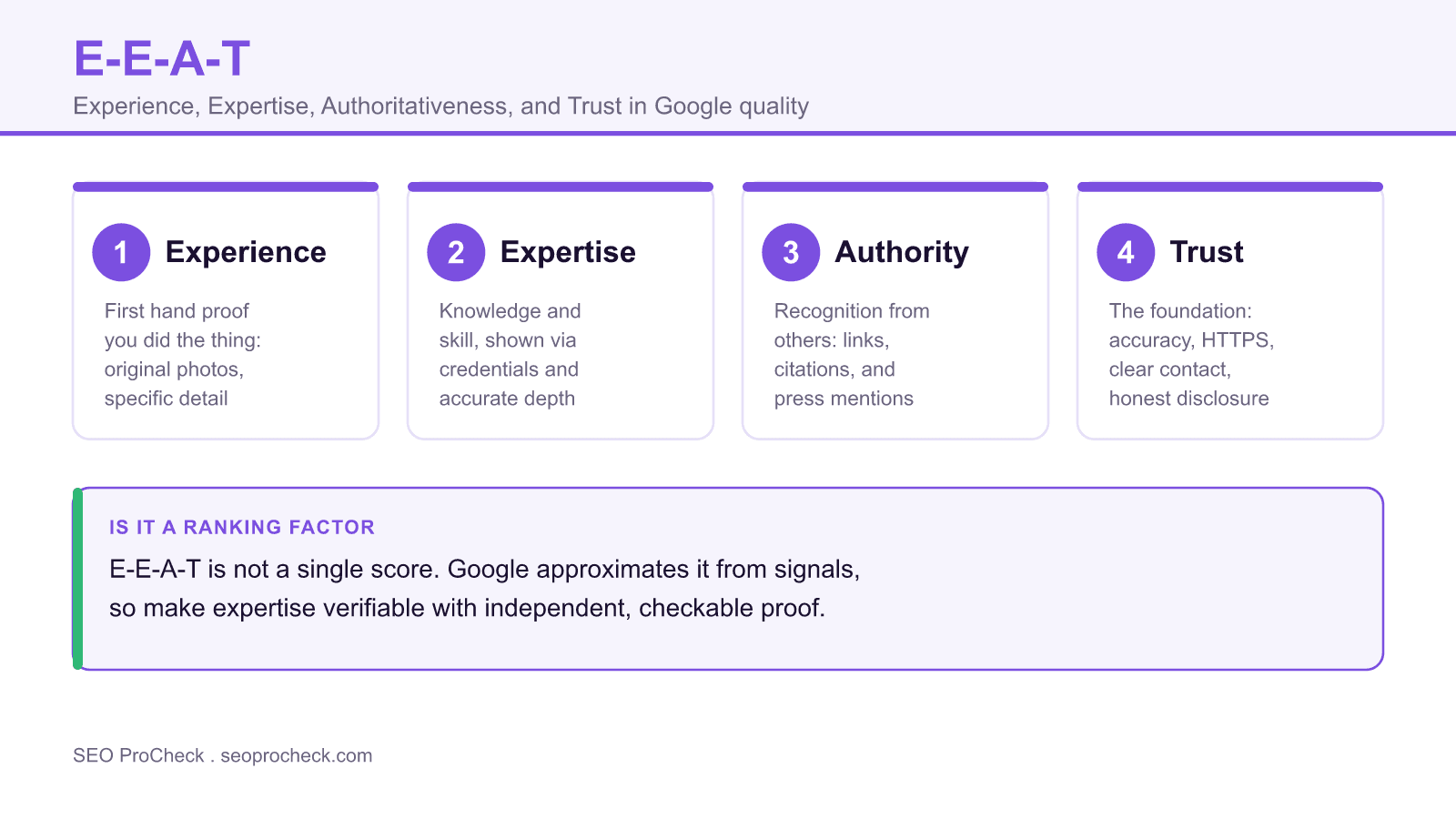
E-E-A-T is Google's quality framework covering Experience, Expertise, Authoritativeness, and Trust. It is not a single ranking signal but a lens for the qualities Google's systems try to reward, and it matters most for YMYL topics.
- Google added the extra Experience in December 2022 to value first hand, real world knowledge.
- Trust is the most important member of the group, and the other three mean little without it.
- You cannot tag E-E-A-T; you demonstrate it with authors, citations, and verifiable evidence.
- YMYL topics that affect health, money, or safety face stricter quality evaluation.
Complete guide to E-E-A-T: Google's quality guidelines for content. Understanding experience, expertise, authoritativeness, and trustworthiness, and how to demonstrate them for better rankings.
Table of Contents
E-E-A-T Basics
What is E-E-A-T?
Google's quality framework: Experience, Expertise, Authoritativeness, Trustworthiness. Used by human quality raters to evaluate search results. Not a direct ranking algorithm, but guides what Google's algorithms aim to reward. Essential concept for content strategy, especially for YMYL topics.
Is E-E-A-T a ranking factor?
Not directly measurable as a single ranking signal. E-E-A-T describes qualities Google's algorithms try to identify through various signals. Think of it as a framework for understanding what Google values, not a checkbox to tick. Multiple ranking factors contribute to E-E-A-T signals.
What changed from E-A-T to E-E-A-T?
Google added "Experience" in December 2022. Recognizes that first-hand experience adds value beyond formal expertise. Someone who actually used a product can provide valuable perspective even without credentials. Experience complements expertise rather than replacing it.
What is YMYL content?
Your Money or Your Life: topics that could significantly impact health, financial stability, safety, or welfare. Includes medical, financial, legal, news, and civic information. YMYL content faces stricter quality evaluation. Poor YMYL content can harm people, so Google scrutinizes it more.
What topics are considered YMYL?
Health and medical information, financial advice and services, legal information, news and current events, civic/government information, shopping (for large purchases), safety information. If wrong information could seriously harm someone, it's likely YMYL. Standards are higher for these topics.
Who are Google's quality raters?
Contractors who evaluate search results using Google's Search Quality Rater Guidelines. Their ratings don't directly affect rankings but help Google assess if algorithm changes improve quality. The guidelines reveal what Google considers high-quality content.
Experience
What does "Experience" mean in E-E-A-T?
First-hand, real-world experience with the topic. Did the author actually use the product, visit the place, or live through the situation? Personal experience provides authentic insight that pure research cannot. Especially valuable for reviews, recommendations, and how-to content.
How do I demonstrate experience?
Include personal photos (not stock), specific details only someone with real experience would know, describe personal successes and failures, share timeline of experience, mention specific versions or iterations encountered. Authenticity shows through specificity.
How is experience different from expertise?
Expertise is formal knowledge (education, credentials). Experience is practical, lived knowledge. A doctor has medical expertise; a cancer survivor has patient experience. Both perspectives are valuable. Some topics benefit more from one than the other.
What signals indicate experience to Google?
Original photos and videos, specific product/service details, timeline of engagement, author bio mentioning relevant experience, user-generated reviews with verified purchase, community participation, detailed first-person accounts with unique insights.
Expertise
What does "Expertise" mean in E-E-A-T?
Knowledge and skill in a particular area. For formal topics (medical, legal, financial), this means credentials and training. For everyday topics (hobbies, lifestyle), demonstrated knowledge suffices. Expertise level expected varies by topic complexity and potential impact.
How do I demonstrate expertise?
Author bios with credentials, citations to authoritative sources, comprehensive coverage of topics, accurate information, appropriate technical depth, clear explanations showing understanding, consistent publication in your niche over time.
Is formal education required for expertise?
Depends on topic. Medical/legal/financial topics: formal credentials strongly preferred. Everyday topics: demonstrated knowledge through content quality suffices. A hobbyist with years of experience can be expert in their niche without formal credentials.
Should I focus on a niche to build expertise?
Generally yes. Demonstrating expertise across narrow topics is easier and more credible than claiming expertise in everything. Topical authority through comprehensive niche coverage signals expertise to Google. Expand gradually from strong foundation.
Authoritativeness
What does "Authoritativeness" mean in E-E-A-T?
Reputation as a go-to source for information in your field. Authority is about recognition from others: backlinks, mentions, citations, reviews, awards. While expertise is what you know, authority is whether others recognize and trust your knowledge.
How do I build authoritativeness?
Earn backlinks from respected sites, get mentioned in industry publications, build social proof (followers, engagement), contribute to authoritative publications, speak at conferences, accumulate positive reviews and testimonials, be cited as a source by others.
What signals authority to Google?
Quality backlinks from authoritative domains, brand mentions, Wikipedia citations, press coverage, social media presence and engagement, industry awards, consistent NAP across web, positive reviews on third-party sites, author profiles on respected platforms.
How do new sites build authority?
Start with excellent content demonstrating expertise. Guest post on established sites. Build relationships with industry peers. Seek press coverage when newsworthy. Consistently publish valuable content. Authority builds over time through persistent quality. No shortcuts for genuine authority.
Trustworthiness
What does "Trustworthiness" mean in E-E-A-T?
Overall reliability and legitimacy of the page, content, and website. Trust is the most important E-E-A-T component according to Google. Encompasses accuracy, honesty, safety, and transparency. Users must be able to rely on your content without being harmed.
How do I demonstrate trustworthiness?
Accurate information with sources cited, clear author and site ownership identification, secure site (HTTPS), easy-to-find contact information, transparent about advertising/affiliations, privacy policy and terms, professional design, no deceptive practices.
What trust signals does Google look for?
HTTPS security, clear contact information, about page explaining who's behind site, author identification, citation of sources, factual accuracy, user reviews, BBB or similar ratings, transparent advertising disclosure, privacy policy, professional site design.
What harms trustworthiness?
Inaccurate information, hidden ownership, deceptive practices, excessive ads, security issues, fake reviews, plagiarized content, misleading headlines, undisclosed conflicts of interest, poor site security, no contact information, abandoned or unmaintained content.
Implementation
Why are author bios important for E-E-A-T?
Author bios demonstrate who created content and their qualifications. Include credentials, experience, expertise areas, and links to profiles. For YMYL content, author expertise is crucial. Google has confirmed author signals matter. Every article should identify its author.
Should I create author pages?
Yes, especially for multi-author sites or YMYL content. Dedicated author pages aggregate author bio, credentials, expertise, articles written, and external profiles. Link from each article to author page. Use Person schema. Builds author entity signals.
How important is the About page for E-E-A-T?
Very important. Establishes who you are, your mission, qualifications, and why readers should trust you. Include company history, team credentials, values, contact information, and evidence of expertise. Often the first place quality raters check.
Should I cite sources in my content?
Yes, especially for claims, statistics, and factual statements. Link to authoritative sources. Citing sources demonstrates research, enables verification, and builds trust. Don't just cite for SEO; cite because accurate content requires evidence.
How does content freshness relate to E-E-A-T?
Outdated content can harm trust, especially for YMYL topics. Information changes; old advice may be wrong or dangerous. Regularly audit and update content. Display last-updated dates. Remove or update obsolete information. Fresh content signals ongoing care.
Can I measure E-E-A-T?
Not directly as a metric. Proxy measures: backlink growth, brand mention sentiment, author recognition metrics, time-on-page, return visitors, page quality scores from SEO tools, user reviews. Evaluate qualitatively against Quality Rater Guidelines. Compare against high-E-E-A-T competitors.
How do I audit content for E-E-A-T?
Check: author identified and qualified? Sources cited? Information accurate and current? Trustworthy site signals present? Experience demonstrated? Content comprehensive? Compare against Google's Quality Rater Guidelines examples. Review competitor content rated highly. Be honest about gaps.
How to demonstrate each E-E-A-T pillar
| Pillar | What it is | How to demonstrate (verifiable) |
|---|---|---|
| Experience | First hand, lived contact with the topic | Original photos and video, specific details only a real user knows, testing dates |
| Expertise | Knowledge and skill in the subject | Author credentials, accurate depth, citations, consistent niche coverage |
| Authoritativeness | Recognition from others as a source | Quality backlinks, press mentions, citations, industry awards |
| Trust | Reliability and legitimacy of the page | HTTPS, clear contact and About pages, disclosures, accurate dates |
Quick E-E-A-T FAQ
Is E-E-A-T a direct ranking factor?
Not as a single measurable signal. E-E-A-T describes qualities Google's algorithms try to identify through many separate signals like links, mentions, and citations. Treat it as a framework for what Google values, not a checkbox you tick.
What does the extra E in E-E-A-T stand for?
Experience. Google added it in December 2022 to recognise first hand, real world knowledge, such as actually using a product or living through a situation, which adds value beyond formal expertise.
Which part of E-E-A-T matters most?
Trust. Google calls it the most important member of the family, and the other three carry little weight without it. Trust covers accuracy, honesty, transparency, and site safety.
What is YMYL content?
Your Money or Your Life content covers topics that could significantly affect health, finances, safety, or welfare, such as medical, financial, and legal information. Google applies stricter quality standards to it.
How do I demonstrate experience to Google?
Use original photos and video rather than stock, share specific details only a real user would know, and describe your own successes and failures. Authenticity shows through specificity that pure research cannot fake.
Can I measure E-E-A-T directly?
No single metric exists. Use proxies like backlink growth, brand mention sentiment, author recognition, and page quality scores, and evaluate content honestly against Google's Quality Rater Guidelines.
Claude Vincent is a technical SEO consultant focused on crawlability, rendering, and AI-search visibility. He writes the field guides and case studies at SEO ProCheck, with a bias toward the durable, unglamorous work that decides whether search engines and AI answer engines can actually read and cite a site.
About SEO ProCheck
Technical SEO consulting and GEO strategy with 20 years of enterprise experience. Case studies, resources, and tools for search and AI visibility.
Work With Me
Technical SEO audits, GEO strategy, site migrations, and international SEO. Hourly consulting for teams who need hands-on support, not just reports.
Subscribe to our newsletter!







Recent Posts
- Can AI Crawlers Actually Read Your Site? I Measured 400 of the Biggest September 5, 2026
- The Pre-Publish Quality Gate for AI-Assisted Content August 6, 2026
- AGENTS.md vs llms.txt vs llms-full.txt: Which Agent File Does What July 18, 2026