


AI Summary
Local keywords are queries where the searcher wants a result tied to a place, either explicitly (plumber in mesa) or implicitly (just plumber, which Google localizes anyway). The costly mistake is chasing only geo-modified terms and conceding the unmodified head term, whose local volume, spread across every city, is often larger than all the explicit variants combined.
- Explicit intent names the place; implicit intent leaves it to Google.
- The unmodified head term is local too, and usually the bigger bucket.
- Validate demand with Search Console impressions and autocomplete, not national volume columns.
- Map one keyword group to one URL to avoid local cannibalization.
What Local Keywords Are
Local keywords are the queries where the searcher wants a result tied to a place, either because they said so ("plumber in Mesa") or because Google decided so on their behalf ("plumber"). Miss the distinction and you'll build pages for queries the map pack already owns, while ignoring the head terms quietly sending your competitors their best leads.
Implicit vs. Explicit Local Intent
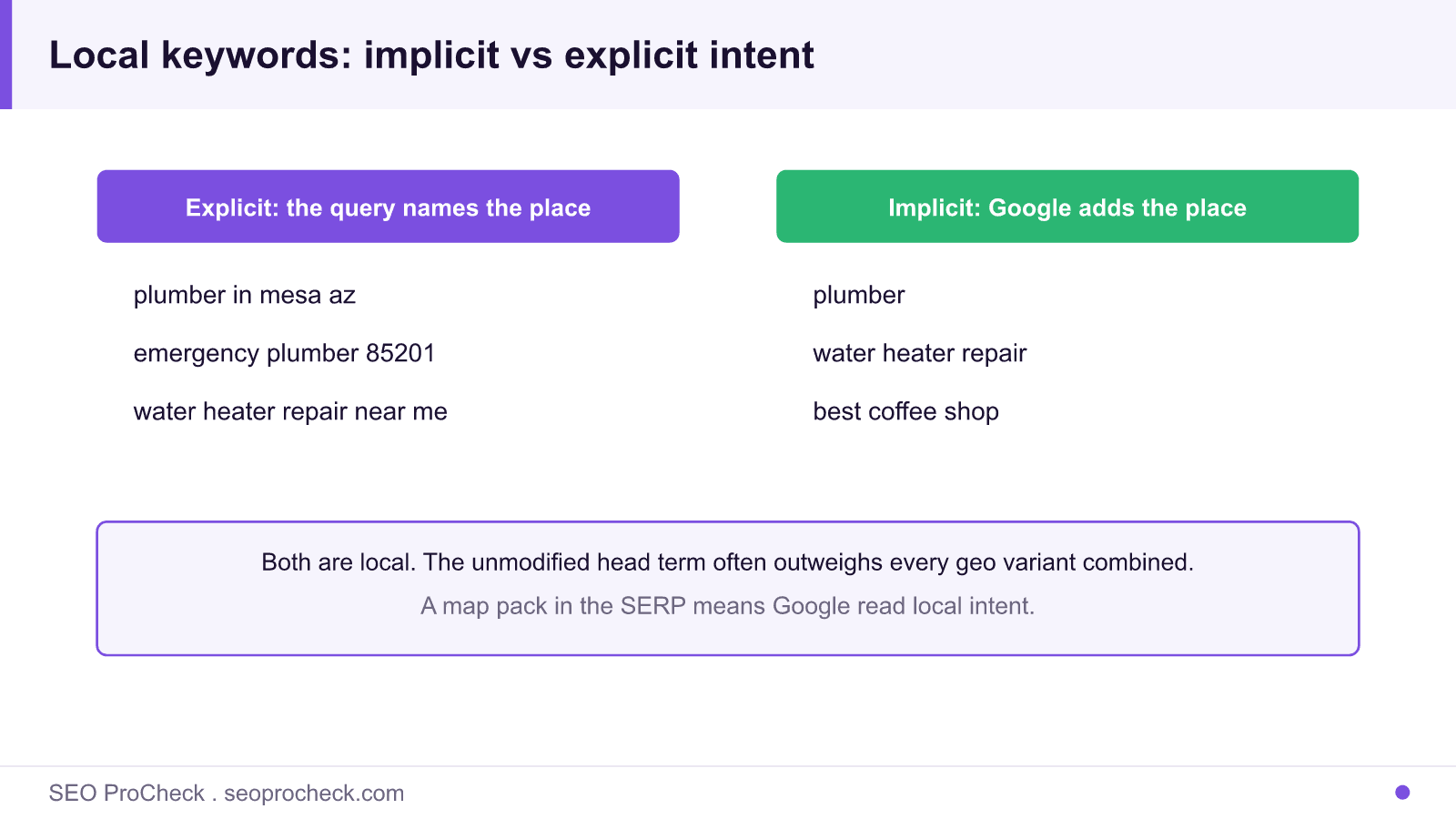
This is the concept that makes or breaks local keyword research. Explicit local intent has geography in the query: "plumber near me," "plumber in mesa az," "emergency plumber 85201." Implicit local intent has none, the query is just "plumber", but Google localizes the results anyway, because decades of behavior data say someone typing "plumber" wants one who'll show up at their house, not a Wikipedia article on pipe fitting.
Here's why it matters in practice: keyword tools report "plumber" with big national volume and "plumber mesa az" with a sliver. Inexperienced marketers chase the modified terms because they look "local." But the unmodified term is also local, its volume is distributed across every city, and your slice of it is often larger than all the explicit variants combined. Your service page competes for both. The searcher typing "near me" isn't a different customer; they're the same customer with a different typing habit.
Keyword Patterns, Intent, and Where to Target Them
| Pattern | Example | Intent | Target it with |
|---|---|---|---|
| [service], unmodified | "water heater repair" | Implicit local, transactional | Core service page + Google Business Profile services |
| [service] near me | "water heater repair near me" | Explicit, urgent, map-pack-dominated | GBP proximity + reviews; same service page wins the organic slot |
| [service] + [city] | "water heater repair mesa" | Explicit, transactional | City-specific service/location page |
| best [service] + [city] | "best plumber in mesa" | Comparison shopping | Review volume, list-post presence, GBP rating |
| [service] cost / price + [geo] | "water heater installation cost arizona" | Research, pre-transactional | Pricing guide with real local context |
| emergency / 24 hour [service] | "24 hour plumber mesa" | Urgent, high value | Dedicated emergency page + hours/attributes on GBP |
| [neighborhood/suburb] variants | "plumber dobson ranch" | Explicit, thin volume individually | Only if you can make the page genuinely distinct, otherwise the city page |
How to Check It (and Do the Research)
- Pull 6-12 months of queries from Google Search Console, filter for your service terms, and split them into implicit vs. explicit buckets. This is real demand from your actual market, not a tool estimate.
- Run your seed terms through Google Keyword Planner or Semrush with location targeting set to your metro, national volume numbers are noise for local decisions.
- Search each candidate keyword yourself (incognito) and note what the SERP shows. A map pack means Google reads local intent; all-informational results mean a blog post, not a service page.
- Mine Google Autocomplete and People Also Ask for your service + city, this surfaces the cost, "same day," and neighborhood modifiers tools underreport.
- Assign every keyword group to exactly one URL before writing anything. The mechanics are in the keyword mapping guide, local sites cannibalize themselves faster than any other kind.
Common Mistakes
- Stuffing "near me" into titles and copy. "Plumber Near Me | Best Plumber Near Me", Google resolves "near me" against the searcher's location, not your keyword usage. It reads as spam to humans and does nothing algorithmically. Fix: write for the service and the city; let proximity handle "near me."
- Spinning a page per suburb. Twenty templated pages differing only by town name is doorway-page territory and post-2024 it's also scaled-content risk. Fix: fewer pages with genuinely local substance, the multi-location page guide shows where the line is.
- Dismissing zero-volume terms. Tools show 0 for "foundation repair queen creek" while GSC shows it converting monthly. City-modified long-tails are systematically underreported. Fix: trust GSC and autocomplete over volume columns; long-tail keywords covers why the estimates fail.
- Ignoring implicit-intent head terms. If your whole strategy is city-modified pages, you've conceded the biggest bucket. Your core service pages need to be your strongest pages.
- Copying a national competitor's keyword list. Their demand profile isn't yours. A brokerage in a resort town and one in a commuter suburb face different query mixes, the real estate SEO breakdown is a good case study in how local demand shapes targeting.
Reading the SERP to confirm local intent
The fastest way to know whether a keyword is local is to search it yourself in an incognito window and look at what Google returns. A map pack (the three business listings with a map) is Google stating plainly that it reads local intent for that query, so a service or location page is the right target and your Google Business Profile does much of the ranking work. If the page instead fills with informational articles and no map, the query is research intent and wants a guide, not a service page. Watch for queries that flip: a term can show a map pack in a dense metro and none in a rural area, which changes what you should build.
Once intent is confirmed, size the real demand with Search Console rather than a keyword tool. Filter the Performance report to your service terms, split them into explicit and implicit buckets, and note which city-modified long tails already earn impressions even when tools report zero volume. Those underreported terms are where local pages quietly win four-figure jobs. Assign every group to exactly one URL before writing, because local sites cannibalize themselves faster than any other kind when two pages chase the same city and service.
FAQ
Should I put "near me" in my title tags?
No. You can rank for "near me" queries without the phrase anywhere on your page, proximity and relevance to the base term do the work. Spend those title characters on the service and city.
Keyword tools show zero volume for my city terms. Are they worthless?
The terms aren't; the estimates are. Low-population geo-modifiers fall under tool measurement thresholds. Validate with GSC impressions and autocomplete instead, and remember one "water heater replacement gilbert" click can be a four-figure job.
How many location pages should I build?
As many as you can make genuinely different, real service details, local proof, area-specific content. For most single-location businesses that's the primary city plus maybe 2-4 substantial area pages, not thirty clones.
Do I target different keywords for the map pack vs. organic?
Same keywords, different levers. The map pack responds to your GBP (categories, reviews, proximity); organic responds to your pages. A good local keyword plan feeds both from one list.
Is "near me" search still growing?
It matured years ago and behavior keeps shifting toward unmodified queries as users learn Google localizes automatically. Which is the point: build for the service, the city, and the intent, not for one modifier.
Take this with you
The assistant links open with a question about this page already written. Nothing is sent until you press enter.
Claude Vincent is a technical SEO consultant focused on crawlability, rendering, and AI-search visibility. He writes the field guides and case studies at SEO ProCheck, with a bias toward the durable, unglamorous work that decides whether search engines and AI answer engines can actually read and cite a site.
About SEO ProCheck
Technical SEO consulting and GEO strategy with 20 years of enterprise experience. Case studies, resources, and tools for search and AI visibility.
Work With Me
Technical SEO audits, GEO strategy, site migrations, and international SEO. Hourly consulting for teams who need hands-on support, not just reports.
Subscribe to our newsletter!








Recent Posts
- Most Top Sites Never Say Who They Are in Structured Data October 14, 2026
- Homepage Titles Are Mostly Too Short, Not Too Long October 8, 2026
- Who Actually Serves an llms.txt? 184 Top Sites Measured September 29, 2026