


AI Summary
Long-tail keywords are longer, more specific search phrases that each attract very little volume, yet together they account for the majority of everything typed into a search engine. They are the realistic way for a lower-authority site to earn traffic, because specific queries carry far less competition and much sharper intent than the head terms everyone chases.
- Volume per phrase is low by definition: the value is in the aggregate across hundreds of queries, never in any single one.
- Group long-tail queries by shared intent, then answer each variation on one page. One page per phrase creates thin duplicates that compete with each other.
- Your Search Console Queries report is the highest-yield source you already own: filter it with a question regex and look at positions 8 to 30.
- Conversational AI prompts are long-tail by nature, so pages that answer one specific question directly are exactly what answer engines quote.

Long-tail keywords are longer, more specific search phrases: "how to fix cumulative layout shift on a WordPress blog" rather than "CLS." Each one has low search volume, which is exactly why most people overlook them, and exactly why they are one of the best opportunities in SEO, especially for newer sites.
Why "low volume" is misleading
Any single long-tail term gets few searches. But there are millions of them, and collectively they make up the majority of all search queries. The handful of high-volume head terms are the visible tip; the long tail is the vast body of demand beneath. You cannot win the head as a newer site, but you can win thousands of tail queries, and they add up to more traffic than the head ever would.
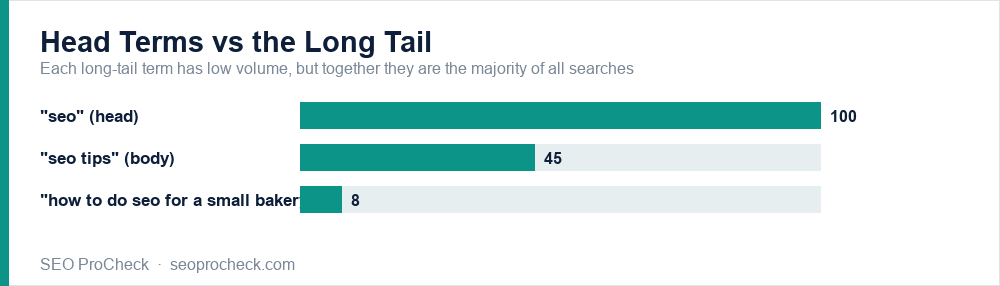
The three advantages
- Easier to rank. Specific terms have far less competition than broad ones, so a lower-authority site can actually win them.
- Higher intent and conversion. A specific query usually means a specific need. Someone searching "best SEO audit tool for a small agency" is much closer to acting than someone searching "SEO."
- They feed the head. Ranking and earning links across many long-tail pages builds the topical authority that eventually lets you compete for the bigger terms.
How to find them
- Mine the SERP: autocomplete, "People Also Ask," and "related searches" are pure long-tail goldmines.
- Use keyword tools with question and modifier filters (how, what, best, for, near, vs).
- Read your audience: forums, reviews, support tickets, and your own site search show the exact phrasing people use.
- Check Search Console: the Queries report reveals long-tail terms you already get impressions for but could target better.
Where to mine long-tail queries
Each source returns a different slice of the tail. The free ones are not a budget compromise: they are closer to real language than any tool database, because they come from live behaviour rather than a sampled index.
| Source | What it gives you | Cost | Best used for |
|---|---|---|---|
| Search Console Queries report | Phrases you already get impressions for, with position and CTR | Free | Finding tail queries you nearly rank for and can win with one section |
| Google autocomplete | Live prefix suggestions as people actually type them | Free | Harvesting real phrasing and question stems fast |
| People Also Ask | Question variants Google itself associates with the topic | Free | Building the H2 and H3 skeleton of a page |
| Related searches (SERP footer) | Lateral phrasings and adjacent intents | Free | Spotting when one query splits into two intents |
| Your own site search logs | The words visitors use once they are already on your site | Free | Product and documentation gaps nobody searches externally |
| Forums, subreddits, support tickets | Unfiltered problem statements in the user's vocabulary | Free | Troubleshooting pages and honest comparison angles |
| Keyword tools with question filters | Scaled variant lists with rough volume and difficulty | Paid | Sizing a cluster and prioritising which page to build first |
How to target them
You do not need one page per long-tail phrase. Group related long-tail queries that share an intent onto a single comprehensive page, and answer each variation within it: with clear headings that match how people ask. One strong page can rank for dozens or hundreds of long-tail variations at once. That is how a modest content library quietly accumulates serious traffic.
Long-tail keyword classes and what actually ranks for them
Not all long-tail queries want the same page. The modifier in the query telegraphs the intent, and the intent dictates the format that wins. This is the mapping I use when triaging a keyword export:
| Keyword class | Intent signal | Content format that ranks |
|---|---|---|
| Question queries ("how to…", "why does…", "what is…") | Informational; user wants an explanation or steps | Guide or glossary entry that answers in the first two sentences, then numbered steps with headings matching the question phrasing |
| Comparisons ("X vs Y", "X alternatives") | Commercial investigation; shortlisting is underway | Head-to-head comparison with a criteria table and an honest "choose X if / choose Y if" verdict |
| Qualified "best" queries ("best X for small agencies") | Commercial; the qualifier is the actual keyword | Curated list built around that qualifier's needs, not a generic top-10 with the qualifier bolted on |
| Troubleshooting ("X not working", "fix X error") | Urgent informational; user has the problem right now | Diagnostic doc: symptom, cause, fix, in that order; ranked causes first, no life story |
| Transactional modifiers ("buy", "pricing", "coupon") | Ready to act | Product, pricing, or offer page: a blog post here wastes the intent |
| Templates and examples ("X template", "X examples") | Do-it-myself intent; user wants an artifact, not theory | Page delivering the actual template or a gallery of real examples, with brief commentary |
| Local qualifiers ("near me", city names) | Local intent; map pack in play | Location page with genuine local substance, backed by a maintained Business Profile |
A worked example of grouping
Take six real queries: "how to write alt text", "alt text examples", "alt text for decorative images",
"does alt text help seo", "alt text length limit", and "alt text vs title attribute". Search each one and
compare the results. The first five return the same handful of comprehensive guides, which is Google telling
you they share an intent: one page, with an H2 per variation, covers all five. The sixth returns comparison
tables and developer documentation, a different result set entirely, so it earns its own page. That test,
run in about ten minutes, is more reliable than any grouping rule applied from a spreadsheet.
Once the page is live, hold it to a simple rule: every H2 should be answerable in the first two sentences
under it. Long-tail visitors arrive mid-problem and leave the moment they have to hunt. Front-loading the
answer under each heading is also what makes the section quotable by
answer engines,
which lift self-contained passages rather than whole pages.
The long-tail goldmine you already own: Search Console
Before buying a single keyword-tool credit, mine your own impression data. In Search Console, open Performance → Search results, set the date range to the last 3 or 6 months, and add a query filter with Custom (regex) (see the regex filters in Search Console guide for the full syntax). A pattern like ^(how|what|why|when|which|can|does|is|should)\b surfaces every question query you already appear for. Sort by impressions and look for queries sitting at positions 8 to 30 with zero or near-zero clicks: Google already considers you relevant for these, and no page of yours is answering them head-on. Each one is either a new section on an existing page or, when a cluster of them shares an intent, a new page.
Two more passes worth doing: filter queries containing vs or best to find commercial long-tail you are accidentally ranking for with informational pages, and check the Pages tab for URLs collecting impressions across many unrelated long-tail queries: that is usually a page trying to do too many jobs, and splitting it is the fix.
One page or many? The judgment call
The grouping rule from above (one page per intent, not per phrase) has a failure mode in each direction. Splitting every variation into its own page produces a pile of thin near-duplicates that cannibalize each other: two of your URLs swap in and out of the results for the same query, and neither settles. Merging too aggressively produces a page so broad it ranks decisively for nothing. The test I apply: if two queries would be satisfied by the same H2 sections in the same order, they share a page; if the searcher for one would scroll past half the content as irrelevant, they need separate pages. When in doubt, check what Google already does: search both phrases, and if the results overlap heavily, one page is the answer.
FAQ
What exactly counts as a long-tail keyword?
A long-tail keyword is a specific, lower-volume search phrase: usually, but not necessarily, longer than three words. The defining trait is specificity of intent, not word count: "cheapest CLS fix WordPress" is long-tail, while a four-word head term like "best free antivirus software" still behaves like a head term. The tail refers to the demand-curve shape, where millions of rare queries collectively outweigh the popular ones.
Are long-tail keywords easier to rank for?
Generally yes, because fewer sites target each specific phrase and the head-term competitors often only cover it incidentally. But easier is not automatic: some long-tail queries are answered by a strong section inside authoritative pages, and you still have to out-answer that section. Check the actual results for the phrase before assuming it is a soft target.
How many long-tail keywords should one page target?
As many as share one intent: often dozens or hundreds of phrasings of the same underlying need. Write one comprehensive page with headings that mirror the main variations, and let Google map the rest. The moment two variation groups need different content to satisfy them, they have stopped sharing an intent and deserve separate pages.
Do long-tail keywords still matter with AI search and AI Overviews?
More than before, in my view. Conversational queries typed into AI assistants are long-tail by nature, and answer engines cite pages that resolve specific questions directly. A page built to answer one specific need in its opening lines is exactly the shape these systems quote. The head terms are where AI answers absorb the most clicks; specific queries still route users to specific sources.
How do I find long-tail keywords for free?
Your own Search Console queries report (filtered with a question regex as described above), Google autocomplete, the People Also Ask boxes, related searches at the bottom of the results page, and your site-search logs. Forums and subreddits in your niche add the phrasing real people use. Paid tools mostly repackage and scale these same sources.
What is a realistic traffic expectation from a long-tail page?
Individually small: many successful long-tail pages earn a handful of visits a day, and that is the design, not a failure. The economics work in aggregate: a library of such pages compounds, and the per-visit conversion rate typically runs higher than head-term traffic because the intent is tighter. Judge the program by the library's total curve over quarters, never by one page's first month.
Targeting the right keywords?
Keyword strategy is where every successful SEO campaign starts. See how an advanced SEO audit works →
Take this with you
The assistant links open with a question about this page already written. Nothing is sent until you press enter.
Claude Vincent is a technical SEO consultant focused on crawlability, rendering, and AI-search visibility. He writes the field guides and case studies at SEO ProCheck, with a bias toward the durable, unglamorous work that decides whether search engines and AI answer engines can actually read and cite a site.
About SEO ProCheck
Technical SEO consulting and GEO strategy with 20 years of enterprise experience. Case studies, resources, and tools for search and AI visibility.
Work With Me
Technical SEO audits, GEO strategy, site migrations, and international SEO. Hourly consulting for teams who need hands-on support, not just reports.
Subscribe to our newsletter!








Recent Posts
- Most Top Sites Never Say Who They Are in Structured Data October 14, 2026
- Homepage Titles Are Mostly Too Short, Not Too Long October 8, 2026
- Who Actually Serves an llms.txt? 184 Top Sites Measured September 29, 2026