

AI Summary
Dwell time is the stretch between a searcher clicking your result and returning to Google to pick something else, and it is an inferred idea about satisfaction, not a metric Google hands you. Treat it as a proxy for one question: did the click resolve the search, or send the person back to try again?
- Google has never confirmed a metric named dwell time; the term was popularized by Bing engineers and SEO writers.
- It maps to the good click versus bad click split that click weighting systems such as NavBoost reportedly use.
- You cannot pull it from a report, so triangulate it from Search Console CTR, GA4 engagement, and session recordings.
- The durable fix is answering the query in the first screen so real searchers have no reason to bounce.
What Dwell Time Actually Means
Dwell time is the stretch of time between a searcher clicking your result in Google and returning to the search page to pick something else. It is an inferred, third-party idea about user satisfaction, not a number Google hands you in any dashboard.
Here is the honest part that most glossary pages skip: Google has never confirmed a metric called "dwell time." The term was popularized by Bing engineers years ago and by SEO commentators trying to name the gap between a click and a bounce-back. When people say Google "uses dwell time," what they usually mean is that Google may use click-and-return patterns as one of many signals. That distinction matters, because it changes what you can and cannot do about it.
Where Dwell Time Fits: The Click-Signal Debate
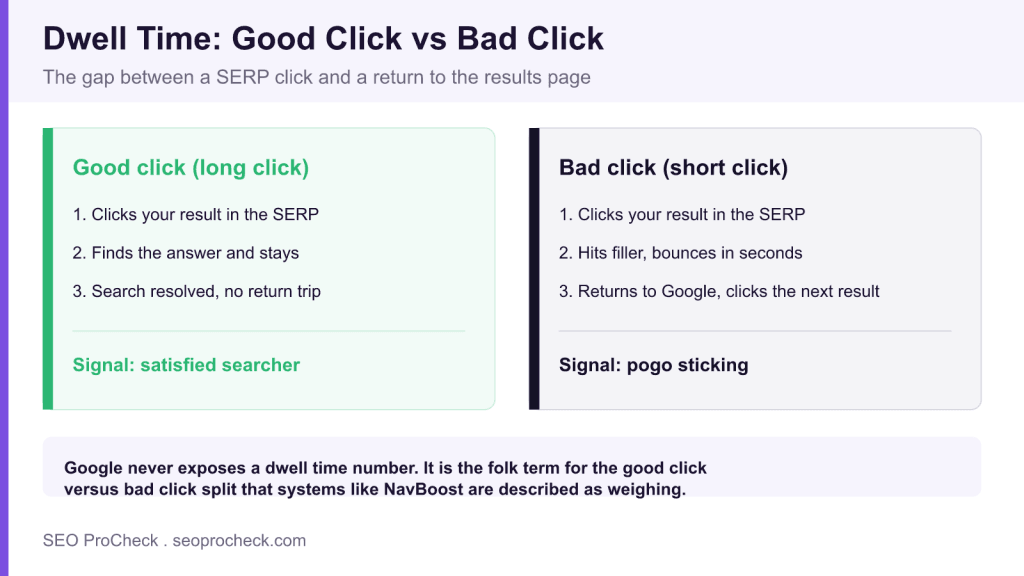
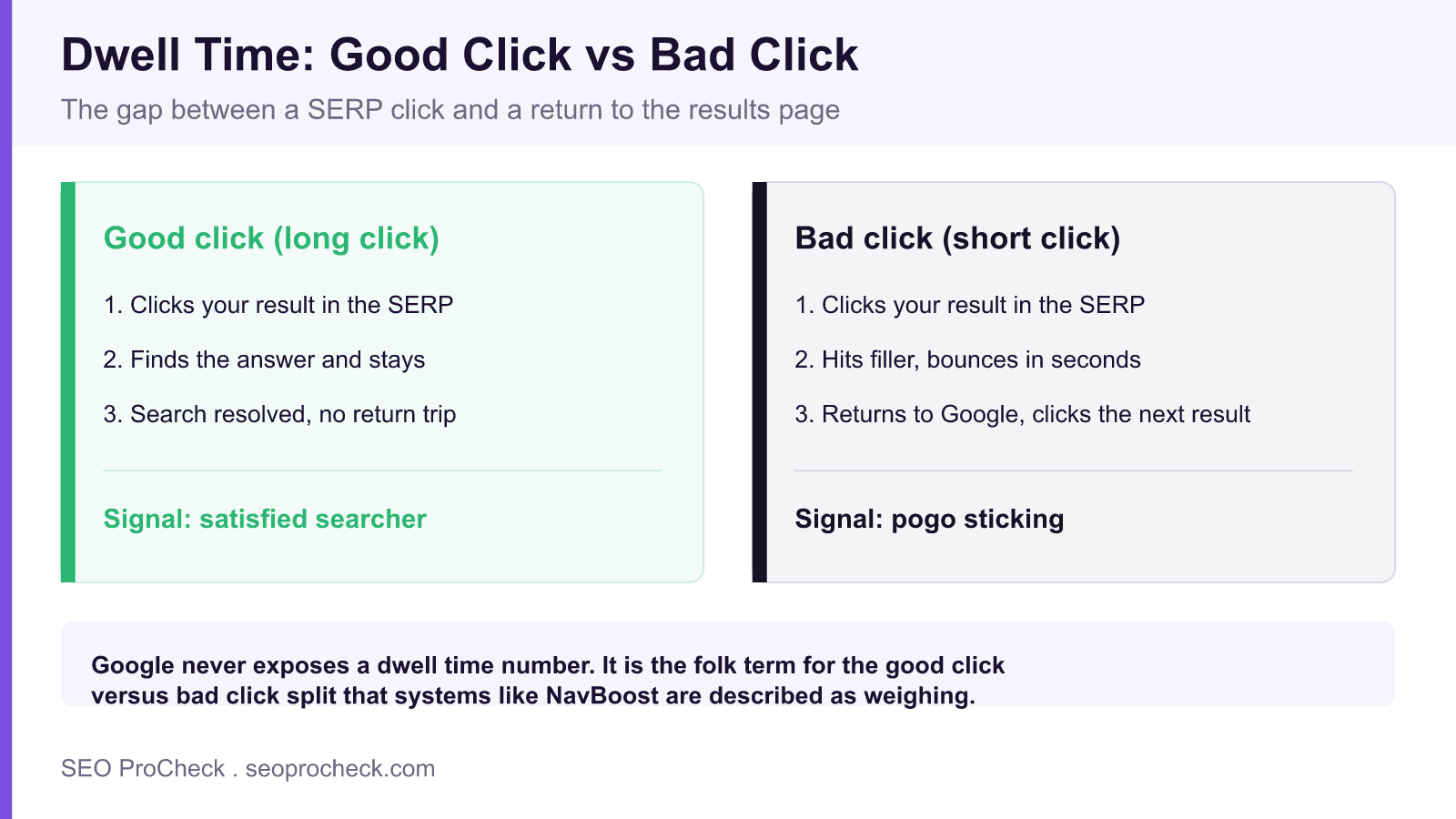
The reason dwell time refuses to die as a concept is the long-running argument over whether Google uses click behavior to rank pages. For years Google's public line downplayed clicks as too noisy and too easy to game. Then the 2023 antitrust testimony and the 2024 leak of internal Content Warehouse documentation put a name to a system called NavBoost, which reportedly weighs clicks, including a distinction between "good clicks" and "bad clicks." A good click is one where the searcher stays; a bad click is one where they bounce straight back and try the next result.
Dwell time is basically the folk term for the thing that separates a good click from a bad one. When a searcher clicks you, immediately hits the back button, and clicks the next listing, that back-and-forth is pogo-sticking, and it is the behavior most likely to hurt you. The deep dive on pogosticking walks through why that pattern is a cleaner signal than raw time-on-page, because a fast return to the SERP is unambiguous: the searcher looked at your page and rejected it.
So treat dwell time as a proxy for one question: did the click resolve the search, or send the person back to try again? That framing is more useful than obsessing over a specific number of seconds you cannot measure anyway.
A Real Example
Say two pages rank for "how to reset a Netgear router." Page A opens with three paragraphs of history about Netgear as a company before it gets to the steps. Page B opens with the exact button sequence and a photo of the reset pinhole. A searcher in a hurry clicks Page A, sees a wall of throat-clearing, hits back within four seconds, and clicks Page B, where they stay for two minutes following the steps.
Nobody at Google typed "Page A dwell time = 4 seconds." But the aggregate pattern, thousands of people bouncing off A and settling on B, is exactly the kind of signal a click-weighting system like NavBoost is described as using. Over time B looks like the result that satisfies the query, and the SERP tends to reflect that. That is dwell time doing its work without ever being a metric you can open a report and read.
Dwell Time vs. the Metrics People Confuse It With
| Concept | What it measures | Who owns the data | Can you see it directly? | What it tells you |
|---|---|---|---|---|
| Dwell time | Time from SERP click to return to the SERP | Google (inferred; never exposed) | No | Whether the click satisfied the search |
| Time on page | Time on one page before the next pageview | Your analytics tool | Partly (last-page time is unmeasured) | Engagement, but blind to how they left |
| Bounce rate (UA) | Sessions with a single pageview | Your analytics tool | Yes (legacy) | Single-page visits, not satisfaction |
| Engagement rate (GA4) | Sessions over 10s, or with a conversion or 2+ views | Your analytics tool | Yes | Whether the visit was active |
| Pogo-sticking | Click, fast return, click next result | Google (inferred) | No | Clearest signal of a rejected result |
| Long click / short click | Whether the searcher stayed or came right back | Google (inferred) | No | The "good click / bad click" split |
How to Check It (Since You Can't Check It Directly)
You cannot pull dwell time from a report, so you triangulate it from the metrics you do own. Here is the practical sequence:
- Open Search Console and sort by position, then by CTR. Find queries where you rank in the top three but earn a below-average click-through. A poor CTR at a strong position often means your title and snippet are pulling clicks that the page then disappoints, which is the setup for a fast return.
- Cross-reference with GA4 engagement. In GA4's organic reports, look at engagement rate and average engagement time for those exact landing pages. A page with high impressions, decent clicks, and rock-bottom engagement time is your prime dwell-time suspect.
- Watch session recordings. Tools like Microsoft Clarity or Hotjar show you rage clicks, dead scrolls, and instant exits. If most sessions on a page die above the fold, searchers are not finding what the SERP promised.
- Run a SERP gap check. Search your target query yourself. If the top results answer it in the first screen and yours makes people scroll or read filler first, you have found the friction.
- Track ranking movement after fixes. The only real confirmation is the SERP itself. Improve the page, wait a few weeks, and watch whether position holds or climbs. Ranking is the scoreboard; everything else is a proxy.
Common Mistakes and How to Fix Them
- Treating dwell time as a confirmed Google metric. It is not. Fix: talk about it as click-satisfaction behavior, and design for the search being resolved, not for a magic number of seconds.
- Padding pages to inflate time on page. Making people scroll through fluff to find the answer produces the exact fast-return you are trying to avoid. Fix: answer the query in the first screen, then expand for the people who want depth.
- Confusing time on page with dwell time. Your analytics never sees the moment someone returns to Google, and it cannot time the last page in a session at all. Fix: use time on page as a rough engagement read, not as a stand-in for search satisfaction.
- Chasing dwell time on transactional queries. Someone searching "UPS tracking" wants to leave fast, and a quick exit there is success, not failure. Fix: judge the behavior against search intent before deciding a short visit is a problem.
- Ignoring the SERP snippet as a cause. A misleading title earns clicks the page can't honor, guaranteeing bounce-backs. Fix: align your title and meta description with what the page actually delivers.
Frequently Asked Questions
Does Google actually use dwell time as a ranking factor?
Google has never confirmed a metric by that name. What the antitrust testimony and the 2024 documentation leak point to is a click-weighting system (NavBoost) that appears to distinguish clicks where users stay from clicks where they bounce back. Dwell time is the informal label for that difference, not an official signal you can point to in Google's documentation.
How is dwell time different from bounce rate?
Bounce rate is a metric your own analytics reports for single-pageview sessions. Dwell time is an inferred behavior Google may observe, specifically the gap between a SERP click and a return to the SERP. A visitor can read your whole page and still count as a bounce, so the two measure different things.
What's a "good" dwell time in seconds?
There isn't one, and any number you have seen quoted was invented for a blog post. The right question is whether the visit resolved the search. For a quick fact, ten satisfied seconds is a win; for a buying guide, thirty seconds probably means you failed.
Is dwell time the same as pogo-sticking?
They are two sides of the same coin. Pogo-sticking is the fast-return-and-click-the-next-result pattern; a very short dwell time is what pogo-sticking produces. The pogo-sticking article covers the mechanics of why that return trip is the signal Google can trust most.
Can I manipulate dwell time to rank higher?
Not reliably, and not safely. Bot-driven click schemes are exactly the noise Google spent years learning to discount, and they don't survive audits. The durable move is to make the page genuinely answer the query so real searchers have no reason to go back.
Claude Vincent is a technical SEO consultant focused on crawlability, rendering, and AI-search visibility. He writes the field guides and case studies at SEO ProCheck, with a bias toward the durable, unglamorous work that decides whether search engines and AI answer engines can actually read and cite a site.
About SEO ProCheck
Technical SEO consulting and GEO strategy with 20 years of enterprise experience. Case studies, resources, and tools for search and AI visibility.
Work With Me
Technical SEO audits, GEO strategy, site migrations, and international SEO. Hourly consulting for teams who need hands-on support, not just reports.
Subscribe to our newsletter!







Recent Posts
- Can AI Crawlers Actually Read Your Site? I Measured 400 of the Biggest September 5, 2026
- The Pre-Publish Quality Gate for AI-Assisted Content August 6, 2026
- AGENTS.md vs llms.txt vs llms-full.txt: Which Agent File Does What July 18, 2026