AI Summary
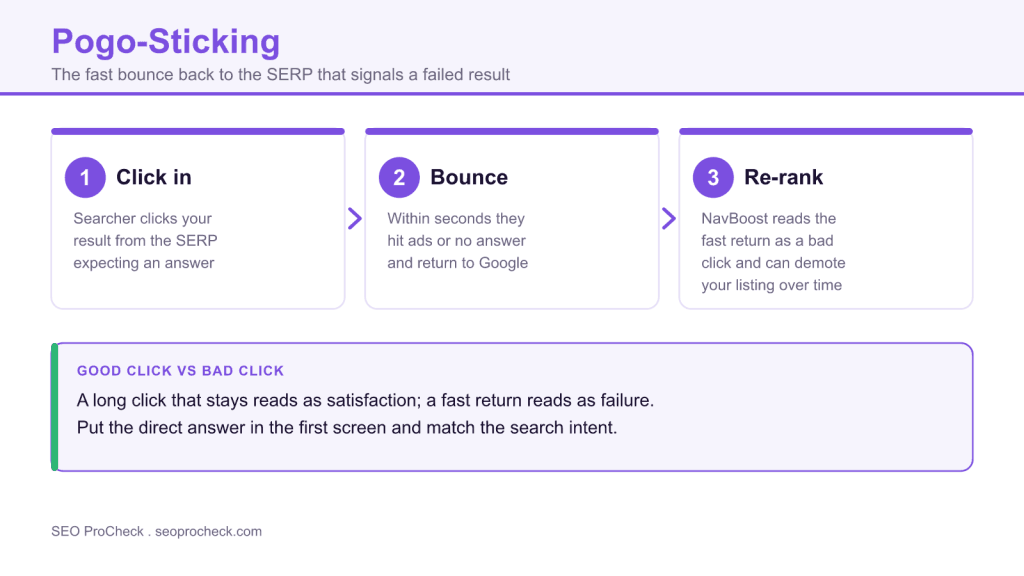
Pogo-sticking is when a searcher clicks your result, decides within seconds it does not answer the query, and bounces back to the SERP to try another link. Done often enough on your listing, it signals a failed result and can cost you rankings.
- A long click that stays reads as satisfaction; a fast return reads as a bad result.
- DOJ antitrust exhibits revealed NavBoost, which uses aggregated click data as a ranking signal.
- Pogo-sticking lives in Google's click stream, unlike bounce rate, which sits only in your analytics.
- Fix it by putting the direct answer in the first screen and matching the search intent.

What pogo-sticking means
Pogo-sticking is when a searcher clicks a result, decides within seconds it does not answer their query, and bounces straight back to the results page to try a different link. The name is the picture: click in, click out, click the next one, up and down like a pogo stick. The stakes: when this happens often enough on your listing, it is a loud signal that your page failed the searcher, and there is strong evidence Google uses that pattern to decide who deserves to rank, so pogo-sticking is not just a UX annoyance, it is a ranking liability.
We cover the full mechanics in the flagship breakdown, Pogosticking: The Click Pattern That Quietly Decides Who Ranks. This glossary entry is the short version.
The behavior, and why Google cares about it
Picture someone searching how to fix a running toilet. They click the first result, hit a wall of ads and a vague intro with no actual steps, and within four seconds they are back on the SERP clicking result number two, which shows a clean numbered fix, and they stay. That second click "sticking" while the first got abandoned is exactly the contrast search engines can measure.
This stopped being theory. Testimony and exhibits from the U.S. Department of Justice antitrust case against Google surfaced a system called NavBoost, which uses aggregated click data, including how long users stay on a result versus bouncing back, as a ranking signal. Google spokespeople have long downplayed clicks as a direct ranking factor, but the DOJ material made it hard to argue that click behavior, and specifically the "good click vs bad click" distinction, is ignored. A "long click" (you clicked and stayed) reads as satisfaction; a fast return to the SERP reads as a bad result. Pogo-sticking is the visible face of that bad click.
Pogo-sticking vs bounce rate vs dwell time
| Metric | What it measures | Where it's measured | What it signals to Google |
|---|---|---|---|
| Pogo-sticking | Fast return to the SERP to click another result | Search engine side (click stream) | Strong, this specific result failed the query |
| Dwell time | How long between the click and the return to search | Search engine side | Strong, long dwell reads as satisfaction |
| Bounce rate | Single-page sessions with no further action | Your analytics (GA4) | Weak/indirect, Google doesn't see your GA |
The confusion worth killing: a bounce is not automatically bad. Someone lands on your page, gets the phone number, closes the tab satisfied, that is a bounce with a happy searcher and no return to the SERP. Pogo-sticking is the genuinely bad version, because the return to Google proves the query went unanswered. Bounce rate lives in your analytics and Google cannot see it; pogo-sticking and dwell time live in Google's own click stream, which is why they carry weight.
How to check for pogo-sticking on your own site
- Find the mismatch pages in Search Console. In Performance, sort by impressions and look for pages with lots of impressions, decent position, but low CTR or a position that keeps slipping. Ranking that erodes over time on a good query is a classic pogo signal.
- Cross-reference GA4 engagement. Pull engagement rate and average engagement time by landing page. Pages that pull organic clicks but show seconds of engagement and no scroll are the ones people are abandoning.
- Watch real sessions. Microsoft Clarity or Hotjar session recordings and scroll maps show you exactly where people give up, a rage-scroll to find the answer, then gone. That is pogo-sticking you can watch happen.
- Do the four-second test yourself. Click your own result from the live SERP. Is the answer visible in the first screen, or buried under ads, a cookie wall, and a 300-word preamble? If you would bounce, so do they.
- Compare against who outranks you. Open the results that beat you and note what they answer in the first screen that you do not. The gap is your fix list.
Common mistakes and how to fix them
- Burying the answer below the fold. If someone has to scroll past ads and an intro to get what they searched for, they leave. Fix: put the direct answer in the first screen, then expand for the people who stay.
- Intent mismatch on the ranking page. Ranking a sales page for an informational query guarantees a fast bounce back. Fix: match the page to what the query actually wants before worrying about anything else.
- Slow load and layout shift. A page that takes five seconds to render sends impatient searchers back to the SERP before they see your answer. Fix: improve Core Web Vitals, speed is the cheapest anti-pogo win there is.
- Clickbait titles the page can't cash. A title that overpromises pulls the click and then loses the trust in three seconds. Fix: make the title an honest summary of what the page delivers, so the click sticks.
- Thin content that "answers" in one line. If a competitor covers the follow-up questions and you do not, users bounce to them. Fix: answer the query and the obvious next questions so there is no reason to go back and click the next result.
Why this matters for rankings
If Google's system reads your result as the one people abandon, it has a direct, click-based reason to prefer the pages searchers stay on. That connects pogo-sticking straight to dwell time, they are two ends of the same measurement, the bad end and the good end. Killing pogo-sticking is not a vanity metric exercise; it is making the page good enough that the searcher stops looking, which is exactly the outcome every search intent match is supposed to produce.
FAQ
Is pogo-sticking the same as bounce rate?
No, and conflating them causes bad decisions. Bounce rate is a single-page session in your analytics, which can be a perfectly satisfied user who got what they needed. Pogo-sticking specifically means returning to the SERP to click another result, which proves the query went unanswered. One is neutral; the other is a failure signal.
Does Google actually use pogo-sticking as a ranking factor?
The evidence points that way. DOJ antitrust exhibits revealed NavBoost, a system that leans on aggregated click behavior including good-versus-bad clicks. Google has historically downplayed clicks as a direct factor, but the "long click vs fast return" distinction is clearly part of how results get re-ranked, and pogo-sticking is that fast return.
How do I stop people pogo-sticking off my pages?
Answer the query fast and completely. Put the direct answer in the first screen, match the page to the search intent, load quickly, and cover the follow-up questions so there is nothing left to go back and look for. In short: give the searcher no reason to return to Google.
Can I see pogo-sticking in Google Analytics?
Not directly, GA4 cannot see the searcher returning to the SERP, because that happens on Google's side. What you can see are proxies: low engagement time, no scroll, single-page sessions on organic landing pages. Combine those with slipping rankings in Search Console to infer where pogo-sticking is happening.
What's a "good click" versus a "bad click"?
In the click-behavior framing, a good click is one where the searcher lands, stays, and does not come back for the same query, the result satisfied them. A bad click is a fast return to the SERP to try something else. Pogo-sticking is a string of bad clicks on your listing, and it is exactly what you want to eliminate.
More on pogo-sticking
What is a good pogo-sticking rate?
There is no published threshold, and you cannot see the raw metric because it lives in Google's click stream. Judge it by proxies: slipping rankings on a good query, low engagement time, and no scroll on organic landing pages together point to a pogo problem.
How is pogo-sticking different from dwell time?
They are two ends of the same measurement. Dwell time is how long a searcher stays after clicking your result; pogo-sticking is a fast return to the SERP before that dwell can build. Long dwell reads as satisfaction, a fast bounce reads as failure.
Does pogo-sticking affect every page equally?
No. It hurts most on informational queries where searchers expect a quick, direct answer. Pages that bury the answer under ads, a cookie wall, or a long preamble are the ones people abandon fastest.
What is NavBoost?
NavBoost is a Google system revealed in the DOJ antitrust exhibits that uses aggregated click data, including how long users stay versus how fast they bounce back, as a ranking signal. It is the mechanism that turns pogo-sticking into a ranking consequence.
How fast can I fix pogo-sticking?
The on-page changes are quick: move the direct answer into the first screen, match the page to the search intent, and speed up load. Ranking recovery is slower, because Google needs to observe the improved click behaviour over repeated visits.
Claude Vincent is a technical SEO consultant focused on crawlability, rendering, and AI-search visibility. He writes the field guides and case studies at SEO ProCheck, with a bias toward the durable, unglamorous work that decides whether search engines and AI answer engines can actually read and cite a site.
About SEO ProCheck
Technical SEO consulting and GEO strategy with 20 years of enterprise experience. Case studies, resources, and tools for search and AI visibility.
Work With Me
Technical SEO audits, GEO strategy, site migrations, and international SEO. Hourly consulting for teams who need hands-on support, not just reports.
Subscribe to our newsletter!