AI Summary
10x content is Rand Fishkin's quality bar: content that is ten times better than the best result ranking for a query, not ten times longer. It forces one honest question before you publish: is this the best thing a searcher could possibly land on for this query?
- The number is not literal; it is a deliberately high bar, not a word count target.
- 10x comes from usefulness, experience, trust, and uniqueness, not length.
- Read the top results first to find the ceiling you have to clear.
- Reserve the effort for money terms and pillar pages, not every thin utility page.
What 10x content means
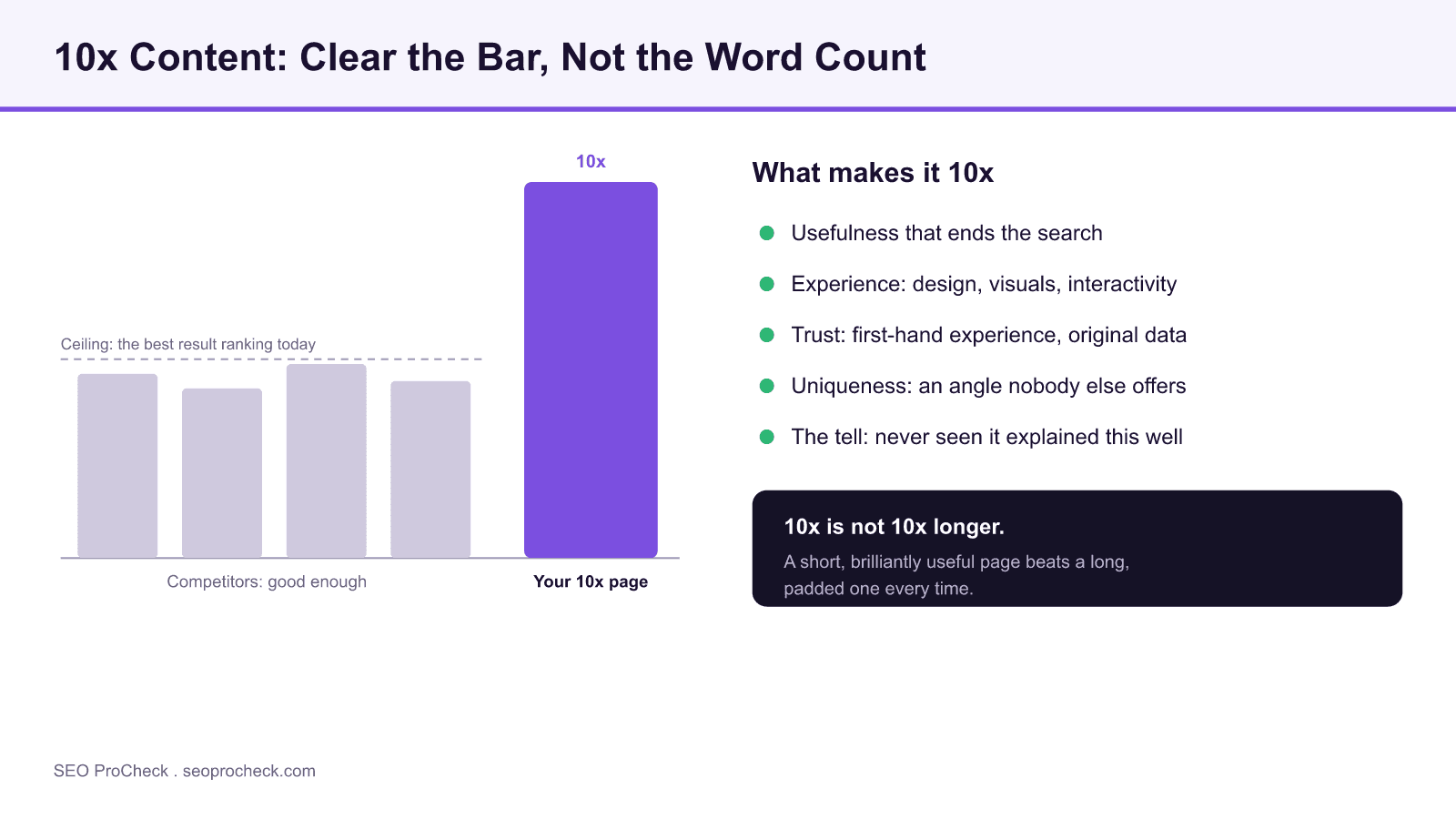
10x content is Rand Fishkin's idea: content that's ten times better than the best result currently ranking for a query, not ten times longer, ten times better. It's a quality bar, a gut-check you apply before publishing, and the whole point is to stop shipping "good enough" pages into a search result that's already full of good-enough pages.
The number isn't literal. Nobody measures "10x" with a ruler. It's a deliberately high bar meant to force a real question: is this the best thing a searcher could possibly land on for this query? If the honest answer is "it's about as good as what's already there," you haven't cleared it.
A real example
Search "how to read a nutrition label." The top results are competent: a definition, a labeled diagram, a few bullet points. Perfectly fine, entirely forgettable, indistinguishable from each other.
A 10x version isn't the same article with more words. It's an interactive label where you hover any line to see what it means, a section on the specific traps people fall for (serving size vs container size, "0g trans fat" rounding rules), photos of real labels from real products with annotations, and a short quiz to check understanding. Same topic, dramatically better experience. That's the gap between "good enough" and 10x, and it's the gap that earns links, shares, and durable rankings.
What actually makes content 10x
| Dimension | "Good enough" content | 10x content |
|---|---|---|
| Usefulness | Answers the question adequately | Answers it so completely the reader stops searching |
| Experience | Wall of text | Design, visuals, or interactivity that make it easy and pleasant to use |
| Trust | Generic, could be anyone | First-hand experience, original data, credible sourcing |
| Uniqueness | Rehashes the same points as everyone else | Adds an angle, dataset, or tool nobody else offers |
| Emotional pull | Flat and functional | Memorable enough that people share and cite it |
| The tell | "It's fine" | "I've never seen it explained this well" |
How to make (or check for) 10x content
- Actually read the top results. Open the first page for your target query and study what's there, not to copy it, but to find the ceiling you have to clear.
- Name what they all miss. Every one is outdated, or ignores a common edge case, or is painful to read, or lacks visuals, or has zero first-hand experience. That shared weakness is your opening.
- Pick a differentiator you can genuinely deliver. Original data, a working tool, real expertise, or a far better presentation. One strong, unfakeable advantage beats five weak ones.
- Build for the reader, not the word count. Make it the easiest, most complete, most trustworthy answer available. Length follows from covering the topic properly, it's never the goal.
- Apply the honest gut-check. Would you link to this over everything else ranking? If you hesitate, it's not 10x yet. Keep going or don't publish.
Common mistakes and how to fix them
- Reading "10x" as "10x longer." This is the core misunderstanding. Length isn't quality, and padding actively hurts. Fix: chase better, not bigger, a concise page can absolutely be 10x.
- Skipping the competitive read. You can't beat the best result if you never looked at it. Fix: study the current top pages before you write a word.
- Adding differentiators nobody wants. A flashy widget that doesn't help the reader is noise. Fix: every addition must make the answer more useful, not just more elaborate.
- Publishing "good enough" and hoping. Parity content in a crowded result mostly gets ignored. Fix: if it doesn't clear the bar, keep working, another mediocre page won't move.
- Treating 10x as a one-time event. The bar rises as competitors improve. Fix: revisit your best pages and re-clear the bar as the result changes underneath you.
Frequently asked questions
Does 10x content mean 10x more words?
No: this is the mistake to avoid above all others. 10x refers to how much better the content is, across usefulness, trust, design, and uniqueness. A short, brilliantly useful page beats a long, padded one every time.
Is 10x content a Google ranking factor?
Not a literal one: there's no "10x score." It's a mindset that produces the things Google's systems do reward: genuine helpfulness, first-hand experience, and content people choose to link to and share.
How is this different from the skyscraper technique?
They share DNA: both start by finding the best existing content and beating it. 10x is the quality standard; the skyscraper technique wraps that standard in a specific link-outreach process. 10x is the bar; skyscraper is one way to cash it in for links.
Can every page be 10x?
Realistically, no, and that's fine. Reserve the effort for pages that matter: your money terms, your pillar pages, the topics you want to own. Chasing 10x on every thin utility page is a poor use of time.
What if a competitor already has 10x content?
Then the honest move is to either clear a genuinely higher bar or pick a different angle where you can win. Publishing a weaker copy of an already-excellent page is wasted effort.
Where this fits
10x is the quality bar; a content hub is where you apply it at scale: every spoke aiming to be the best answer for its query. It's also the standard behind the skyscraper technique's "make it notably better" step. For a grounded take on quality, see measuring content quality objectively.
Claude Vincent is a technical SEO consultant focused on crawlability, rendering, and AI-search visibility. He writes the field guides and case studies at SEO ProCheck, with a bias toward the durable, unglamorous work that decides whether search engines and AI answer engines can actually read and cite a site.
About SEO ProCheck
Technical SEO consulting and GEO strategy with 20 years of enterprise experience. Case studies, resources, and tools for search and AI visibility.
Work With Me
Technical SEO audits, GEO strategy, site migrations, and international SEO. Hourly consulting for teams who need hands-on support, not just reports.
Subscribe to our newsletter!