

How Google Treated A Major Site Performance Problem From A Crawling And Ranking Perspective
- January 23, 2019
- Crawling and Indexing
AI Summary
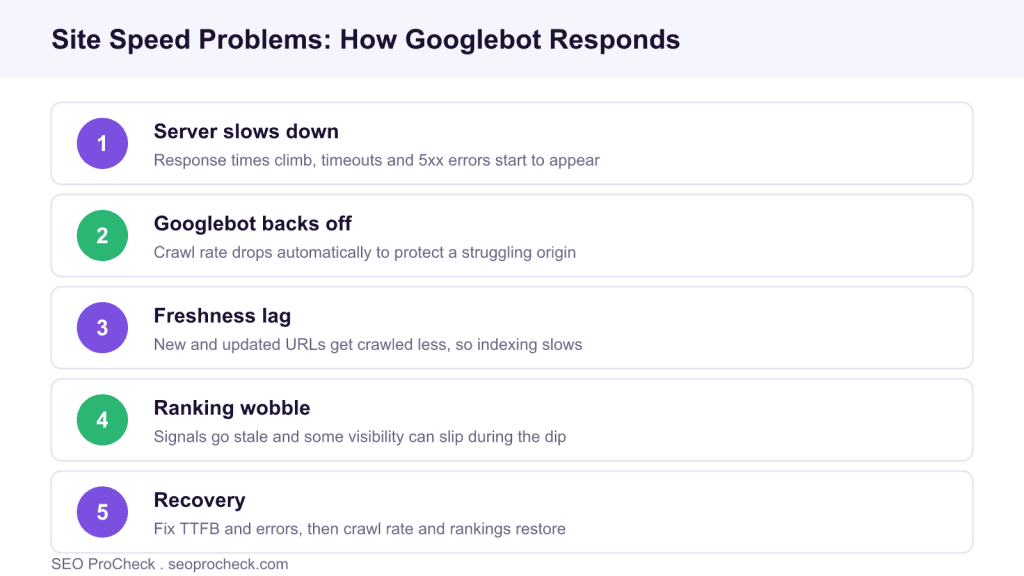
Google reacts to a slow site by lowering its crawl rate so it does not add load, which delays how quickly new and updated pages are discovered and refreshed. Rankings can wobble while signals go stale, but they typically recover once server response times and error rates return to normal.
- Sustained slow responses and 5xx errors push Googlebot to throttle its crawl automatically.
- Slower crawling means slower indexing of fresh and changed URLs, not an instant ranking penalty.
- Fixing time to first byte, timeouts and server errors is what restores crawl rate and visibility.
- Watch Crawl Stats in Search Console for average response time and host status spikes.
This case study, originally documented by Glenn Gabe at GSQI, looks at how Google responded when a large site hit a serious performance problem, and how that showed up in both crawling and ranking. Below we keep the original summary and source, then add practitioner notes on how to read the same pattern in your own logs and Search Console data.
This SEO case study documents a successful optimization initiative, providing actionable insights for practitioners. The documented approach demonstrates how strategic SEO implementation drives measurable results.
Initial Situation
Understanding the starting point is essential context for evaluating any case study. This documentation covers the initial challenges, competitive position, and business objectives that shaped the SEO strategy.
Strategy and Approach
The strategic approach combined multiple SEO disciplines to address identified opportunities. Key decisions around prioritization and resource allocation provide a template for similar initiatives.
Implementation
Moving from strategy to execution required specific technical implementations, content development, and process changes. This case study documents the practical steps that translated strategy into action.
Results and Learnings
The outcomes demonstrate effectiveness through measurable improvements in rankings, traffic, and business metrics. Analysis of successes and challenges provides learning value for practitioners.
Case studies like this contribute to the SEO knowledge base, helping practitioners learn from documented real-world experiences.
Source: https://www.gsqi.com/marketing-blog/how-google-treated-site-performance-problem-seo-case-study/
How Googlebot reacts to a slow origin
Googlebot runs a feedback loop on your server health. When request latency climbs and it starts seeing timeouts or 5xx responses, it lowers the crawl rate to avoid pushing an already struggling origin over the edge. This is protective behaviour, not a manual action. The practical effect is that fewer URLs get fetched per day, so newly published and recently updated pages sit in a discovery queue longer than usual.
The ranking impact is indirect. Google is not demoting you for being slow in this scenario, it simply has staler information. Canonical choices, freshly added internal links, updated titles and new content all take longer to be reflected. On a large site that lag is enough to produce visible movement in reporting, which is why performance incidents often look like ranking incidents at first glance.
Read the signals in Crawl Stats and logs
Open Search Console, then Settings, then Crawl Stats. The two charts that matter here are average response time and the host status section. A performance problem shows as a rising response time line that correlates with a falling total crawl requests line. In your server logs, filter to verified Googlebot and group by status code: a healthy crawl is dominated by 200 and 304 responses, while an incident shows a growing share of 500, 502, 503 and 504.
If you want to separate a crawl problem from an indexing problem, cross reference with the Pages report. A true performance throttle slows recrawl of URLs that are already known and indexed, which is different from a quality issue where URLs are crawled but not selected. Understanding what crawl budget really means helps here, because on most sites the ceiling is set by demand and host capacity rather than a fixed quota.
| Signal | Healthy pattern | Performance incident |
|---|---|---|
| Average response time | Flat and low | Rising, often in steps |
| Total crawl requests | Stable or growing | Falling as latency climbs |
| Status mix in logs | Mostly 200 and 304 | Growing 5xx and timeouts |
| Host status in Search Console | No problems | Flagged for availability |
| Indexing freshness | Updates reflected in days | Updates lag by weeks |
A recovery checklist that works
Stabilise the origin first: cut time to first byte with caching and a content delivery network, return a proper 503 with a Retry-After header during genuine outages rather than a slow 200, and remove any accidental rate limiting that blocks Googlebot ranges. Once response times are healthy, Google raises the crawl rate on its own within days. Do not reach for a crawl rate limiter as a fix, because throttling further is the opposite of what a slow site needs. If your server has a hard timeout, keep it comfortably under the point where Google gives up, and see the Googlebot timeout is three minutes for why that ceiling matters. Efficient validation caching, covered in whether Googlebot uses ETag headers, also lets Google confirm unchanged pages cheaply and spend capacity on what actually moved.
What has changed since this case study
The core mechanics still hold, but the tooling is better. Crawl Stats now exposes host status plus by response, by file type and by purpose breakdowns, so you can separate a discovery crawl from a refresh crawl during an incident. Core Web Vitals and page experience signals have risen and fallen in prominence, yet none of that replaces raw availability: a site that times out cannot be crawled or ranked regardless of its field data. The current guidance from Google is unchanged in spirit, keep the server fast and reliable and the crawl rate takes care of itself.
Frequently asked questions
Does a slow site directly lower my rankings?
Not as a direct penalty in this scenario. The bigger effect is that Google crawls and reindexes your pages more slowly, so your freshest signals take longer to count, which can look like a ranking dip until performance recovers.
How fast does Googlebot resume normal crawling after a fix?
Usually within a few days of stable, fast responses. Google raises the crawl rate gradually as it confirms the origin can handle the load, so there is no instant snap back.
Where do I confirm a performance throttle is happening?
In Search Console under Settings then Crawl Stats. Look for average response time rising while total crawl requests fall, plus any host status availability flags, then confirm the status code mix in your server logs.
Should I return 503 or a slow 200 during an outage?
Return a 503 with a Retry-After header. A slow or partial 200 can get cached or indexed as broken content, while a clean 503 tells Google to come back later without harming what is already indexed.
Will lowering the crawl rate protect my server?
It reduces load but it is not a real fix, because it also slows indexing of everything you publish. Address the root cause with caching, a content delivery network and faster back end responses instead.
How do I stop this from recurring?
Add alerting on time to first byte and 5xx rates, load test before big launches, and cache aggressively so that traffic and crawl spikes do not translate directly into origin load.
Claude Vincent is a technical SEO consultant focused on crawlability, rendering, and AI-search visibility. He writes the field guides and case studies at SEO ProCheck, with a bias toward the durable, unglamorous work that decides whether search engines and AI answer engines can actually read and cite a site.
About SEO ProCheck
Technical SEO consulting and GEO strategy with 20 years of enterprise experience. Case studies, resources, and tools for search and AI visibility.
Work With Me
Technical SEO audits, GEO strategy, site migrations, and international SEO. Hourly consulting for teams who need hands-on support, not just reports.
Subscribe to our newsletter!







Recent Posts
- Can AI Crawlers Actually Read Your Site? I Measured 400 of the Biggest September 5, 2026
- The Pre-Publish Quality Gate for AI-Assisted Content August 6, 2026
- AGENTS.md vs llms.txt vs llms-full.txt: Which Agent File Does What July 18, 2026