

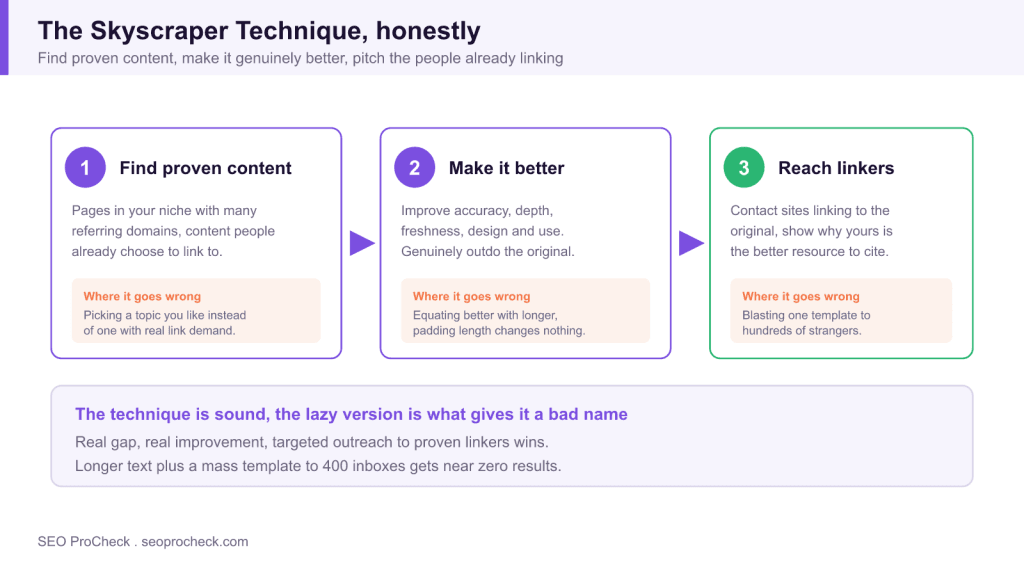
AI Summary
The skyscraper technique is Brian Dean's three step link building play: find content that already earns links, make something notably better, then pitch the people linking to the original. It works when the improvement is real and the outreach is targeted, and it fails when notably better just means longer and the pitch is a mass template.
- Only target content with demonstrated link demand, because no existing linkers means no one to pitch.
- Better means more accurate, current, and usable, not padded with extra word count.
- Pull the referring domains of the original and email each one specifically, referencing the exact page they linked from.
- Returns have thinned as the tactic became common knowledge, so pair it with other link approaches and expect a modest hit rate.
What the skyscraper technique is
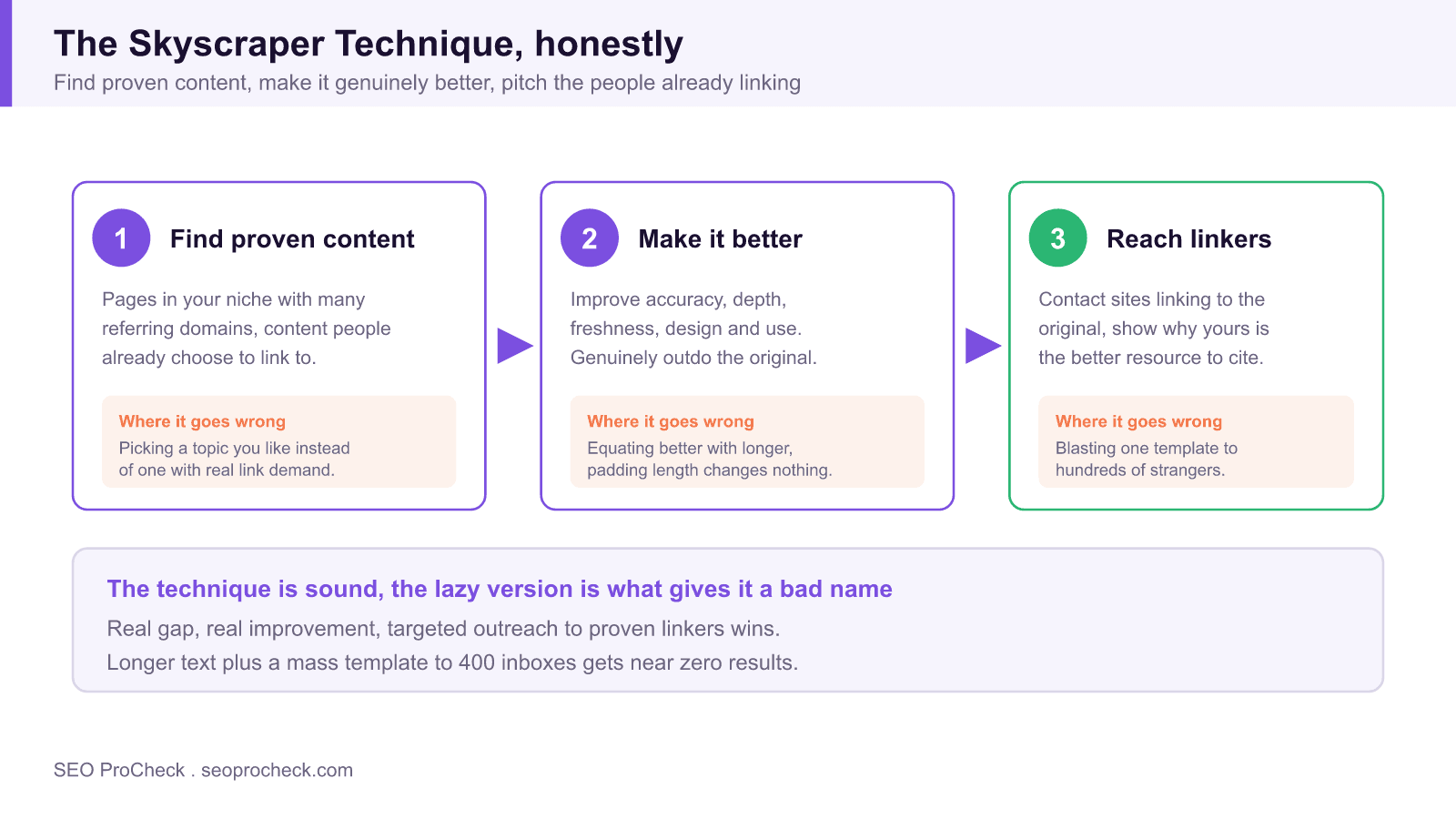
The skyscraper technique is Brian Dean's three-step link-building play: find top-performing content that already earns links, make something notably better, then reach out to the people linking to the original and ask them to link to yours instead. The appeal is that you're not guessing what earns links, you're targeting proven link magnets and improving on them.
It works when the improvement is real and the outreach is targeted. It fails, badly and often, when people treat "notably better" as "add 2,000 more words" and blast a template at anyone with an email address. The technique is sound; the lazy version of it is what gives it a bad name.
The three steps, honestly
| Step | What you do | Where it goes wrong |
|---|---|---|
| 1. Find proven content | Identify pages in your niche with lots of referring domains, content people already choose to link to | Picking a topic you like instead of one with demonstrated link demand |
| 2. Make it notably better | Improve accuracy, depth, freshness, design, and usefulness, genuinely outdo the original | Equating "better" with "longer"; padding length changes nothing |
| 3. Reach out to linkers | Contact the sites that link to the original and show why yours is the better resource to cite | Mass-blasting an identical template to hundreds of unqualified addresses |
A real example
Say the top-ranking guide to "container gardening" is from 2019, links to three dead product pages, and uses low-res photos. That's a genuine opening. You build a version with current, tested plant recommendations, your own photos of real setups, a printable spacing chart, and no broken references. Then you pull the list of sites linking to the 2019 piece, garden blogs, a couple of local extension resources, and email each one specifically: "You link to X in your beginner roundup; that guide's product links are dead now, here's an updated resource with a spacing chart your readers might find handy."
That's the technique working: a real gap, a real improvement, and outreach to people who've already shown they link to this exact topic. Contrast it with adding 1,500 filler words to a decent article and emailing 400 strangers "I saw your great post", same three steps on paper, near-zero results in practice.
How to run it without wasting a week
- Find content with proven link demand. Use a backlink tool to surface pages in your niche ranked by referring domains. No existing links, no skyscraper, you need linkers to pitch.
- Diagnose why it earns links, then find its weaknesses. Outdated data, dead links, thin coverage, ugly presentation, missing a key angle. Your improvement should attack those specific gaps.
- Build something genuinely better. Update the facts, add original data or visuals, fix what's broken, and make it easier to use. If you can't honestly say it's the best resource on the topic, stop here.
- Pull the linker list. Export the referring domains for the original piece. These are your prospects, they've already proven they link to this subject.
- Send personalized, specific outreach. Reference the exact page they linked from, name a concrete reason yours is more useful, and keep it short. Personalization is the whole ballgame.
- Expect diminishing returns and plan around them. This tactic is well-known now, inboxes are saturated, and reply rates are low. Treat a modest hit rate as normal and pair it with other link approaches.
Common mistakes and how to fix them
- Believing longer automatically wins. Word count isn't quality. A tighter, more accurate, better-designed page beats a bloated one. Fix: improve substance and usefulness, not length.
- Skyscrapering a topic nobody links to. If the original has few referring domains, there's no one to pitch. Fix: only target content with demonstrated link demand.
- Templated mass outreach. Identical "I loved your article" emails get deleted. Fix: reference the specific linking page and a concrete reason to update it; send fewer, better emails.
- Ignoring that everyone knows this trick. The tactic's own success eroded its returns, site owners get these pitches constantly. Fix: set realistic expectations and lead with genuine value, not the formula.
- Making a copy, not an upgrade. Rewording the original with a fresh coat of paint fools no one. Fix: add something that didn't exist before, original data, better tooling, real expertise.
Frequently asked questions
Does the skyscraper technique still work in 2026?
It can, but returns have thinned as the tactic became common knowledge and inboxes filled with skyscraper pitches. It works best now when the improvement is genuinely substantial and the outreach is highly targeted, not as a volume play.
Does "better" just mean longer?
No, and this is the single biggest misconception. Longer often means padded, which is worse. "Better" means more accurate, more current, better designed, easier to use, or covering an angle the original missed. Length is at best a side effect.
How many linkers do I need to reach out to?
Quality over volume. A tight list of sites that already link to the original, each emailed specifically, beats a blast to hundreds. Reply rates are low regardless, so make every pitch count rather than chasing send volume.
Is this a black-hat tactic?
No. You're building a better resource and asking relevant sites to cite it, that's legitimate. It only edges toward spam when the "improvement" is fake and the outreach is mass, unpersonalized noise.
What if outreach mostly gets ignored?
That's the normal experience, not a sign you did it wrong, expect a modest hit rate. Improve targeting and personalization, and don't rely on skyscraper alone; treat it as one tactic in a broader link-building mix.
Where this fits
The "make it notably better" step is really a quality bar, and the highest version of that bar is 10x content, content ten times better than the best result, not ten percent longer. For the wider toolkit, see the link building FAQ and the general link building overview. A related, often higher-yield outreach angle is broken link building.
Take this with you
The assistant links open with a question about this page already written. Nothing is sent until you press enter.
Claude Vincent is a technical SEO consultant focused on crawlability, rendering, and AI-search visibility. He writes the field guides and case studies at SEO ProCheck, with a bias toward the durable, unglamorous work that decides whether search engines and AI answer engines can actually read and cite a site.
About SEO ProCheck
Technical SEO consulting and GEO strategy with 20 years of enterprise experience. Case studies, resources, and tools for search and AI visibility.
Work With Me
Technical SEO audits, GEO strategy, site migrations, and international SEO. Hourly consulting for teams who need hands-on support, not just reports.
Subscribe to our newsletter!








Recent Posts
- Most Top Sites Never Say Who They Are in Structured Data October 14, 2026
- Homepage Titles Are Mostly Too Short, Not Too Long October 8, 2026
- Who Actually Serves an llms.txt? 184 Top Sites Measured September 29, 2026