

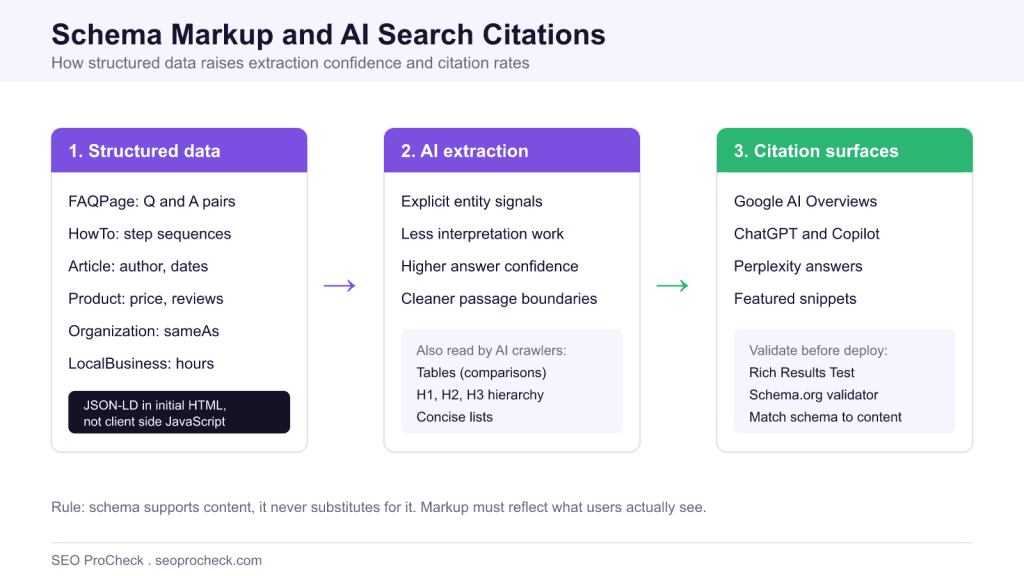
AI Summary
Structured data is not required for AI search visibility, but it reliably lowers the interpretation work an AI system has to do, and pages that carry it tend to be cited more often. FAQPage markup shows the strongest correlation, with pages carrying it appearing 3.2x more often in AI Overviews, while tables and clean heading hierarchy add further extraction confidence.
- FAQPage schema correlates with 3.2x higher AI Overview appearance, and tables with 2.5x more citations.
- Google confirms no special markup is required, yet Microsoft states schema helps its LLMs understand content.
- Embed JSON-LD in the initial HTML so crawlers that do not run JavaScript still read it.
- Match markup to visible content and validate before deploy, or the signal works against you.
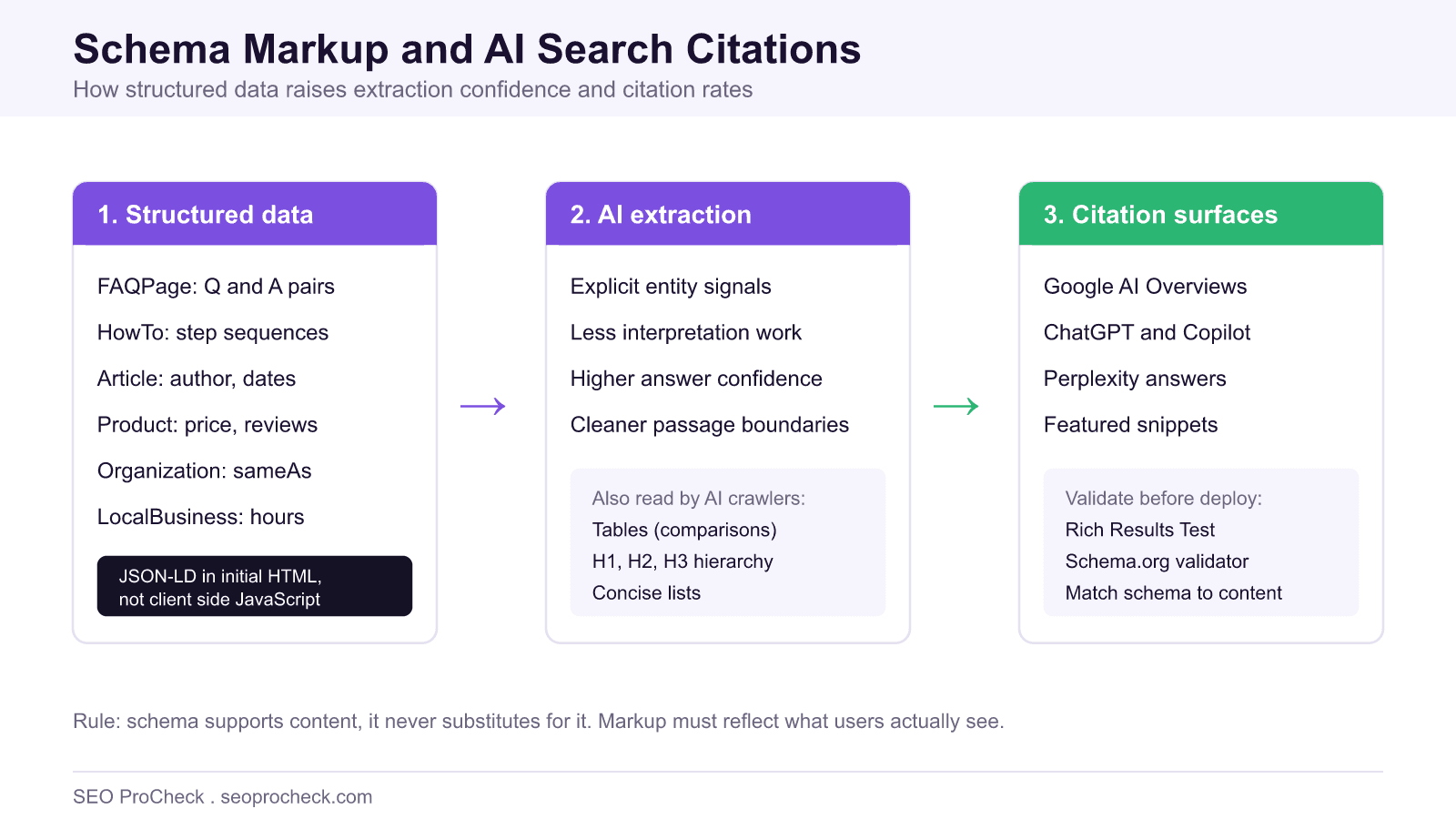
While Google states structured data isn't required for AI features, research shows significant correlation between schema markup and AI citation rates. Pages with FAQPage schema are 3.2x more likely to appear in AI Overviews.
Schema Impact on AI Citations
| Schema/Format Type | Impact on AI Citations | Source |
|---|---|---|
| FAQPage schema | 3.2x higher AI Overview appearance | Industry research |
| Proper H1-H2-H3 hierarchy | 40% more ChatGPT citations | Lily Ray / Amsive |
| Tables in content | 2.5x more citations | Industry analysis |
| Listicle format | 50% of top AI citations | Content analysis |
Read these figures as correlation, not a guarantee. The pages that carry clean FAQPage markup also tend to be the pages someone bothered to structure well, so part of the lift comes from the content discipline that sits behind the schema. In practice the markup and the writing move together: mark up a genuine question and answer block and you have usually already written the concise, quotable answer an AI system wants to lift. The safest way to use this data is to treat schema as a way to remove ambiguity from content that is already good, not as a shortcut around thin pages.
Google's Official Position
Google Search Central states: "You don't need to create new machine readable files, AI text files, or markup to appear in these features."
However, empirical research shows that while not required, structured data significantly improves extraction confidence and citation rates. Microsoft's Fabrice Canel confirmed at SMX: "Schema Markup helps Microsoft's LLMs understand content."
What's Changed Since
Schema advice for AI search has a short shelf life, so a dated note matters here. Three shifts are worth holding in mind:
- FAQ rich results narrowed, then ended, in web search. In 2023 Google limited the visible FAQ rich result to well known, authoritative health and government sites, and on May 7, 2026 it stopped showing FAQ rich results for every site. For a typical page the star treatment in the blue link results mostly went away, which led many teams to strip FAQPage markup entirely.
- The markup kept its machine value. Losing the visible SERP feature did not stop AI systems and Bing from parsing FAQPage data. That parsing is exactly the payoff this page is about, so removing the markup to chase a lost rich result was often the wrong call.
- The payoff moved from snippet to extraction. Through 2024 and 2025, as AI Overviews and assistant answers expanded, the value of clean question and answer markup shifted from a visible snippet toward extraction confidence inside AI answers. Judge FAQPage on citation lift now, not on whether a rich result renders.
If you audited a site a year or two ago and pulled FAQPage markup because the rich result disappeared, this is the section to revisit. For a fuller treatment see whether FAQ schema is still worth it.
Why Structured Data Helps AI Systems
1. Reduced Interpretation Work
AI systems can process natural language, but structured data provides explicit signals:
- FAQPage schema: Clearly identifies question-answer pairs
- HowTo schema: Identifies step-by-step instructions
- Product schema: Identifies prices, availability, reviews
- LocalBusiness schema: Identifies location, hours, contact info
2. Confidence in Extraction
When AI extracts information from unstructured text, it may be uncertain about interpretation. Schema provides certainty about:
- What type of content this is
- What the key facts are
- How information relates to each other
3. Entity Recognition
Schema helps AI systems understand entities and their relationships:
- Organization schema: Identifies your brand as an entity
- Person schema: Identifies authors and experts
- sameAs property: Connects to Wikipedia, social profiles
High-Impact Schema Types for AI
FAQPage Schema
Pages with FAQPage schema show 3.2x higher AI Overview appearance. Implementation example:
{
  "@context": "https://schema.org",
  "@type": "FAQPage",
  "mainEntity": [
    {
      "@type": "Question",
      "name": "How far down in search results do AI tools look?",
      "acceptedAnswer": {
        "@type": "Answer",
        "text": "Typically between 10-50 results. ChatGPT retrieves 3-10 pages per query. Google AI Overviews pull 76% of citations from the top 10."
      }
    }
  ]
}
Article Schema
Helps AI understand content authorship and dates:
{
  "@context": "https://schema.org",
  "@type": "Article",
  "headline": "How AI Search Tools Source Information",
  "author": {
    "@type": "Person",
    "name": "Your Name"
  },
  "datePublished": "2025-01-01",
  "dateModified": "2025-01-01"
}
HowTo Schema
For instructional content and step-by-step guides:
{
  "@context": "https://schema.org",
  "@type": "HowTo",
  "name": "How to Optimize for AI Search",
  "step": [
    {
      "@type": "HowToStep",
      "name": "Implement server-side rendering",
      "text": "Ensure your content is accessible without JavaScript execution."
    }
  ]
}
LocalBusiness Schema (for Restaurants)
Critical for local and restaurant SEO:
{
  "@context": "https://schema.org",
  "@type": "Restaurant",
  "name": "Restaurant Name",
  "address": {
    "@type": "PostalAddress",
    "streetAddress": "123 Main St",
    "addressLocality": "Chicago",
    "addressRegion": "IL"
  },
  "servesCuisine": "Steakhouse",
  "priceRange": "$$$"
}
Which Schema to Use, and Where It Pays Off
Pick the schema type that matches the job of the page. Forcing a type onto the wrong template is the fastest way to earn a mismatch flag in validation and to lose AI trust.
| Schema type | Best for | AI surface it helps most |
|---|---|---|
| FAQPage | Pages with genuine question and answer blocks | AI Overviews, featured snippets |
| HowTo | Ordered, step by step procedures | Assistant how to answers |
| Article | News, research, and dated posts | Freshness and authorship signals |
| Product | Ecommerce detail pages | Shopping and price answers |
| Organization | Brand home and about pages | Entity links and knowledge panels |
| LocalBusiness | Storefront and service area pages | Map packs and local AI answers |
Content Formatting for AI Extraction
Tables
Tables receive 2.5x more AI citations than unstructured content. AI systems can extract tabular data efficiently:
- Use tables for comparisons, data, specifications
- Include clear headers
- Keep tables focused on single topics
- Use proper HTML table markup
Heading Hierarchy
Content with proper H1,H2,H3 hierarchy is 40% more likely to be cited by ChatGPT:
- One H1 per page (the main topic)
- H2s for major sections
- H3s for subsections
- Use headings as questions when relevant
Lists and Bullet Points
Listicles account for 50% of top AI citations:
- Use numbered lists for sequences and rankings
- Use bullet points for features and attributes
- Keep list items concise but informative
- Use proper HTML list markup
Implementation Best Practices
1. Embed Schema in HTML
Always embed schema markup in the initial HTML response, not generated via JavaScript. AI crawlers that can't execute JavaScript won't see client-side generated schema.
2. Validate Before Deployment
Use Google's Rich Results Test or Schema.org validator to ensure markup is valid and complete.
3. Keep Schema Updated
Ensure dates, prices, and other dynamic information in schema stays current. Outdated schema can hurt credibility.
4. Match Schema to Content
Schema must accurately reflect page content. Don't add FAQPage schema unless you actually have Q&A content on the page.
A Minimal Deployment Workflow
You do not need a schema plugin sprawl to get the citation benefit. A tight, repeatable routine beats a large graph that nobody maintains:
- Draft the answer first. Write the visible question and answer or the visible steps before you touch JSON-LD. The markup describes the page, so the page has to be right first.
- Generate one JSON-LD block server side. Emit a single script tag in the initial HTML. Do not inject it with client JavaScript, and do not stack three overlapping FAQ blocks.
- Validate the exact rendered URL. Run the live URL, not a staging draft, through the Rich Results Test and the Schema.org validator, and confirm the values match what a visitor sees.
- Recheck after template changes. Theme updates and page builders silently drop or duplicate schema. Add a quarterly spot check to your calendar so a broken graph does not sit live for months.
For the retrieval side of this equation, see how AI search tools source information from organic results and why server side rendering keeps that markup visible to crawlers.
Frequently Asked Questions
Is schema required for AI visibility?
Not required, but beneficial. Google confirms AI features don't require special markup, but research shows 3.2x higher appearance rates with FAQPage schema.
Which schema types matter most for AI?
FAQPage shows the strongest correlation with AI citations. Article, HowTo, and LocalBusiness schemas also show benefits for their respective content types.
Do AI crawlers read JSON-LD schema?
Yes, JSON-LD is embedded in HTML and doesn't require JavaScript execution. AI crawlers can read it even without JavaScript rendering capability.
Should I add schema to every page?
Add appropriate schema to pages where it makes sense. Don't force FAQPage schema on pages without Q&A content. Quality and relevance matter more than quantity.
Is FAQPage schema still worth it now that Google removed the FAQ rich result for all sites?
Yes for AI extraction. The visible FAQ rich result narrowed to authoritative health and government sites in 2023 and ended for every site on May 7, 2026, but AI systems and Bing still parse FAQPage data. Judge it on citation lift inside AI answers rather than on whether a rich snippet renders.
What happens if my schema does not match the visible content?
It can hurt you. Validators flag mismatches, and AI systems lower trust in markup that describes content a visitor cannot see. Keep the JSON-LD in sync with the page, and never mark up questions or steps that are not actually present.
Sources
- Google: About AI Overviews
- Google: Introduction to Structured Data
- Search Engine Land: Microsoft Says Schema Markup Helps LLMs
- Schema.org: FAQPage
Related Research
- How AI Search Tools Source Information from Organic Search Results
- JavaScript and AI Search: Why Server-Side Rendering Matters
- Google AI Overviews: How to Optimize for AI Overview Citations
Take this with you
The assistant links open with a question about this page already written. Nothing is sent until you press enter.
Claude Vincent is a technical SEO consultant focused on crawlability, rendering, and AI-search visibility. He writes the field guides and case studies at SEO ProCheck, with a bias toward the durable, unglamorous work that decides whether search engines and AI answer engines can actually read and cite a site.
About SEO ProCheck
Technical SEO consulting and GEO strategy with 20 years of enterprise experience. Case studies, resources, and tools for search and AI visibility.
Work With Me
Technical SEO audits, GEO strategy, site migrations, and international SEO. Hourly consulting for teams who need hands-on support, not just reports.
Subscribe to our newsletter!








Recent Posts
- Most Top Sites Never Say Who They Are in Structured Data October 14, 2026
- Homepage Titles Are Mostly Too Short, Not Too Long October 8, 2026
- Who Actually Serves an llms.txt? 184 Top Sites Measured September 29, 2026