

AI Summary
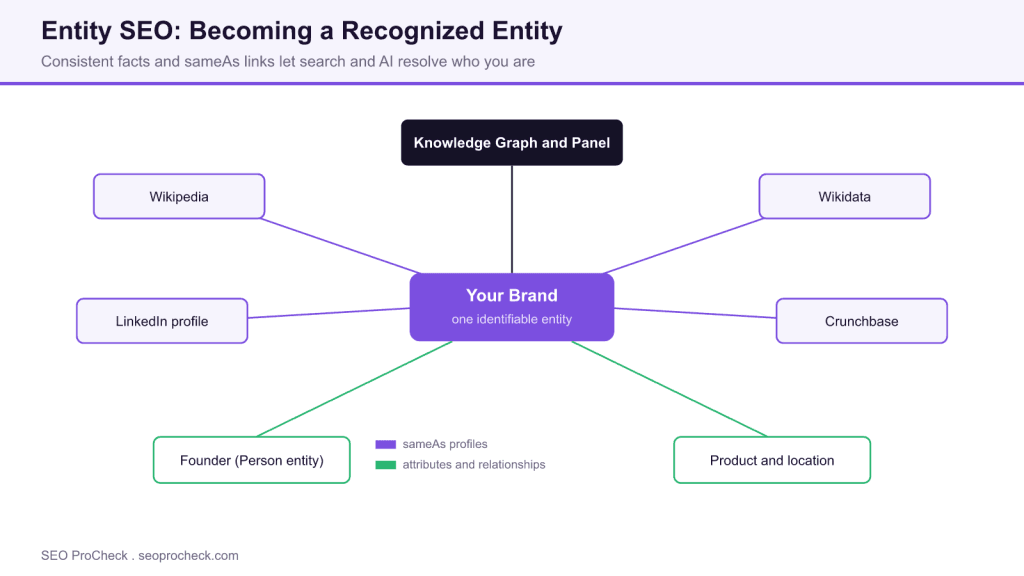
Entity SEO is the work of making search engines and AI systems recognize your brand, person, or product as one clearly defined thing rather than a fuzzy string of keywords. You strengthen your entity with consistent names and descriptions, Organization or Person structured data, sameAs links to authoritative profiles, and corroboration from trusted third party sources.
- An entity has an identity independent of the words used to describe it, so "Apple" the company and "apple" the fruit are separate.
- Google stores entities in its Knowledge Graph, and the Knowledge Panel is its public face.
- You cannot force a Knowledge Panel, but you can supply the consistent, linked signals that earn one.
- Entity SEO and keyword SEO are complementary: identity underneath, keyword relevance on top.

An entity is a uniquely identifiable thing: a person, a brand, a product, a place. Search engines and AI systems increasingly map the web as a network of entities and relationships, not just a bag of keywords. You strengthen your entity by being consistent (name, address, descriptions), by publishing Organization or Person structured data with sameAs links to authoritative profiles, by maintaining a clear About page, and by earning mentions in trusted third-party sources. You cannot force a Knowledge Panel, but you can give the systems everything they need to recognize you and connect the dots correctly.
What an entity is and why it matters
An entity is a thing that can be pointed to without ambiguity. You are an entity. Your company is an entity. So is the city you operate in, the product you sell, and the conference you spoke at last spring. The defining quality is that an entity has an identity independent of the words people use to describe it. "Apple" the company and "apple" the fruit share a string of letters but are two completely separate entities, and a search engine that understands this can route a query to the right one.
For most of search history, ranking was a contest of strings. A page that contained the query words, in the right density and the right places, tended to win. That model had a ceiling. It could not tell whether two pages were about the same subject described in different words, and it could not reason about how things relate to one another. Entity modeling raised that ceiling. When a system knows that a given page is about a specific company, and that the company is headquartered in a specific city, founded by a specific person, and sells a specific category of product, it can answer questions that no amount of keyword matching could reach.
This matters more now because AI answer systems sit on the same foundation. When a generative assistant summarizes "the best accounting software for freelancers" or describes what your firm does, it is reasoning over entities and the facts attached to them. If your brand is a well defined entity with consistent, corroborated information across the web, you are a candidate for that summary. If your brand is a fuzzy string that the systems cannot resolve to a single, confident identity, you are easy to overlook or, worse, to confuse with someone else.
How entities get recognized
Behind the scenes, Google maintains a Knowledge Graph: a large structured store of entities and the relationships between them. Each entity carries attributes (a founding date, a logo, a headquarters) and edges to other entities (this person founded that company, that company makes this product). The public face of the Knowledge Graph is the Knowledge Panel, the boxed summary that appears beside or above results for well established subjects.
Entities enter that graph from many directions. Structured databases such as Wikidata and Wikipedia are heavily weighted because they are curated and machine readable. Authoritative directories, licensing bodies, and well known publications contribute corroboration. And the open web itself contributes: when many independent, trustworthy sources describe the same thing in compatible ways, the system gains confidence that the thing exists and that its attributes are correct. Recognition is rarely a single event. It is the accumulation of consistent signals until the system is confident enough to treat you as a known quantity. For a deeper look at the formats that make your brand legible to machines, see our guide on building a machine-readable brand with entity HTML.
How to strengthen your entity signals
You cannot edit the Knowledge Graph directly, but you control the inputs it reads. Work through the following checklist.
- Fix your name, address, and phone (NAP) everywhere. Use one canonical spelling of your business name and one consistent address and phone number across your site, your profiles, and every directory listing. Conflicting details force the systems to guess, and guessing erodes confidence.
- Publish Organization or Person structured data. Mark up your homepage or About page with schema that names you, describes you, and states your core attributes (logo, founding date, location, contact point). This is the cleanest way to tell a machine, in its own language, exactly who you are.
- Add
sameAslinks to authoritative profiles. Inside that structured data, thesameAsproperty points to other places the same entity is described: your Wikipedia or Wikidata page, your LinkedIn company page, your verified social profiles, your Crunchbase or industry listings. These links are the bridges that let a system confirm that the entity on your site is the same one it already knows elsewhere. - Build a strong About page. Write a clear, factual account of who you are, what you do, when you started, and who is behind the work. This is the human readable counterpart to your structured data, and it is often what both people and AI systems read to understand you.
- Earn presence in authoritative third-party sources. A Wikidata item, a relevant Wikipedia citation, listings in respected industry directories, and coverage in trusted publications all corroborate your existence. You do not control these directly, but you can earn and maintain accurate entries where the inclusion bar is met honestly.
- Keep descriptions consistent across the web. The one or two sentence summary of your business should say the same thing on your site, your social bios, and your directory profiles. Wildly different descriptions read as noise; a consistent description reads as a confirmed fact.
- Use internal linking to reinforce topic relationships. Link related pages together with descriptive anchors so the systems can see how your products, services, and topics connect. Strong internal structure tells search engines what you are an authority on and how the pieces of your site relate.
The technical groundwork behind these signals is covered in our overview of machine-readable web standards, and for location based businesses our LocalBusiness schema guide walks through the markup in detail.
<script type="application/ld+json">
{
  "@context": "https://schema.org",
  "@type": "Organization",
  "name": "Example Co",
  "url": "https://www.example.com",
  "logo": "https://www.example.com/logo.png",
  "description": "Example Co builds accounting software for freelancers.",
  "sameAs": [
    "https://en.wikipedia.org/wiki/Example_Co",
    "https://www.wikidata.org/wiki/Q00000000",
    "https://www.linkedin.com/company/example-co",
    "https://www.crunchbase.com/organization/example-co"
  ]
}
</script>
Entity SEO vs keyword SEO
These are not rivals, and you do not pick one. Keyword SEO is about matching the language of a query: understanding what people type, and making sure your pages speak that language clearly. Entity SEO is about identity and relationships: making sure search engines and AI systems know who you are, what you are connected to, and which facts about you are true.
The practical difference is what each one optimizes. Keyword work helps a specific page rank for a specific search. Entity work builds the durable foundation underneath: it makes you a recognized subject that the systems can describe, recommend, and pull into AI answers without confusion. Keyword strategy still earns the click on a particular query. Entity strategy decides whether you are a known quantity in the first place. The strongest programs do both: clear, keyword aware pages sitting on top of a well defined, well corroborated entity.
How to check your entity
You can read the systems' current understanding of you with a few quick checks.
- Search your own brand name. Your brand SERP, the page of results for your exact name, is the closest thing to a report card. Look at what ranks, whether the right profiles appear, and whether anything inaccurate or unrelated shows up.
- Look for a Knowledge Panel. If one appears for your brand or your name, check every fact in it. If something is wrong and you can verify the correct information, established profiles let you suggest edits.
- Check Wikidata and the Knowledge Graph. Search Wikidata for your entity to see whether an item exists and what attributes it holds. This is one of the most directly editable, machine readable sources feeding entity recognition.
- Use entity tools. Google's Natural Language API demo, for example, shows which entities a system extracts from a block of your text and how salient it considers each one. That is a useful read on whether your own pages make your core entity prominent.
Entity signals, what they do, and where to place them
Entity recognition is the sum of many small, consistent signals. This table maps the most important ones to their job and where they live.
| Signal | What it tells the systems | Where it lives |
|---|---|---|
| Consistent name, address, phone | This is one stable, real organization | Site, profiles, every directory listing |
| Organization or Person schema | Core attributes in machine language | Homepage or About page markup |
| sameAs links | The entity here equals the one known elsewhere | Inside the structured data |
| About page | Human readable facts and history | A dedicated page on your site |
| Wikidata item and directories | Independent corroboration of existence | Third party curated sources |
| Descriptive internal links | How your topics and products relate | Body copy across your site |
FAQ
No. A Knowledge Panel appears only when Google is confident it has a well defined, corroborated entity to display. You cannot buy or request one. What you can do is supply consistent, structured, well linked information across your site and authoritative third-party sources so that confidence is earned over time.
No. Wikipedia helps because it is curated and widely trusted, but it is one of many corroborating sources. A Wikidata item, consistent directory listings, structured data with sameAs links, and accurate coverage elsewhere can establish your entity without a Wikipedia article. Never create a Wikipedia page that does not meet its notability standards; it will be removed and can do harm.
There is no fixed timeline. Recognition accumulates as the systems re-crawl your site, read your structured data, and reconcile it with other sources. Consistency is what moves it: the longer your name, descriptions, and profile links stay aligned, the more confident the systems become.
No. The two work together. Keyword research tells you the language your audience uses and which pages to build. Entity work establishes who you are so those pages rank from a position of recognized authority and so AI systems can describe and recommend you accurately.
A keyword is a string of text people type, while an entity is the real thing that string can refer to. The keyword "jaguar" is ambiguous; the entity is a specific animal, car brand, or sports team. Keyword SEO matches the language of a query, and entity SEO makes sure the systems know which real thing your pages are actually about.
Start by searching your exact brand name and reading the results as a report card: note whether the right profiles rank and whether a Knowledge Panel appears. Then check Wikidata for an item about you, and run a sample of your own copy through an entity extraction tool to confirm your brand reads as the salient entity on your key pages.
An advanced SEO audit maps your current entity signals, structured data, and brand SERP, then shows you exactly where to strengthen them.
Take this with you
The assistant links open with a question about this page already written. Nothing is sent until you press enter.
Claude Vincent is a technical SEO consultant focused on crawlability, rendering, and AI-search visibility. He writes the field guides and case studies at SEO ProCheck, with a bias toward the durable, unglamorous work that decides whether search engines and AI answer engines can actually read and cite a site.
About SEO ProCheck
Technical SEO consulting and GEO strategy with 20 years of enterprise experience. Case studies, resources, and tools for search and AI visibility.
Work With Me
Technical SEO audits, GEO strategy, site migrations, and international SEO. Hourly consulting for teams who need hands-on support, not just reports.
Subscribe to our newsletter!








Recent Posts
- Most Top Sites Never Say Who They Are in Structured Data October 14, 2026
- Homepage Titles Are Mostly Too Short, Not Too Long October 8, 2026
- Who Actually Serves an llms.txt? 184 Top Sites Measured September 29, 2026