

AI Summary
An SEO content brief is a short specification that hands a writer every decision already made: the target keyword, the intent, the outline, the internal links, and the on-page targets. You build one by mining the live SERP for the query, extracting the shared subtopics and questions, then writing a fielded template a writer can follow without guessing.
- A brief converts a keyword-map row into a buildable spec before any drafting starts.
- Reverse-engineer the top 10 results for shared H2 subtopics and People Also Ask questions.
- Fix the on-page targets: title, H1, word range, internal links, and meta description.
- A good brief cuts revision cycles because the writer never has to guess intent or scope.
What an SEO content brief is, and what it is not
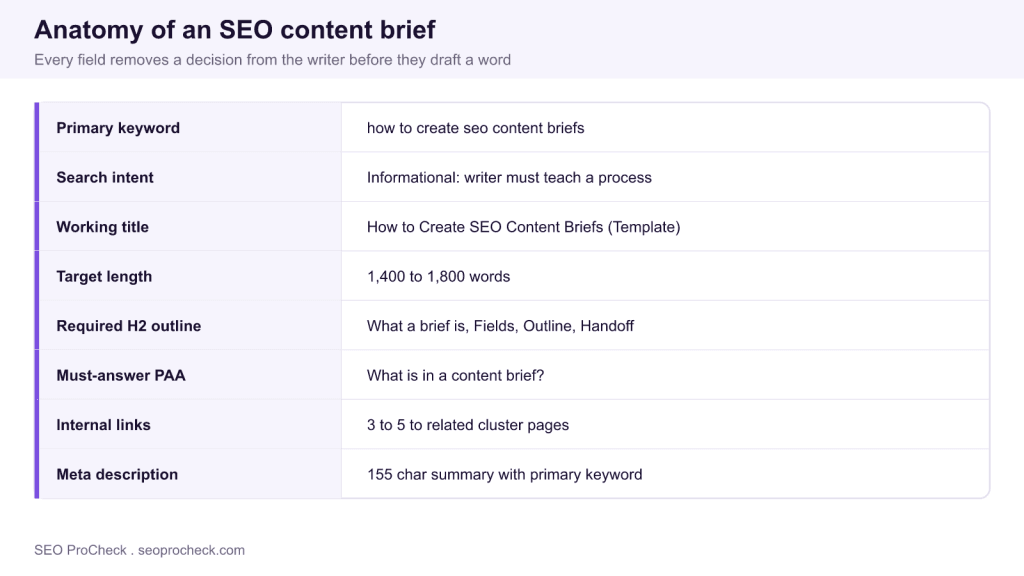
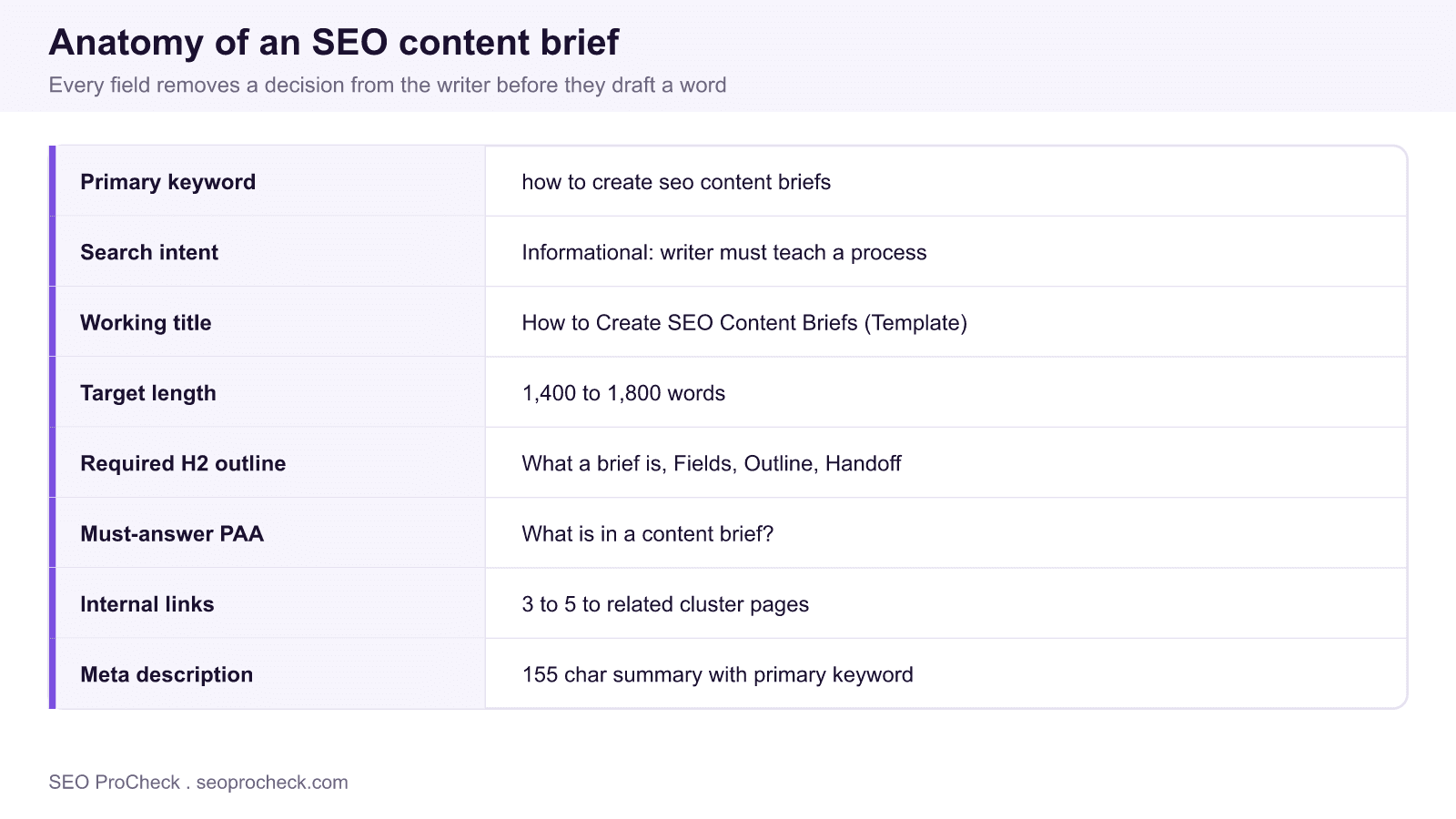
A content brief is a one-page specification that translates a single keyword-map row into something a writer can build without stopping to make strategic decisions. It is not the article, and it is not a vague topic suggestion like "write something about content briefs." A real brief names the primary keyword, the search intent, the working title, the required outline, the questions the page must answer, the internal links to include, and the on-page targets. The test of a finished brief is simple: could a competent writer who has never seen your keyword strategy produce an on-target draft from it alone? If yes, the brief is done.
Where a brief sits in the workflow
Briefs are step three of a four-step chain. First you build a keyword map that assigns each cluster to one URL. Second you prioritize which URLs to build. Third you write a brief for each prioritized URL. Fourth the writer drafts. Skipping the brief is the most expensive shortcut in content production because the cost surfaces later, as revision rounds, off-intent drafts, and thin pages that never rank. The brief is where you spend one focused hour to save three rounds of edits.
Step 1: Confirm intent from the live SERP
Open an incognito window and search the primary keyword. Read the top 10 results and classify what Google is already rewarding. Are they step-by-step guides, comparison listicles, or product pages? That format is your intent signal, and the brief must match it. If the SERP is all tutorials and you brief a sales page, the page will not rank no matter how good the copy is. Note the dominant content type in the brief so the writer does not fight the SERP.
Step 2: Extract the shared outline
Skim the subheadings of the top five results and list every H2 or H3 that appears on two or more of them. Recurring subtopics are the ground Google expects the page to cover. Add anything competitors all miss but users clearly need, which is your differentiation. Then pull the People Also Ask box and the related searches; each question that fits the intent becomes either an H2 or an FAQ entry. The output of this step is a required outline, not a suggestion.
| Brief field | How to source it | Why the writer needs it |
|---|---|---|
| Primary keyword | Keyword map row | Anchors title, H1, and focus |
| Search intent | Top 10 SERP content type | Picks the format that can rank |
| Outline (H2 list) | Shared subheadings plus PAA | Guarantees topical coverage |
| Target length | Median word count of top 5 | Scopes effort, avoids thin or bloated |
| Internal links | Cluster and hub pages | Passes relevance and aids navigation |
| Title and meta | Primary keyword plus a hook | Drives click-through in the SERP |
Step 3: Set the on-page targets
Fill the fixed fields. The working title should lead with the primary keyword and stay under roughly 60 characters so it does not truncate. The H1 mirrors the title. Word range comes from the median of the top five results, not the longest outlier, so you match reader expectation without padding. Specify three to five internal links by URL and suggested anchor, drawn from the same cluster and the topic hub. Write a 150 to 155 character meta description that contains the primary keyword and a reason to click. Store all of this in one reusable template so every brief looks identical.
PRIMARY: how to create seo content briefs
INTENT: informational (guides dominate the SERP)
TITLE: How to Create SEO Content Briefs (Template)
LENGTH: 1400 to 1800 words
OUTLINE:
  H2 What a content brief is
  H2 Where a brief sits in the workflow
  H2 The fields every brief needs
  H2 Handoff and quality gate
PAA: What is in a content brief? How long should it be?
LINKS: /keyword-map/ , /prioritize-seo-tasks/ , /content-strategy/
META: A field-by-field guide to writing SEO content briefs that cut revision rounds.
Step 4: Handoff and the quality gate
Before you send the brief, run it through one gate: intent match, complete outline, defined length, links assigned, title and meta written. Attach two or three example URLs the writer can model tone and depth on. A useful habit is to write the first sentence of the introduction yourself so the writer inherits the angle rather than inventing one. When the draft returns, review it against the brief fields, not against personal taste, so feedback stays objective and fast.
Scaling briefs without losing quality
Once the template is stable, the bottleneck is SERP analysis, not writing the brief. Batch the research: pull the top 10 for ten queries in one sitting, capture outlines and PAA into the template, then refine. Keep a shared library of finished briefs so patterns emerge and new team members ramp quickly. The brief is also where accessibility and structured data notes belong, so the writer knows to include descriptive image alt text and a FAQ block from the start rather than bolting them on later.
Brief mistakes that create revision rounds
- No intent line. Without a stated intent the writer defaults to their own format, and half the time it fights the SERP. Always name the content type Google is rewarding.
- Outline as a wish list. Listing every possible subtopic bloats the draft. Include only the subheadings that appear across the top results plus your one differentiator.
- Copying the longest competitor. Matching a 4,000 word outlier forces padding. Scope to the median of the top five so depth matches reader expectation.
- Links left to the writer. If you do not name the internal links, they get skipped. Specify destination and anchor in the brief so they always ship.
Briefs do not exist in isolation. Each one starts from a mapped keyword cluster and feeds a prioritized production queue. Learn how to build the upstream map in how to build a keyword map, decide which briefs to write first in prioritizing SEO tasks, and help writers execute them in training teams on SEO.
Frequently Asked Questions
What should an SEO content brief include?
At minimum: the primary keyword, the search intent, a working title and H1, a required H2 outline, the target word range, three to five internal links, the People Also Ask questions to answer, and a meta description. The goal is that a writer can produce an on-target draft from the brief alone without asking follow-up questions.
How long should a content brief be?
The brief itself is usually one page, roughly 300 to 600 words of instructions. What matters is completeness, not length: every strategic decision should already be made. The article it produces is scoped separately, typically to the median word count of the current top five ranking pages.
How do I decide the intent for a brief?
Read the top 10 live results for the primary keyword in an incognito window. The dominant content type, whether guides, comparisons, or product pages, is the intent Google rewards. Match the brief to that format rather than to what you wish the page could be.
Can I use AI to write content briefs?
AI can accelerate SERP summarization and draft an outline, but a human should confirm intent, verify the shared subtopics against the live results, and set internal links, because those judgments are where briefs add value. Treat AI output as a first pass to edit, not a finished brief.
How is a content brief different from a keyword map?
A keyword map assigns clusters to URLs across the whole site; it is the plan. A content brief is the detailed spec for one of those URLs. You build the map once, then write a brief each time you are ready to produce a specific page from it.
How many internal links should a brief specify?
Three to five is a practical range for most articles. Pull them from the same topic cluster and the hub page so the new page reinforces its cluster. Give the writer both the destination URL and a suggested anchor so the links get placed naturally in context.
Claude Vincent is a technical SEO consultant focused on crawlability, rendering, and AI-search visibility. He writes the field guides and case studies at SEO ProCheck, with a bias toward the durable, unglamorous work that decides whether search engines and AI answer engines can actually read and cite a site.
About SEO ProCheck
Technical SEO consulting and GEO strategy with 20 years of enterprise experience. Case studies, resources, and tools for search and AI visibility.
Work With Me
Technical SEO audits, GEO strategy, site migrations, and international SEO. Hourly consulting for teams who need hands-on support, not just reports.
Subscribe to our newsletter!




Recent Posts
- Can AI Crawlers Actually Read Your Site? I Measured 400 of the Biggest September 5, 2026
- The Pre-Publish Quality Gate for AI-Assisted Content August 6, 2026
- AGENTS.md vs llms.txt vs llms-full.txt: Which Agent File Does What July 18, 2026