

AI Summary
Prioritizing SEO tasks means scoring each backlog item by the traffic or revenue it can move against the effort it costs, then working the highest ratio first. The fastest method is an impact and effort matrix backed by an ICE or PIE score, refreshed against Search Console data every sprint.
- Score by impact over effort, not by whatever feels urgent or interesting.
- Quick wins (high impact, low effort) ship first; time sinks get dropped.
- ICE and PIE give a repeatable number so priority is defensible, not political.
- Re-rank every sprint using live Search Console and rank-tracker data.
Why SEO prioritization is the real skill
Most SEO backlogs contain far more work than any team can finish, so the job is not listing tasks, it is sequencing them. The difference between a program that compounds and one that spins is whether the highest-leverage work gets done first. Prioritization forces two questions on every item: how much organic traffic or revenue can this move, and how much effort does it cost? When you answer those consistently, the backlog stops being a wish list and becomes an ordered queue.
Start with the impact and effort matrix
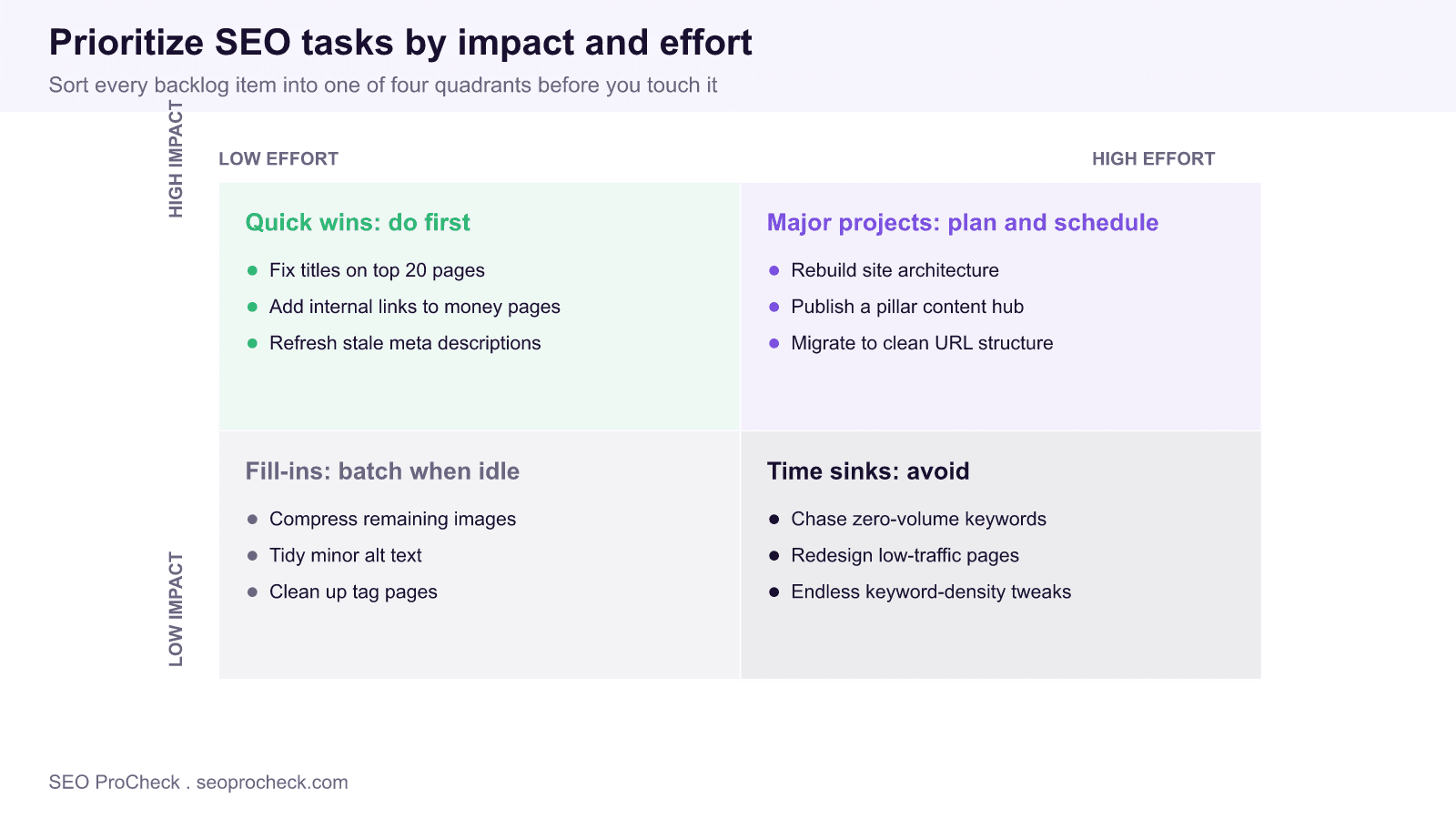
The fastest triage is a two-by-two. Plot impact on the vertical axis and effort on the horizontal, then drop each task into a quadrant. Quick wins sit top-left: high impact, low effort, and they ship this week. Major projects sit top-right: high impact but expensive, so they get planned and resourced rather than squeezed in. Fill-ins sit bottom-left: cheap but minor, batched for idle time. Time sinks sit bottom-right: costly and low value, and the correct action is to delete them from the backlog entirely. Sorting a raw backlog this way takes thirty minutes and immediately surfaces the work that matters.
Add a numeric score with ICE or PIE
A matrix groups tasks; a score ranks them inside the groups and settles arguments. Two frameworks are worth knowing. ICE scores each task on Impact, Confidence, and Ease from 1 to 10, then multiplies or averages them. PIE scores Potential, Importance, and Ease. Both give a single comparable number so priority is a calculation, not a preference. Confidence matters because a huge projected impact you are only 20 percent sure of should rank below a smaller, near-certain gain.
| Task | Impact | Confidence | Ease | ICE score |
|---|---|---|---|---|
| Fix titles on top 20 pages | 8 | 8 | 9 | 8.3 |
| Add internal links to money pages | 7 | 7 | 8 | 7.3 |
| Publish a pillar content hub | 9 | 6 | 3 | 6.0 |
| Redesign a low-traffic page | 3 | 5 | 4 | 4.0 |
Ground the scores in real data
Impact should not be a gut number. Pull the evidence first. Open the Search Console Performance report and sort pages by impressions with low click-through; those are ranking near the top with a weak title, which is why title fixes score so high. Filter queries in positions 5 to 15, because a page on page one but below the fold can often be pushed up with modest on-page work, a far better bet than a query sitting at position 60. Cross-reference your rank tracker for keywords with commercial value and a downward trend. When impact is anchored to impressions, position, and revenue rather than opinion, the ranking holds up in a stakeholder meeting.
A weighted formula when you need more rigor
For larger programs, a weighted score keeps business value front and center. A simple version:
priority = (traffic_potential * 0.4)
         + (revenue_value * 0.3)
         + (confidence * 0.2)
         + (ease * 0.1)

# traffic_potential: search volume x realistic CTR at target position
# revenue_value: traffic_potential x conversion rate x order value
# confidence and ease: 1 to 10
Weighting revenue and traffic above ease stops the backlog from filling with trivial but effortless tasks. The point of any formula is consistency: the same task scored by two people should land in nearly the same place.
Re-rank on a fixed cadence
Priorities decay. A page that was a quick win last month may already be fixed, and a core update can turn a fill-in into an emergency. Re-score the top of the backlog at the start of every sprint using fresh Search Console and rank data, and reserve capacity for reactive work so an algorithm update or a broken template does not blow up the plan. Keep the scored backlog in one shared sheet so anyone can see why item A is above item B.
A worked prioritization pass
Picture a backlog of thirty items. First, drop each into a quadrant in thirty minutes: eight land in quick wins, five in major projects, twelve in fill-ins, and five in time sinks. Delete the five time sinks immediately, because keeping them on the list only creates guilt and noise. Next, score the eight quick wins and five major projects with ICE so you have a clean order inside each group. Now build the sprint: load the top four quick wins first, since they deliver visible movement and buy political capital, then slot one major project that you break into smaller shippable pieces so it does not stall. The twelve fill-ins wait for gaps between larger work. In one hour a chaotic list became a two-week plan any stakeholder can follow.
Common prioritization mistakes
- Confusing urgent with important. A loud request from one stakeholder is not automatically high impact. Run it through the same score as everything else.
- Scoring effort in isolation. Cheap tasks feel satisfying, but a backlog of only easy wins never moves the big numbers. Protect capacity for the high-impact projects too.
- Never deleting anything. Time sinks that stay on the list get revisited again and again. Remove them so the backlog reflects real intent.
- Set-and-forget ranking. A priority order that is never refreshed drifts from reality within a sprint. Re-score against live data on a fixed cadence.
Where to keep the scored backlog
Tooling matters less than discipline, but the backlog needs a single home everyone trusts. A shared spreadsheet with columns for task, quadrant, impact, confidence, ease, score, owner, and status is enough for most teams and makes the sort order self-explanatory. Larger programs move the same fields into a project tool such as Asana, ClickUp, or Jira so tasks connect to sprints and owners. Whatever the tool, keep one source of truth, sort by score, and make the reasoning visible so priority debates reference numbers instead of opinions. The moment work lives in scattered docs and inboxes, prioritization quietly stops happening.
Prioritization sits between planning and execution. It draws its candidate work from your keyword and content plans and hands an ordered queue to the people who do the work. See where the tasks come from in building a keyword map, how each becomes a spec in creating SEO content briefs, and how to get a team executing them in training teams on SEO.
Frequently Asked Questions
How do I prioritize SEO tasks with limited time?
Use an impact and effort matrix and do the top-left quadrant first: high-impact, low-effort quick wins like fixing titles on high-impression pages and adding internal links to key pages. These move rankings fastest for the least work, so they belong at the front of any constrained queue.
What is the ICE scoring model in SEO?
ICE scores each task on Impact, Confidence, and Ease from 1 to 10, then combines them into one number. Impact is the potential result, Confidence is how sure you are it will work, and Ease is how little effort it takes. Ranking the backlog by ICE turns prioritization into a calculation instead of an argument.
Which SEO tasks usually deliver the fastest results?
Title and meta rewrites on pages that already earn impressions, internal links pointing to important pages, and on-page tweaks for queries sitting in positions 5 to 15. These act on pages Google already trusts, so improvements tend to show within weeks rather than months.
How do I measure the impact of an SEO task before doing it?
Estimate it from data: multiply search volume by the realistic click-through rate at your target position to get traffic potential, then multiply by conversion rate and order value for revenue potential. Anchoring impact to Search Console impressions and current position keeps the estimate honest.
How often should I re-prioritize the SEO backlog?
Re-score the top of the backlog every sprint, typically every one to two weeks, using fresh Search Console and rank-tracker data. Completed quick wins drop off, new opportunities surface, and algorithm updates can reorder everything, so a static list goes stale quickly.
Should I ever ignore high-impact SEO tasks?
Yes, when they are high effort and low confidence relative to available quick wins. A big project you are only mildly sure about should be scheduled and resourced deliberately, not started ahead of several near-certain wins. Confidence is exactly why ICE and PIE include it as a factor.
Claude Vincent is a technical SEO consultant focused on crawlability, rendering, and AI-search visibility. He writes the field guides and case studies at SEO ProCheck, with a bias toward the durable, unglamorous work that decides whether search engines and AI answer engines can actually read and cite a site.
About SEO ProCheck
Technical SEO consulting and GEO strategy with 20 years of enterprise experience. Case studies, resources, and tools for search and AI visibility.
Work With Me
Technical SEO audits, GEO strategy, site migrations, and international SEO. Hourly consulting for teams who need hands-on support, not just reports.
Subscribe to our newsletter!







Recent Posts
- Can AI Crawlers Actually Read Your Site? I Measured 400 of the Biggest September 5, 2026
- The Pre-Publish Quality Gate for AI-Assisted Content August 6, 2026
- AGENTS.md vs llms.txt vs llms-full.txt: Which Agent File Does What July 18, 2026