


AI Summary
User generated content such as reviews, questions and answers, forum threads, and comments can be a genuine SEO asset when it is useful, crawlable, and moderated. It adds freshness, covers long tail language your writers would never produce, and supplies the first hand experience signals that support E-E-A-T.
- Treat UGC as a managed program, not a free traffic hack.
- Render contributions in the page HTML so crawlers can read them.
- Pair automated spam filtering with human review, then surface the best and prune the thin.
- Tie UGC to Search Console impressions, rich results, and conversion, not vanity counts.
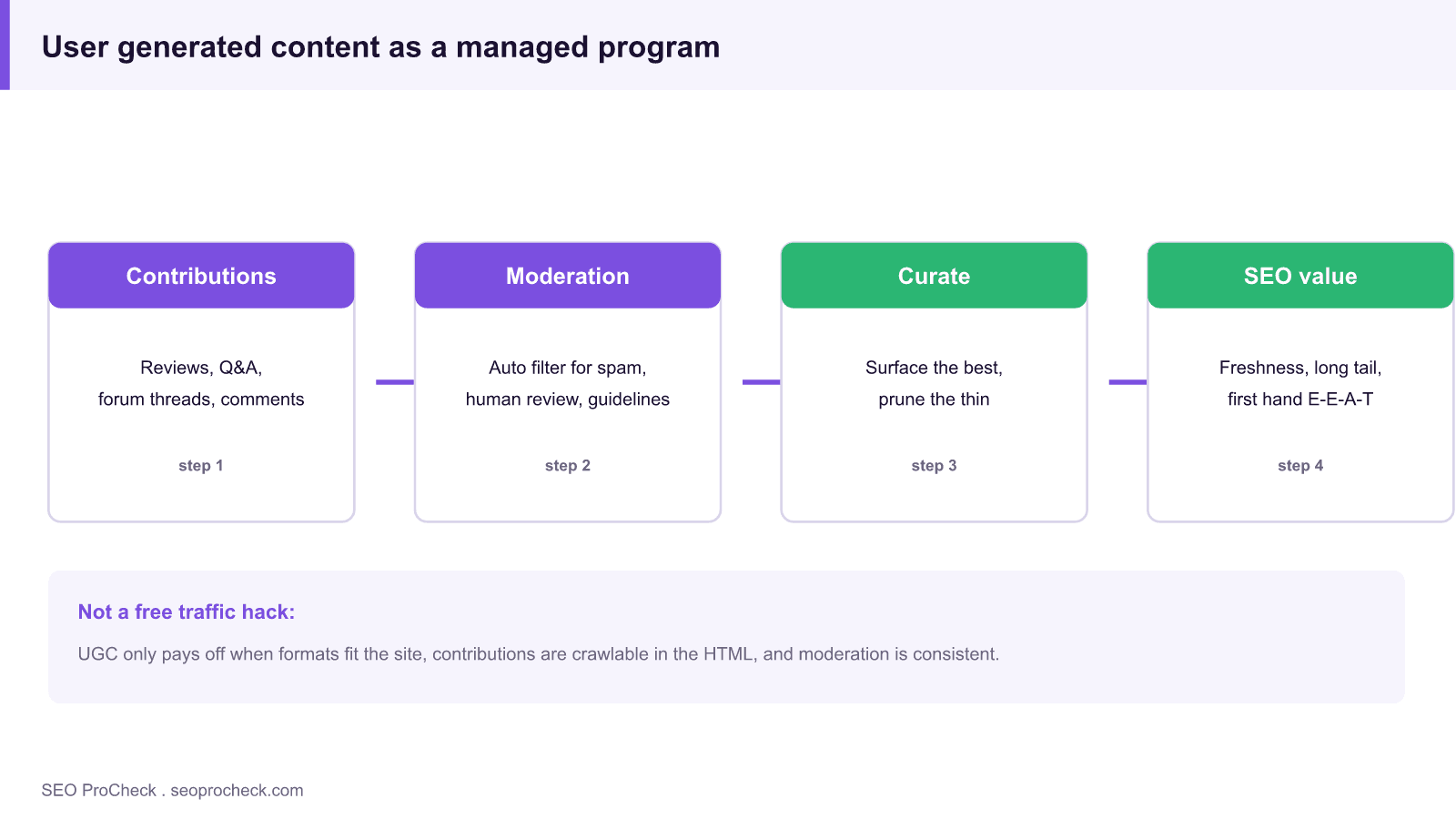
TL;DR: User-generated content (UGC) such as reviews, questions and answers, forum threads and comments can be a genuine SEO asset. It adds freshness, covers long-tail language your editorial team would never write, and supplies the first-hand experience signals that support E-E-A-T. The payoff only arrives when you choose UGC formats that fit your site, make contributions easy and crawlable, and moderate consistently so the best content rises and the worst is removed. Treat UGC as a managed program, not a free traffic hack.
How UGC helps SEO and E-E-A-T
The strongest argument for user-generated content is that it produces the one thing publishers struggle to manufacture: authentic first-hand experience. A review of how a jacket held up after a winter of use, or a forum reply solving a specific configuration error, carries detail no editorial brief can fully anticipate. That experiential layer maps directly to the first "E" in Google's E-E-A-T framework, which rewards content from people who have actually done the thing being described.
UGC also keeps pages alive. A steady flow of new reviews and answers signals that a page is current and actively used, which can support recrawling and help it stay relevant for evolving queries. Just as important, real users phrase things in ways your writers do not: they ask oddly specific questions, mention edge cases, and use the exact wording other searchers type into Google. This widens your long-tail coverage and can make pages eligible for far more queries than the original copy targeted.
There is a reinforcing effect with topical depth, too. When community members discuss related products, problems and concepts on the same page, they strengthen its connection to the broader topic. If you are building a topical model, UGC can supply context that complements your entity SEO work rather than competing with it.
Building a UGC strategy
Start by deciding which UGC formats actually fit your site. An ecommerce catalog benefits most from product reviews and question-and-answer sections on product pages. A software or hobbyist site may get more from a forum or community board. A publication might enable comments on articles. Do not bolt on every format; choose the one or two where your audience already wants to contribute and where the content will be useful to future visitors.
Next, make contributing easy and worthwhile. Prompt for reviews after a purchase or a support interaction, ask focused questions rather than leaving a blank box, and let contributors add photos where it helps. Quality improves when you guide it: a short prompt like "What did you use this for, and how did it work out?" produces far more useful answers than an empty comment field.
Then structure the output so search engines can read and value it. Render UGC in the page HTML rather than loading it only through scripts crawlers may not execute. Give each contribution a clear date, a visible author label, and a stable URL where it makes sense. Where reviews or questions appear, mark them up with appropriate structured data so they are eligible for rich results, applying the same discipline covered in our FAQ schema guide. Mind how UGC interacts with crawl budget and internal linking so useful threads stay reachable and thin ones are not multiplying low-value pages.
Moderation that protects quality
Moderation is where a UGC program earns its keep. Without it, the same openness that invites helpful contributions invites spam, abuse and noise. The goal is not to sanitize every opinion; it is to protect usefulness and trust.
Begin with clear, public guidelines so contributors know what is welcome and what will be removed. Pair automated filtering, which catches obvious spam, links and prohibited language at scale, with human review for the judgment calls machines handle poorly. Automated tools are a first pass, not the whole system.
Beyond removing the worst, actively surface the best. Let helpful answers be voted up, feature standout reviews, and pin authoritative responses at the top of a thread. Prune at the other end: delete spam, merge duplicate questions, and consolidate long-dead threads that add nothing for searchers. Curation is as much a part of moderation as deletion.
Measuring UGC value
Tie UGC to outcomes you already track rather than treating it as a vanity metric. Watch whether pages with active reviews or answers attract more long-tail impressions and clicks in Search Console, and whether they earn rich results. Look at engagement signals such as helpful votes and contribution volume, and at conversion behavior on pages with strong reviews versus those without. Keep a quality lens alongside the quantity lens: a page buried in thin or repetitive comments may need pruning, not celebration. Over time these measurements show which UGC formats deserve more investment and which to retire.
Which UGC format fits which site
| UGC format | Best fit site | Main SEO benefit | Moderation load |
|---|---|---|---|
| Product reviews | Ecommerce product pages | First hand experience, long tail queries, review rich results | Medium |
| Questions and answers | Ecommerce, SaaS docs | Answers real buyer language other pages miss | Medium |
| Forum or community board | Software, hobby, support | Topical depth and steady freshness at scale | High |
| Article comments | Publications, blogs | Freshness and engagement signals | Low to medium |
| Ratings only | Any catalog | Star rich results with very low effort | Low |
Frequently asked questions
Does user-generated content actually help rankings?
It can, when it is genuinely useful. UGC adds fresh, long-tail content and first-hand experience that support relevance and E-E-A-T. The benefit depends on quality and moderation; a flood of thin or spammy contributions helps no one.
Should UGC be visible to search engines?
Useful, moderated UGC should be rendered in the page HTML so crawlers can read it. Use structured data where appropriate. Keep low-value or unmoderated content from generating thin indexable pages.
How much moderation does UGC really need?
Enough to protect quality and trust. Combine automated filtering for spam at scale with human review for nuanced cases, publish clear guidelines, surface the best contributions, and prune the rest on a regular schedule.
Which UGC formats work best for SEO?
Product reviews and question and answer sections suit ecommerce, a forum or community board suits software and hobby sites, and article comments suit publications. Pick one or two formats your audience already wants to use rather than bolting on every option.
Can UGC hurt my rankings?
Yes, if it is left unmoderated. Spam, thin duplicate threads, and low value comments can create weak indexable pages and dilute quality. Consistent moderation and pruning are what keep UGC a net positive.
How do I keep UGC from creating thin pages?
Render useful, moderated contributions in the HTML, but consolidate duplicates and keep near empty threads out of the index. Careful pagination and canonical handling stop low value contributions from multiplying weak URLs.
Turn community content into a ranking advantage
If your reviews, comments or forum threads are not pulling their weight, an audit can show where UGC is helping, where it is creating thin pages, and how to structure and moderate it for results.
Take this with you
The assistant links open with a question about this page already written. Nothing is sent until you press enter.
Claude Vincent is a technical SEO consultant focused on crawlability, rendering, and AI-search visibility. He writes the field guides and case studies at SEO ProCheck, with a bias toward the durable, unglamorous work that decides whether search engines and AI answer engines can actually read and cite a site.
About SEO ProCheck
Technical SEO consulting and GEO strategy with 20 years of enterprise experience. Case studies, resources, and tools for search and AI visibility.
Work With Me
Technical SEO audits, GEO strategy, site migrations, and international SEO. Hourly consulting for teams who need hands-on support, not just reports.
Subscribe to our newsletter!








Recent Posts
- Most Top Sites Never Say Who They Are in Structured Data October 14, 2026
- Homepage Titles Are Mostly Too Short, Not Too Long October 8, 2026
- Who Actually Serves an llms.txt? 184 Top Sites Measured September 29, 2026