

AI Summary
Expert quote link building earns editorial links by answering journalist source requests with a genuinely usable quote that gets you credited by name. It works because the links are unpaid and relevant, and because being quoted on reputable sites builds the experience, expertise, authoritativeness, and trust signals Google values.
- Respond within hours: most source requests close in 24 to 48 hours.
- A pitchable quote has a credential line, one quotable sentence, a concrete specific, and clean attribution with your exact URL.
- Never fabricate a statistic; verifiable falsehoods end the relationship and the placement.
- Even nofollow placements build author authority, referral traffic, and brand searches.
Expert quote link building is the cleanest link tactic left standing. You answer a journalist's or blogger's request for a source, they publish your quote, and they credit you with a link. Nothing is bought, nothing is exchanged, and the link is editorial by definition, which is exactly the kind Google's guidelines reward. As a bonus, being quoted by name on a reputable outlet is one of the few things that genuinely moves the experience, expertise, authoritativeness, and trust signals behind modern rankings.
The tactic is simple to describe and easy to do badly. Most pitches fail because they are slow, generic, or unusable as written. This guide covers where to find requests in 2026, how to write a quote a reporter can lift verbatim, and how to make the placement count for both links and authority.
Where to source requests in 2026
The landscape shifted when the original HARO service was absorbed into Connectively and then discontinued, so there is no single dominant inbox anymore. Practitioners now monitor a handful of platforms and social feeds instead:
- Qwoted and Featured, which run structured request marketplaces across many beats.
- SourceBottle and regional equivalents for niche and local coverage.
- Journalist requests posted directly on social platforms, often under hashtags reporters use to crowdsource sources.
Do not try to service every platform. Pick the two or three where requests match your genuine expertise, and check them on a schedule you can sustain. For a full modern walkthrough of the post-HARO workflow, see our detailed expert-quote link building playbook, which maps the current tools in depth.
What a pitchable quote actually contains
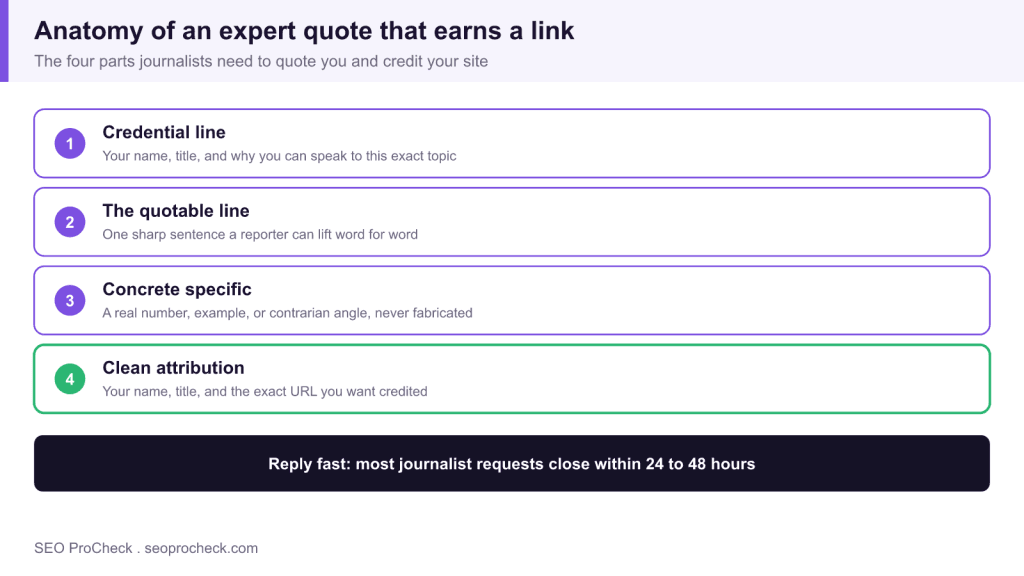
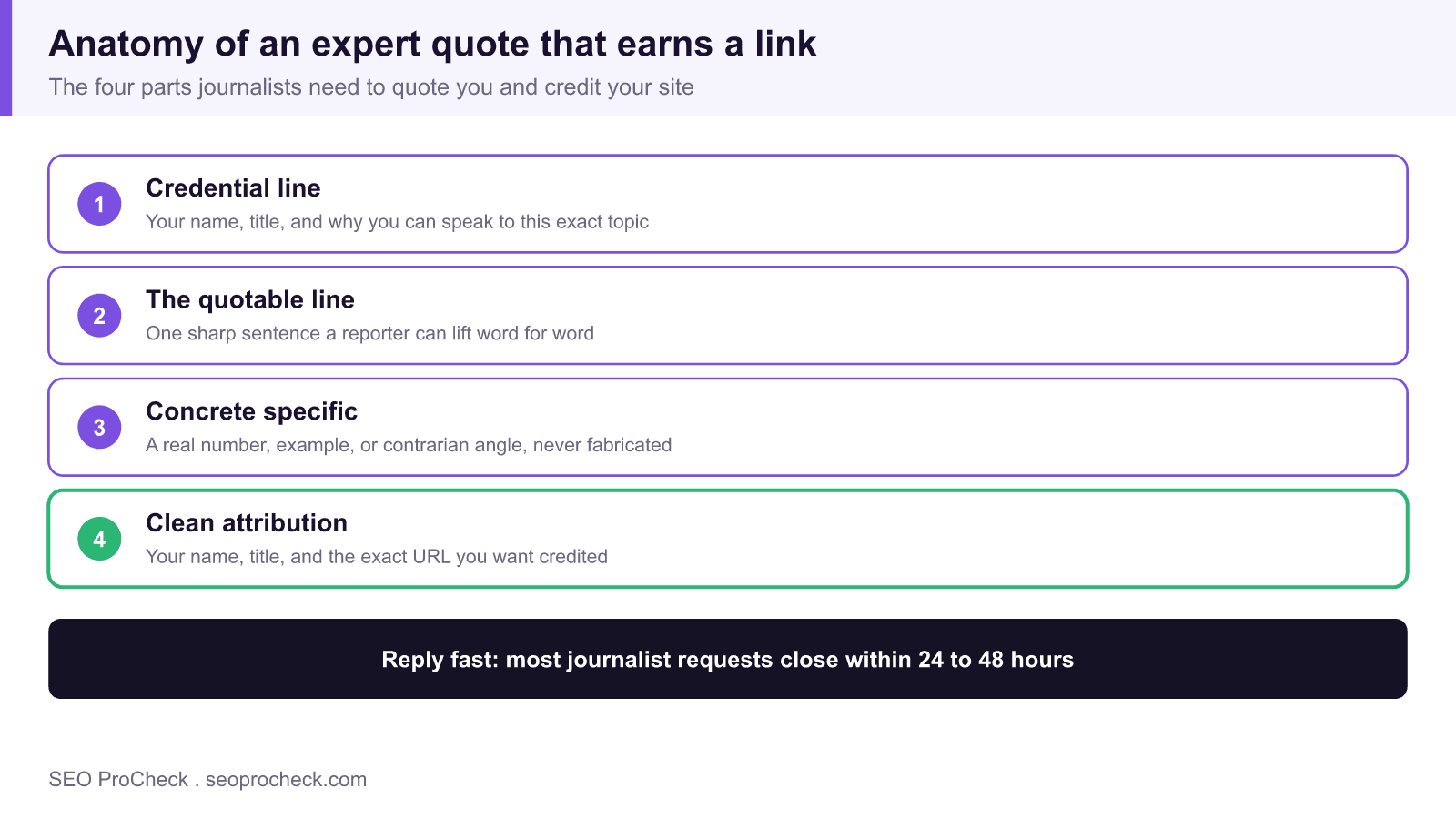
A reporter on deadline needs a quote they can paste into a draft with no editing. That is the bar. The diagram above breaks it into four parts, and every strong response has all four.
- Credential line. Your name, title, and the single reason you can speak to this exact topic. One sentence, no biography.
- The quotable line. One sharp, self-contained sentence that makes a point. If the reporter can lift it word for word and it reads well in isolation, you have done your job.
- Concrete specific. A real number, a named example, or an honest contrarian angle. This is what makes your quote more publishable than the ten generic ones in the reporter's inbox.
- Clean attribution. Your name, title, and the exact URL you want credited, stated plainly at the end so the journalist does not have to hunt for it.
Here is the shape of a response that gets used:
[Name], [title] at [site], focused on [specific area].

Quote: "The mistake most teams make with [topic] is [specific claim],
because [reason]. In practice, [concrete example or number]."

For attribution: [Name], [title], [exact URL].
Happy to expand or jump on a quick call before your deadline.
Speed is a ranking factor for your inbox
Most requests close within 24 to 48 hours, and many reporters stop reading once they have two or three usable answers. A brilliant quote sent on day three is worth nothing. Set up alerts, keep a short bank of angles for topics you cover often, and aim to respond within a few hours for anything squarely in your expertise. Speed plus a ready quote beats a slower, more polished reply almost every time.
Followed, nofollow, and why it still matters
Not every placement gives a followed link. Some large publications apply blanket rel=nofollow policies to external links, while many trade and niche sites link contributors dofollow. Chase the placement for relevance and credibility first, because even a nofollow link on a respected outlet delivers value that a followed link from an irrelevant site cannot.
| Placement type | Typical link | Link value | Authority value |
|---|---|---|---|
| Trade or niche site | Often dofollow | High | High and relevant |
| Major national outlet | Often nofollow | Low direct | Very high |
| Roundup or listicle | Varies | Medium | Medium |
| Podcast or interview | Show-notes link | Medium | High |
How expert quotes build E-E-A-T
Beyond the link, a byline quote creates verifiable third-party evidence that a named person with a stated title said something on the record. That is precisely the kind of signal that supports the authority and trust dimensions of Google's quality framework, and it feeds the entity graph that ties your name to your site across the web. The more consistently you appear as a named source in your field, the stronger that association becomes. For how small sites can compound these signals deliberately, read our guide on demonstrating E-E-A-T as a small site.
Turning it into a repeatable process
One placement is luck; a steady stream is a system. Build a lightweight process so you are not starting from scratch on every request. Keep a running document of your three or four core angles, each already written as a credential line plus a quotable sentence plus a supporting specific, so a relevant request becomes a two-minute edit rather than a fresh draft. Maintain a short list of real numbers and examples you are authorised to share, dated so you never quote stale figures. Track every pitch and outcome in a simple sheet with columns for date, outlet, request topic, sent time, and result, because the response-to-placement ratio tells you which platforms and which angles are worth your time. Over a quarter, that log turns a scattershot habit into a predictable channel that feeds links and authority to the pages you care about most.
Mistakes that keep you unquoted
- Answering a question you are not genuinely qualified for, which reads as filler and gets skipped.
- Writing three paragraphs when the reporter needs one quotable sentence.
- Fabricating a statistic; it can be checked, and it ends the relationship permanently.
- Forgetting the attribution line, so the journalist quotes you without the link.
- Replying after the deadline, when the story is already filed.
Expert quote link building rewards genuine expertise delivered fast and formatted for reuse. Combine it with other earned-link tactics, such as the appearances covered in our guide to HARO strategy for link building, and point every placement at a small set of pages you want to strengthen, so the authority compounds instead of scattering.
Frequently asked questions
What is expert quote link building?
It is the practice of responding to journalist and blogger source requests with a usable expert quote, so that when your quote is published you are credited with a link. The link is editorial and unpaid, which is why it can pass ranking value, and the byline also strengthens your author and brand authority.
Where do I find journalist requests now that HARO has changed?
The original HARO service was folded into Connectively and then wound down, so practitioners now use a mix of platforms such as Qwoted, Featured, SourceBottle, and journalist requests posted directly on social platforms. Monitor two or three sources you can realistically service rather than spreading across every tool.
Are expert quote links dofollow?
Often, but not always. Major publications sometimes apply rel=nofollow site policies, while many trade and niche sites link contributors dofollow. Even a nofollow placement on a respected outlet builds author authority, referral traffic, and brand searches, so pursue relevance and credibility first and treat the followed link as a bonus.
How fast do I need to respond to a source request?
Fast. Most requests close within 24 to 48 hours, and reporters often stop reading replies once they have two or three usable quotes. Aim to respond within a few hours for requests you can answer with genuine expertise, and never pad the queue with off-topic pitches, which trains journalists to ignore you.
Does expert quote link building help E-E-A-T?
Yes, indirectly. Being quoted by name on reputable sites creates verifiable third-party evidence of expertise and authority, the signals that sit behind Google's experience, expertise, authoritativeness, and trust framework. It also builds an entity trail that ties your name and site together across the web.
Can I fabricate a statistic to make my quote more quotable?
Never. Fabricated numbers can be checked, and getting caught costs you the placement, the relationship, and your credibility with that outlet permanently. If you do not have real data, offer a concrete example, a contrarian but honest angle, or a clearly framed estimate labelled as such. Accuracy is the whole point of being a source.
Take this with you
The assistant links open with a question about this page already written. Nothing is sent until you press enter.
Claude Vincent is a technical SEO consultant focused on crawlability, rendering, and AI-search visibility. He writes the field guides and case studies at SEO ProCheck, with a bias toward the durable, unglamorous work that decides whether search engines and AI answer engines can actually read and cite a site.
About SEO ProCheck
Technical SEO consulting and GEO strategy with 20 years of enterprise experience. Case studies, resources, and tools for search and AI visibility.
Work With Me
Technical SEO audits, GEO strategy, site migrations, and international SEO. Hourly consulting for teams who need hands-on support, not just reports.
Subscribe to our newsletter!








Recent Posts
- Most Top Sites Never Say Who They Are in Structured Data October 14, 2026
- Homepage Titles Are Mostly Too Short, Not Too Long October 8, 2026
- Who Actually Serves an llms.txt? 184 Top Sites Measured September 29, 2026