

AI Summary
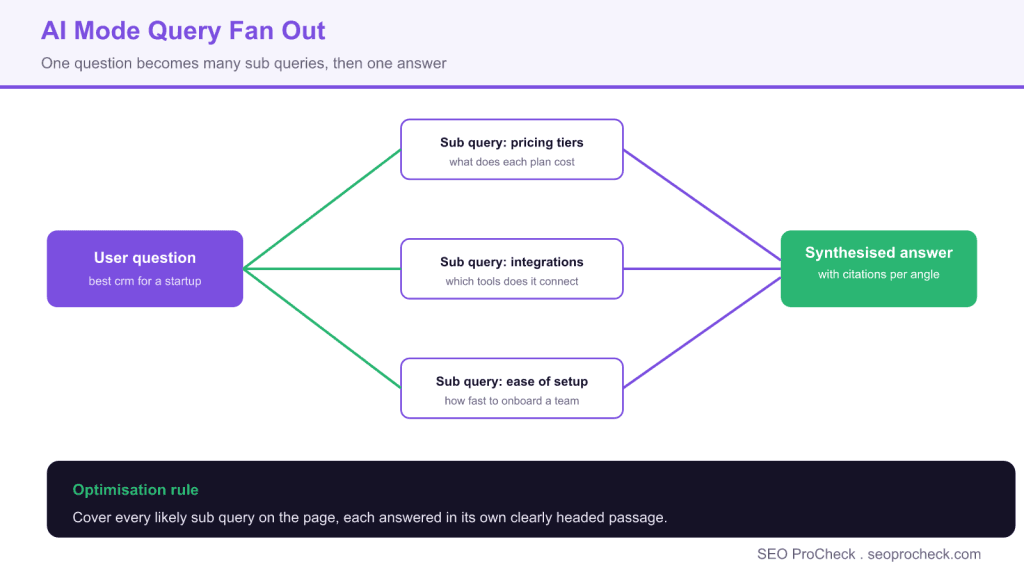
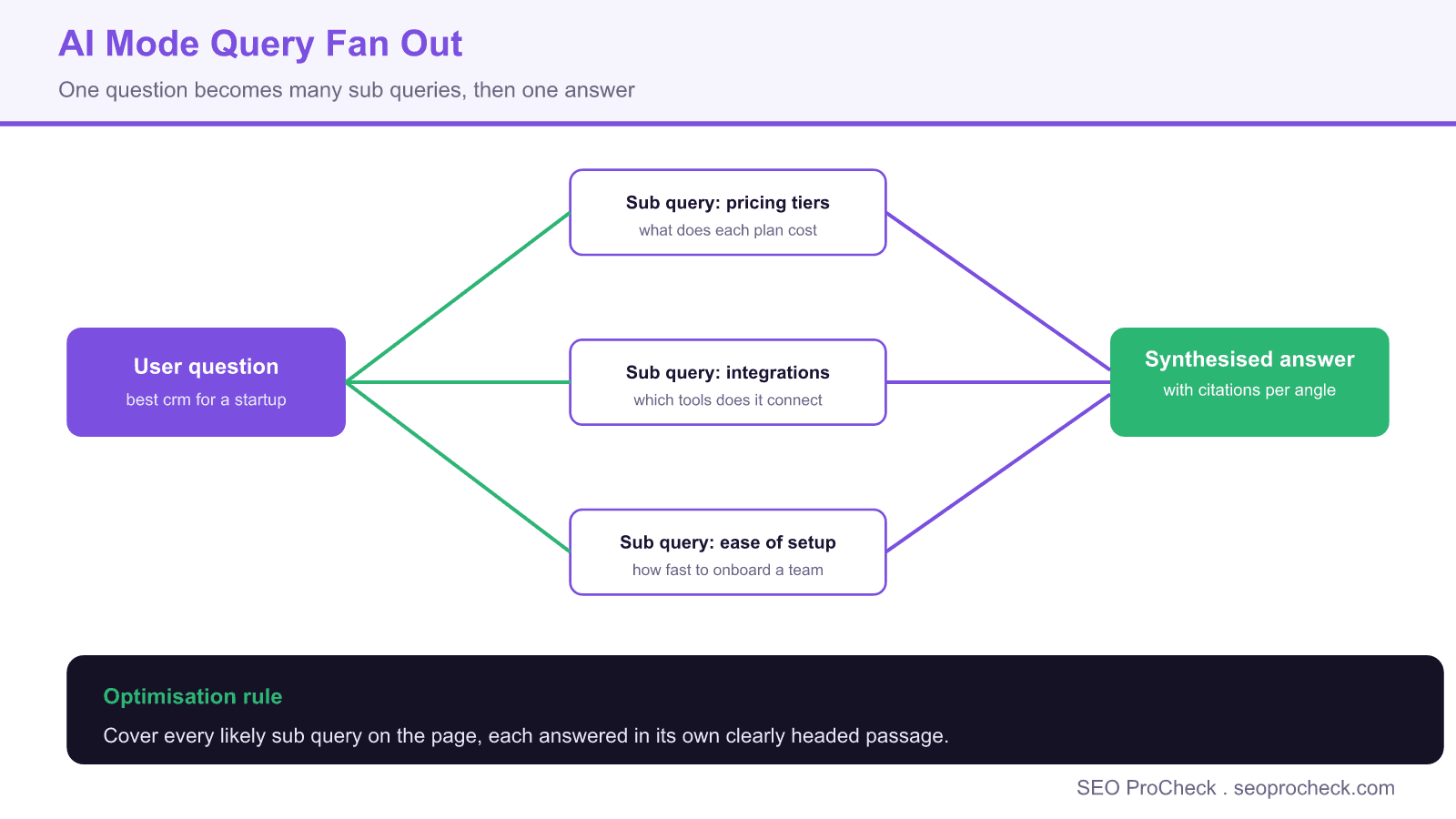
Query fan out is the technique Google AI Mode uses to answer a question: instead of matching your query to one set of results, it silently expands your question into several related sub queries, retrieves passages for each, and synthesises one answer that cites different sources for different angles. To win visibility you make sure a single page covers every likely sub query, each answered in its own clearly headed passage.
- AI Mode breaks one question into many synthetic sub queries behind the scenes.
- Each sub query retrieves its own passages, so comprehensive pages surface more often.
- Structure content so every sub topic has a dedicated heading and direct answer.
- Depth and entity coverage now matter more than repeating a single keyword.
The emergence of AI-powered search and large language models has created new considerations for content optimization. This resource explores how content creators can adapt their strategies to maintain visibility as AI increasingly mediates information discovery.
Understanding AI Content Consumption
Large language models process content differently than traditional search algorithms. They seek factual, well-structured information that can be confidently cited. Understanding these consumption patterns helps optimize content for AI visibility alongside traditional search performance.
Optimization Approaches
Research indicates specific approaches improve AI citation likelihood: including statistics with sources, maintaining factual accuracy, structuring content for easy extraction, and demonstrating clear expertise. These tactics complement rather than replace traditional SEO fundamentals.
Strategic Implications
As AI search grows, early optimization provides compounding advantages. Building citation presence now establishes your content as an authoritative source that AI systems learn to trust. The convergence of good SEO and good GEO practices suggests quality-focused strategies benefit both channels.
This resource provides actionable guidance for the evolving intersection of content strategy and AI visibility.
Source: https://writesonic.com/blog/ai-mode-query-fan-out
SEO ProCheck practitioner notes
Query fan out changes the target you are optimising for. A traditional result matches a query to a page, but AI Mode matches a whole set of sub queries to whichever passages answer them best, then stitches the pieces together. That means a page can be cited for one angle of a question and ignored for another, so the practical goal is to cover the full spread of angles a searcher might care about on one page.
Map the sub queries before you write
Start by listing the questions hiding inside the main query. For a query like best crm for a startup, the fan out is likely to include pricing, integrations, ease of setup, free tiers, and scalability. You can approximate this list from People Also Ask, from autocomplete, from the Related searches block, and from simply asking an assistant to break the topic down. Treat each of those as a heading you owe the reader an answer to. If a competitor page covers five angles and yours covers two, theirs has five chances to be retrieved.
Give every sub query its own passage
Once you have the angles, dedicate a clearly headed passage to each and answer it in the first sentence. Use descriptive h2 and h3 headings that mirror how people phrase the sub query, because those headings act as retrieval anchors. Keep each passage self contained so it reads correctly when lifted out on its own, and resist the urge to spread one answer across three scattered sections. One heading, one direct answer, then supporting detail is the shape the fan out rewards.
Cover the entities, not just the keyword
Fan out leans on meaning rather than exact strings, so entity coverage beats keyword repetition. Name the tools, standards, competitors, and concepts a thorough answer would mention, and define them briefly where a newcomer would need it. A page about a customer relationship platform that names the integrations, the pricing model, the onboarding steps, and the realistic alternatives signals genuine topical depth, which is exactly what a synthesiser looks for when it decides which source to trust for each angle.
Structure for extraction and measurement
Add FAQ schema for the sub queries you answer, use tables for comparisons, and keep your HTML clean so passages chunk cleanly. To measure the effect, watch Search Console for impressions on long, question shaped queries and track whether your brand appears in AI Mode answers for your priority topics. You will rarely get a tidy ranking position, so judge success by coverage and citation presence across the fan out rather than by a single number.
Sub query types and how to cover them
| Sub query type | Example angle | How to cover it on page |
|---|---|---|
| Comparative | Option A versus option B | A comparison table with clear criteria |
| Cost | Pricing and plans | A dated pricing section with sources |
| Procedural | How to set it up | An ordered list with HowTo schema |
| Definitional | What a term means | A short standalone definition passage |
| Suitability | Is it right for my case | A use case section by audience |
What has changed since this guide
Google introduced AI Mode as an experiment and has since expanded it into a broader part of Search, alongside AI Overviews that already use similar fan out behaviour. The practical implication has sharpened: comprehensive, well structured pages that answer a cluster of related questions are retrieved across more of the fan out, while thin single answer pages surface for fewer angles. Nothing in the core advice has been overturned, but the stakes are higher because more queries now trigger an AI generated answer, so the pages that cover a topic in full capture a larger share of citations.
Related reading
- How AI Mode works and how SEO can prepare
- A practical framework for LLM consumption
- Will generative AI kill SEO
Frequently asked questions
What is query fan out in Google AI Mode?
Query fan out is the process where AI Mode expands your single question into several related sub queries behind the scenes, retrieves passages for each, and synthesises one answer. It means a search is answered from many angles at once rather than matched to a single set of blue link results.
How do I optimise content for query fan out?
Cover every sub query a searcher might care about on one page, give each its own clearly headed passage, and answer each in the first sentence. Use descriptive headings that mirror how people phrase the sub queries, add tables and schema, and cover the relevant entities so the page reads as genuinely comprehensive.
Does keyword density still matter with fan out?
Much less than topical coverage. Fan out works on meaning, so naming the relevant entities, tools, and concepts a thorough answer would include matters far more than repeating an exact keyword. Depth and clear structure are the levers, not density.
How can I find the likely sub queries for a topic?
Approximate the fan out from People Also Ask, autocomplete suggestions, the Related searches block, and by asking an assistant to break the topic into its component questions. Each of those becomes a heading you should answer, and covering more of them gives your page more chances to be retrieved.
How do I measure success in AI Mode?
Because there is rarely a single ranking position, judge success by coverage and citation presence. Watch Search Console for impressions on long question shaped queries, and check whether your brand appears in AI Mode answers for your priority topics over time rather than expecting one clean number.
Is query fan out the same as AI Overviews?
They are closely related. AI Overviews and AI Mode both use fan out style expansion to gather passages from multiple angles before generating an answer. AI Mode is the more conversational, fuller experience, but the optimisation approach of covering a topic comprehensively serves both.
Take this with you
The assistant links open with a question about this page already written. Nothing is sent until you press enter.
Claude Vincent is a technical SEO consultant focused on crawlability, rendering, and AI-search visibility. He writes the field guides and case studies at SEO ProCheck, with a bias toward the durable, unglamorous work that decides whether search engines and AI answer engines can actually read and cite a site.
About SEO ProCheck
Technical SEO consulting and GEO strategy with 20 years of enterprise experience. Case studies, resources, and tools for search and AI visibility.
Work With Me
Technical SEO audits, GEO strategy, site migrations, and international SEO. Hourly consulting for teams who need hands-on support, not just reports.
Subscribe to our newsletter!








Recent Posts
- Most Top Sites Never Say Who They Are in Structured Data October 14, 2026
- Homepage Titles Are Mostly Too Short, Not Too Long October 8, 2026
- Who Actually Serves an llms.txt? 184 Top Sites Measured September 29, 2026