

AI Summary
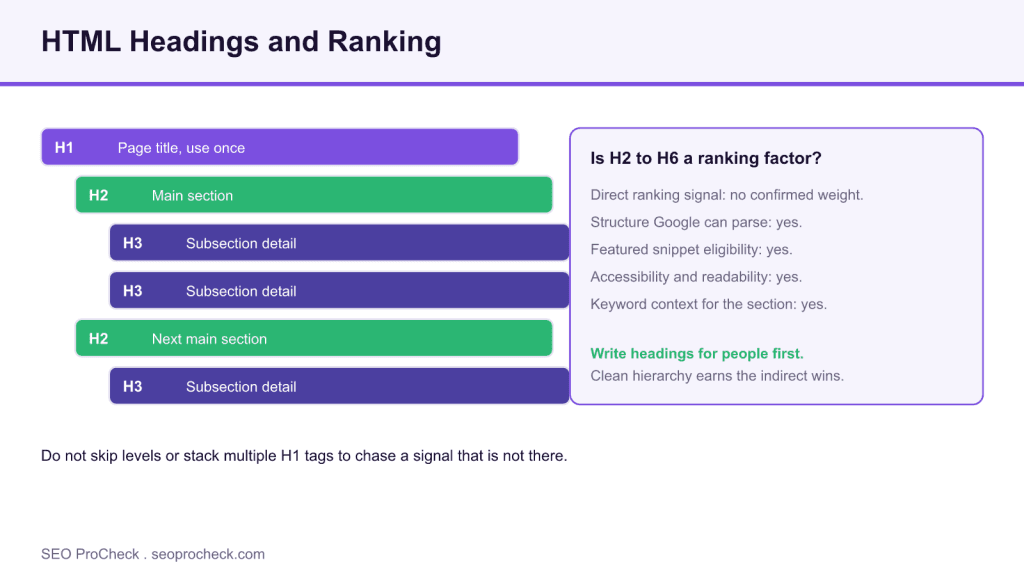
HTML heading tags from H2 to H6 are not a confirmed direct Google ranking factor, and Google has said the order of your headings does not by itself decide rankings. They still matter a great deal indirectly, because clean heading structure helps Google understand your content, supports featured snippets, and improves accessibility and readability.
- There is no confirmed direct ranking weight for H2 to H6 tags.
- Google uses headings to understand a page's structure and context.
- Well structured headings improve featured snippet and passage eligibility.
- One H1 followed by a logical H2 and H3 outline is the safe best practice.
Are HTML Heading Tags (H2-H6) A Google Ranking Factor? provides valuable insights for SEO practitioners. This resource examines approaches and considerations that can improve organic search performance.
What heading tags do
Heading tags label the sections of a page and express its outline. The H1 is the page title, H2 tags mark main sections, and H3 to H6 nest subsections beneath them. Browsers, screen readers, and search engines all use this outline to understand how the content is organised.
Used well, headings turn a wall of text into a scannable document. That scannability is good for users first, and the benefits for search follow from it.
Are H2 to H6 a ranking factor? The honest answer
Google representatives have repeatedly said that headings help Google understand a page but that there is no specific ranking boost tied to heading order or to using a particular level. In other words, correctly nesting an H3 under an H2 will not directly lift your position.
So the honest answer is: not a direct ranking factor, but a strong indirect one. Headings influence how well Google parses your content, whether you win a snippet, and how readable the page is, and all of those feed into performance. Treating headings as a magic ranking lever leads to keyword stuffed subheads that help no one.
How headings help indirectly
Structure Google can parse: a clean outline helps Google identify sections, which supports passage level understanding and featured snippets. A well phrased H2 that matches a question is often what earns the snippet.
Readability and accessibility: screen readers navigate by headings, and human readers scan them. A page with a logical heading order is easier to use, which supports engagement. See our notes on readability for how this connects to content quality.
Keyword context: a heading gives the section beneath it a topical label. Natural, descriptive headings that reflect what users search reinforce relevance without stuffing.
Heading best practices
Use exactly one H1 per page for the main title, and keep it descriptive. If your H1 is too short or generic it weakens the signal, a problem we flag as H1 tag length too short.
Do not skip levels, for example jumping from H2 to H4, and do not choose a heading level for its visual size. Style with CSS and reserve the tag for structure. A consistent heading structure plus strong title tags and meta descriptions gives Google a clear map of the page.
| Heading | Purpose | Best practice |
|---|---|---|
| H1 | Page title | Use once, descriptive, includes the primary topic |
| H2 | Main sections | Match user questions, phrase naturally |
| H3 | Subsections | Nest under the relevant H2, stay specific |
| H4 to H6 | Deeper detail | Use sparingly, keep the outline logical |
What has changed since
- Passage ranking, rolled out from 2021, lets Google surface a relevant section of a page, which rewards clear heading structure.
- AI overviews and answer engines parse headings to extract and cite content, so a clean outline improves the odds of being quoted.
- Google continues to say heading order is not a direct ranking factor, so the value stays in comprehension and snippets rather than a raw boost.
Key Concepts
Understanding the fundamental principles behind this topic helps inform strategic decisions. Whether optimizing for traditional search or emerging AI platforms, foundational concepts remain relevant. This resource covers the essential knowledge practitioners need.
Implementation Considerations
Moving from concept to execution requires understanding practical constraints and opportunities. Different situations call for different approaches. This resource provides guidance for applying concepts in real-world contexts.
Measuring Impact
SEO efforts require measurement to demonstrate value and guide optimization. Identifying appropriate metrics, establishing baselines, and tracking progress enables data-driven improvement. This resource addresses how to evaluate success.
This resource contributes to the knowledge base SEO practitioners need for effective optimization in an evolving search landscape.
Source: https://www.searchenginejournal.com/ranking-factors/html-heading-tags-h2-h6/
Frequently asked questions
Are H2 to H6 tags a Google ranking factor?
Not directly. Google has said heading order does not by itself decide rankings. Headings still matter indirectly because they help Google understand your content, win featured snippets, and improve readability, all of which support performance.
How many H1 tags should a page have?
Use one H1 for the main page title. While HTML5 technically allows more, a single clear H1 is the safe, widely recommended practice because it gives an unambiguous signal about the page's main topic.
Does keyword stuffing headings help rankings?
No. Cramming keywords into headings hurts readability and can look manipulative without providing a direct ranking gain. Write natural, descriptive headings that reflect what the section covers and what users actually search.
Can I skip heading levels for design reasons?
You should not skip levels for design. Jumping from H2 to H4 breaks the logical outline that screen readers and crawlers rely on. Keep the hierarchy correct and use CSS to control the visual size.
Do headings help with featured snippets?
Yes, indirectly. A clear H2 that matches a user question, followed by a concise answer, is a common way pages win featured snippets and appear in AI answers. Good structure makes your content easy to extract.
What is the best heading structure for SEO?
One H1 for the title, H2 tags for main sections that mirror user questions, and H3 tags for supporting detail nested under the right H2. Keep the order logical, avoid skipping levels, and write for people first.
Take this with you
The assistant links open with a question about this page already written. Nothing is sent until you press enter.
Claude Vincent is a technical SEO consultant focused on crawlability, rendering, and AI-search visibility. He writes the field guides and case studies at SEO ProCheck, with a bias toward the durable, unglamorous work that decides whether search engines and AI answer engines can actually read and cite a site.
About SEO ProCheck
Technical SEO consulting and GEO strategy with 20 years of enterprise experience. Case studies, resources, and tools for search and AI visibility.
Work With Me
Technical SEO audits, GEO strategy, site migrations, and international SEO. Hourly consulting for teams who need hands-on support, not just reports.
Subscribe to our newsletter!








Recent Posts
- Most Top Sites Never Say Who They Are in Structured Data October 14, 2026
- Homepage Titles Are Mostly Too Short, Not Too Long October 8, 2026
- Who Actually Serves an llms.txt? 184 Top Sites Measured September 29, 2026