

AI Summary
News SEO is the discipline of earning visibility in Google's news surfaces, where freshness, publishing speed, and per-beat authority decide placement within minutes rather than months. Traditional SEO rewards accumulated depth; news SEO rewards being fast, early, and consistently credible on a specific beat.
- There is no submission process for Top Stories. Eligibility is largely automatic for qualifying sites, so the competition is entirely quality, speed, and authority.
- Authority in news is per topic, not just per site. Sustained coverage of a beat beats a bigger outlet parachuting in.
- Discover is query-less and behaves like a recommendation feed: imagery, honest framing, and trust signals drive it, and volatility is normal.
- The techniques transfer to any site with time-sensitive spikes: launches, earnings, sports, seasonal retail.
What is news SEO and how does it differ from regular SEO? News SEO is the discipline of earning visibility in Google's news surfaces (Top Stories, the News tab, and Discover) where freshness, publishing speed, and topical authority decide rankings within minutes rather than months. It rewards being fast, first, and consistently authoritative on a beat, while traditional SEO rewards depth and accumulated relevance over time.
Ask a News SEO: John Shehata provides valuable insights for SEO practitioners. This resource examines approaches and considerations that can improve organic search performance.
About this interview
The source below is an installment of the "Ask a News SEO" interview series from the WTF is SEO? newsletter, which puts practitioner questions to people who run search strategy inside newsrooms. This edition features John Shehata, one of the best-known figures in news SEO: he founded the news-ranking visibility platform NewzDash and previously led audience development at Condé Nast. The series is worth reading in full because news SEO knowledge rarely gets written down, since most of it lives inside publisher audience teams, and interviews like this one are among the few places where it surfaces publicly.
Why news SEO deserves separate treatment
Publishers operate in a compressed version of the ranking game. A commerce page can climb for eighteen months; a news article has a visibility window measured in hours. That changes almost every operational assumption:
- Speed is a ranking tactic. Being among the first credible articles on a developing story matters enormously in Top Stories selection. Editorial workflow, meaning how fast a headline, image, and first paragraphs can ship, is part of the SEO stack.
- Authority is per-topic, not just per-site. Outlets earn standing on specific beats through sustained coverage. A publisher that covers a topic consistently outranks a bigger outlet that parachutes in.
- Headlines do double duty. They must carry the search phrase people type in the first minutes of a story while still working editorially. Updating headlines as a story's search language evolves is routine practice.
- Technical hygiene is unforgiving. Slow rendering, missing
NewsArticlestructured data, or crawl bottlenecks cost visibility during the only hours that matter. There is no "Google will pick it up eventually" in news. - Discover is a second, volatile channel. Google Discover can dwarf search traffic for publishers, but it behaves more like a recommendation feed: strong imagery, compelling (not clickbait) framing, and E-E-A-T-adjacent trust signals drive it, and volatility is normal.
How to apply news SEO thinking, even outside a newsroom
- Map your "news surfaces." Determine where your vertical actually appears: Top Stories, News tab, Discover, or only blue links. Optimizing for a surface you never qualify for wastes effort.
- Build beat authority deliberately. Pick the topics you can cover faster and deeper than competitors and publish consistently there, rather than chasing every trending story. This is the news version of topical authority, and it compounds.
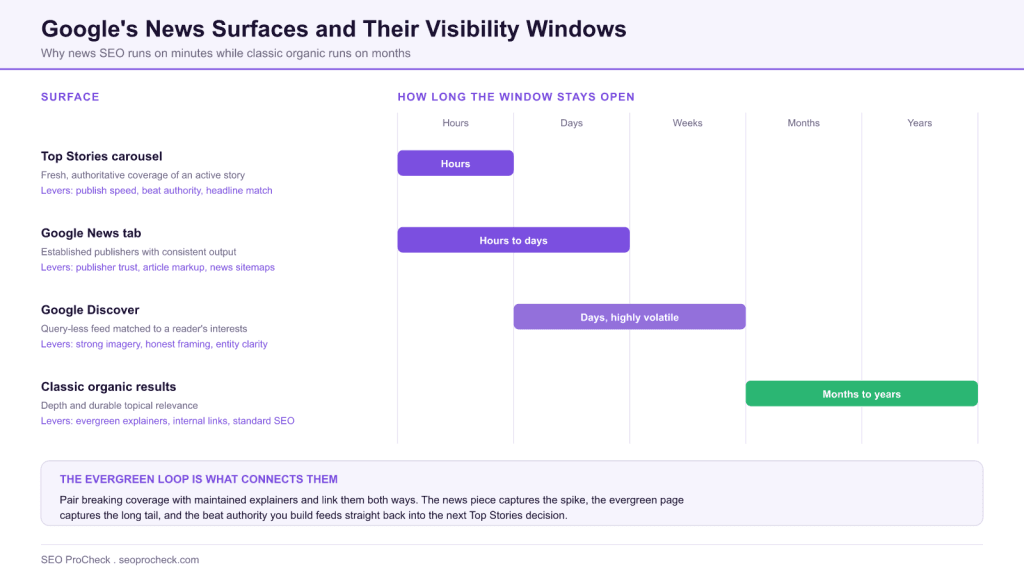
- Create an evergreen-plus-news loop. Pair breaking coverage with maintained explainers and background pages, interlinked both ways. The news piece captures the spike; the evergreen page captures the long tail and feeds authority back.
- Instrument for minutes, not months. Newsroom SEO teams monitor rankings in near real time and update headlines, ledes, and internal links while a story is live. If you run content that spikes (product launches, earnings, seasonal events), borrow this practice.
- Harden the technical layer. Valid
NewsArticleschema, clean publication dates and bylines, fast server-rendered pages, and news-specific sitemaps that update immediately on publish.
The trust dimension underneath all of this, meaning visible authorship, expertise, and accountability, is the same E-E-A-T stack that applies site-wide; our briefing on people-first content and E-E-A-T covers it in depth. And because beat authority takes sustained investment before it pays, the timeline expectations in why SEO takes time apply doubly to publishers building a new coverage area.
Google's news surfaces at a glance
| Surface | What it rewards | Primary levers | Visibility window |
|---|---|---|---|
| Top Stories carousel | Fresh, authoritative coverage of active stories | Publish speed, beat authority, headline-query match, valid structured data | Hours |
| Google News tab / news.google.com | Established publishers with consistent output | Publisher-level trust, clean article markup, news sitemaps | Hours to days |
| Google Discover | Engaging content matched to user interests | Strong images, compelling honest framing, site trust, entity clarity | Days; highly volatile |
| Classic organic results | Depth and durable relevance | Evergreen explainers, internal linking from news spikes, standard SEO | Months to years |
Two of those rows have dedicated playbooks worth reading alongside this one: Google News and Top Stories optimization for the carousel, and Google Discover optimization for the feed.
The technical layer, concretely
"Harden the technical layer" is the step most often nodded at and least often executed. Here is what it means in practice, with the specific fields and constraints that decide whether a story is eligible during the hours it matters.
| Requirement | What it means in practice | Why it decides visibility |
|---|---|---|
NewsArticle structured data | Include headline, datePublished, dateModified, author as a Person or Organization, publisher, and image | Removes ambiguity about what the page is, who wrote it, and when it changed, during the window when there is no time for Google to work it out |
| Accurate, machine-readable dates | datePublished set once at publish, dateModified updated only on a substantive edit, both in ISO 8601 with a timezone offset | Freshness is the core currency of every news surface, and a date that quietly rewrites itself on every cache flush destroys trust in the signal |
| Visible, credentialed bylines | An author name that links to a real author page with a biography and a track record on the beat | The person-level trust layer that both news surfaces and AI citation behaviour lean on |
| News sitemap | A separate sitemap holding only recent articles, regenerated the moment a story publishes rather than on a nightly cron | Google's guidance is to include only articles from the last two days and to cap the file at 1,000 URLs, so a stale or bloated file wastes the mechanism |
| Server-rendered article body | Headline, lede, and body text present in the raw HTML response, not injected by client-side JavaScript | Nothing that depends on the rendering queue can be relied on inside a window measured in hours |
| Stable canonical from the first save | The URL does not change when the headline is rewritten mid-story | A URL change mid-cycle resets accumulated signals at the worst possible moment |
Two of those rows have detailed references on this site: the markup requirements in our NewsArticle schema check, and the file-level rules in the news sitemap entry.
One workflow point sits underneath the whole table. In a newsroom the SEO work happens before the story is filed, not after it is published, because there is no post-publication window in which to fix a missing byline or a broken sitemap ping. That means the checks above belong in the CMS template and the publishing pipeline, enforced by default, rather than in a checklist someone is supposed to remember at 6am on a breaking story.
What's changed since this interview
The structural shift since this series ran is that AI-generated answers now sit above or alongside news results for many queries, and answer engines summarize breaking stories directly. For publishers this sharpens two of the interview era's lessons rather than replacing them: original reporting and clearly attributable expertise are the things AI surfaces must cite rather than absorb, and commodity rewrites of wire copy have even less reason to earn a click than before. The evidence on how AI surfaces choose citations, covering recency, clarity of sourcing, and entity authority, is collected in our case study on what gets you cited by AI search. Separately, Google retired the standalone "Google News approval" mindset years ago: eligibility for news surfaces is now largely automatic for qualifying sites, which moves the competition entirely to quality, speed, and authority.
Frequently asked questions
There is no submission process. You need to be a credible publisher on the story's topic, publish quickly with a headline matching how people search the story, ship valid NewsArticle structured data, and serve a fast, crawlable page. Consistent coverage of the beat over time is what earns carousel placement.
No. Top Stories draws from the open web, not from a curated inclusion list. Google's news surfaces consider any site that meets their content and technical policies.
No single one, but the combination Shehata's field is built around is speed plus topical authority: being early with credible coverage on a beat where your site has a track record.
Discover is query-less, meaning Google pushes content to users based on their interests rather than in response to a search. It rewards imagery, framing, and trust rather than keyword targeting, and its traffic is inherently spiky and less controllable.
Yes, deliberately. Evergreen explainers capture long-tail demand between news cycles, and interlinking them with breaking coverage strengthens both: the explainer feeds authority, the news spike feeds attention.
Much of it. Any site with time-sensitive spikes, such as launches, earnings, sports, and seasonal retail, benefits from newsroom practices: fast publishing workflows, real-time monitoring, and headline iteration while attention peaks.
This resource contributes to the knowledge base SEO practitioners need for effective optimization in an evolving search landscape.
Source: https://wtfseo.substack.com/p/ask-a-news-seo-john-shehata
Claude Vincent is a technical SEO consultant focused on crawlability, rendering, and AI-search visibility. He writes the field guides and case studies at SEO ProCheck, with a bias toward the durable, unglamorous work that decides whether search engines and AI answer engines can actually read and cite a site.
About SEO ProCheck
Technical SEO consulting and GEO strategy with 20 years of enterprise experience. Case studies, resources, and tools for search and AI visibility.
Work With Me
Technical SEO audits, GEO strategy, site migrations, and international SEO. Hourly consulting for teams who need hands-on support, not just reports.
Subscribe to our newsletter!







Recent Posts
- Can AI Crawlers Actually Read Your Site? I Measured 400 of the Biggest September 5, 2026
- The Pre-Publish Quality Gate for AI-Assisted Content August 6, 2026
- AGENTS.md vs llms.txt vs llms-full.txt: Which Agent File Does What July 18, 2026