

AI Summary
An SEO triage plan is a predefined order for fixing problems by severity, so you stop the issues that remove pages from search before you polish the ones that barely move the needle. Sorting every issue by impact against effort turns a scary inherited site or a sudden traffic drop into a calm, prioritized worklist.
- Check indexability first: noindex, robots.txt disallow, broken canonicals and server errors outrank everything.
- Score each issue by impact and effort, then work the high impact low effort quadrant first.
- Triage stops the bleeding fast; a full audit handles the deeper, lower urgency work later.
- Run triage whenever you inherit a site, see a traffic drop, or finish a migration.
Do You Have an SEO Triage Plan? 11 Things to Check provides valuable insights for SEO practitioners. This resource examines approaches and considerations that can improve organic search performance.
Key Concepts
Triage is a borrowed word, and the medical origin is the whole point. When several things are wrong at once you do not treat them in the order you happen to spot them, you treat them in the order of how much damage they do. On a website the equivalent of a life threatening issue is anything that removes pages from the index or blocks crawling, because no amount of content or link work matters if Google cannot see or keep the page. A triage plan writes that order down in advance so that under pressure, when a client calls about a traffic drop, you follow a checklist instead of guessing.
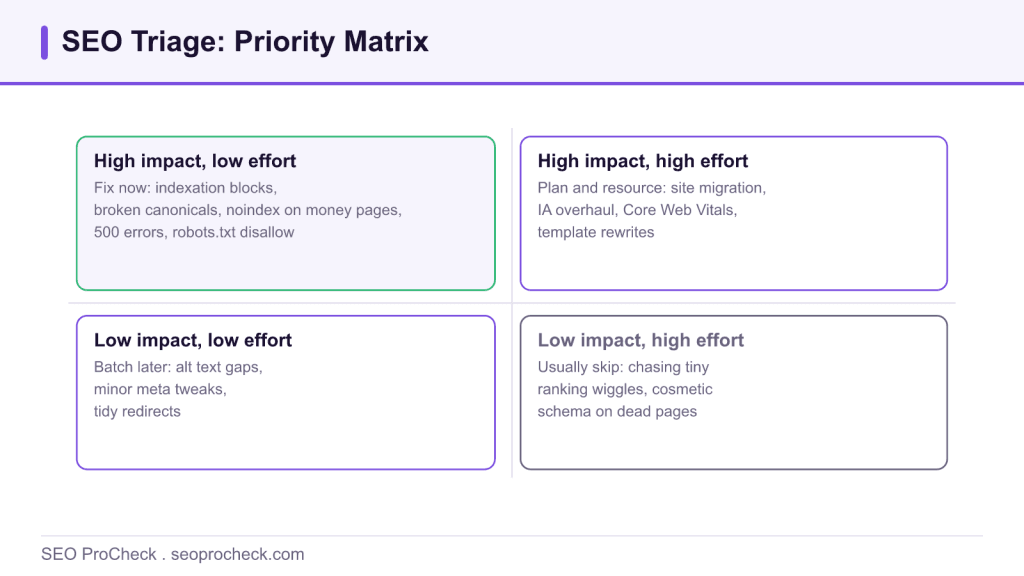
The first tier is always indexability and access. An accidental noindex left over from staging, a robots.txt disallow on a whole directory, a canonical tag pointing at the wrong URL, or a run of 500 errors will each quietly delete visibility. These sit in the high impact, low effort corner of the matrix above, which is why they are checked and fixed first.
Implementation Considerations
Turn the eleven checks into the two by two matrix in the diagram: impact on the vertical, effort on the horizontal. High impact and low effort is the do it now quadrant, holding the indexation and crawl blocks, broken canonicals, noindex on money pages and server errors. High impact and high effort, such as a migration cleanup, an information architecture overhaul or a Core Web Vitals program, gets planned and resourced rather than rushed. Low impact and low effort work like alt text gaps and minor meta tweaks is batched for a quiet week. Low impact and high effort work is usually declined outright, because chasing tiny ranking wiggles burns time that the top quadrant needs.
Keep the tools simple. A crawler, Search Console coverage and page indexing reports, and a quick server log or status check will surface almost everything in the top tier. The meta robots and X-Robots-Tag reference is worth keeping open while you check indexability, since a header level noindex is easy to miss in the HTML.
Measuring Impact
The measure of good triage is speed to stability. Track the time from noticing a problem to restoring an indexable, crawlable state on the affected pages, and watch the indexed page count in Search Console recover afterward. Because triage is selective, also log the issues you consciously deferred, so the full audit later picks them up rather than losing them. When the reporting on all this reaches stakeholders, the habits in our guide to enterprise SEO reporting keep the message about outcomes rather than activity.
| Priority tier | Example issues | Action |
|---|---|---|
| Critical: fix now | Noindex on live pages, robots.txt disallow, broken canonical, 500 errors | Stop the bleeding immediately |
| High impact, planned | Migration cleanup, IA overhaul, Core Web Vitals | Resource and schedule the work |
| Low impact, batched | Alt text gaps, minor meta tweaks, tidy redirects | Group into a later maintenance pass |
| Low value, skip | Cosmetic schema on dead pages, chasing tiny rank shifts | Decline and document why |
What Has Changed Since This Article
The triage order still holds, and if anything the first tier matters more now. Search Console's page indexing report has become the fastest place to catch a site wide indexation problem, and JavaScript rendering issues have joined the classic culprits as a reason pages fall out of the index. AI features that summarize answers also mean a page needs to be both indexable and clearly structured to earn visibility, so the top of the triage list, get seen first, is unchanged while the ways a page can fail to be seen have grown.
Frequently Asked Questions
What is an SEO triage plan?
It is a predefined order for tackling problems when something breaks or a site is handed to you, so you fix what threatens visibility most before touching cosmetic issues. Like medical triage, it sorts by severity rather than by whatever you notice first.
What should I check first on a struggling site?
Start with anything that stops pages being indexed: an accidental noindex, a robots.txt disallow, a broken canonical, or server errors. These silently remove pages from search and outrank every other fix in urgency.
How do I prioritize SEO fixes?
Score each issue by impact and effort. High impact low effort items get done immediately, high impact high effort work gets planned and resourced, and low impact work is batched or skipped.
What are quick wins in SEO triage?
Restoring an indexable state on important pages, fixing internal links that point to redirects or 404s, and correcting canonical tags. These are fast and often recover visibility that was lost by accident.
How is triage different from a full SEO audit?
An audit is exhaustive and documents everything. Triage is fast and selective: it finds and stops the bleeding first, then hands off to a full audit for the deeper, lower urgency work.
When should I run an SEO triage?
Any time you inherit a site, see a sudden traffic drop, or finish a migration or redesign. These are the moments when a critical, visibility killing issue is most likely to be hiding.
Source: https://www.searchenginejournal.com/seo-triage-plan/426234/
Take this with you
The assistant links open with a question about this page already written. Nothing is sent until you press enter.
Claude Vincent is a technical SEO consultant focused on crawlability, rendering, and AI-search visibility. He writes the field guides and case studies at SEO ProCheck, with a bias toward the durable, unglamorous work that decides whether search engines and AI answer engines can actually read and cite a site.
About SEO ProCheck
Technical SEO consulting and GEO strategy with 20 years of enterprise experience. Case studies, resources, and tools for search and AI visibility.
Work With Me
Technical SEO audits, GEO strategy, site migrations, and international SEO. Hourly consulting for teams who need hands-on support, not just reports.
Subscribe to our newsletter!








Recent Posts
- Most Top Sites Never Say Who They Are in Structured Data October 14, 2026
- Homepage Titles Are Mostly Too Short, Not Too Long October 8, 2026
- Who Actually Serves an llms.txt? 184 Top Sites Measured September 29, 2026