

How does AHREFS and SEMRush and Moz, etc, know the volume of searches for a given keyword/phrase?
- July 27, 2024
- General
AI Summary
Ahrefs, Semrush, and Moz do not read Google's true query counts, because Google never shares them. They estimate monthly search volume by blending Google Keyword Planner ranges with clickstream data from real user panels, then scaling and modeling the result. That is why their numbers differ from each other and should be read as ranges.
- Only Google knows exact volume, and Keyword Planner only reports broad ranges.
- Tools scale anonymized clickstream panels up to the full population.
- Different panels and models produce different numbers for the same keyword.
- Use volume to compare and prioritize, not as an exact traffic forecast.
Every SEO tool prints a tidy monthly search volume next to a keyword, yet none of them can see Google's real query counts. This article explains where that number actually comes from, why Ahrefs, Semrush and Moz rarely agree on it, and how to read and blend the figures without over trusting any single one.
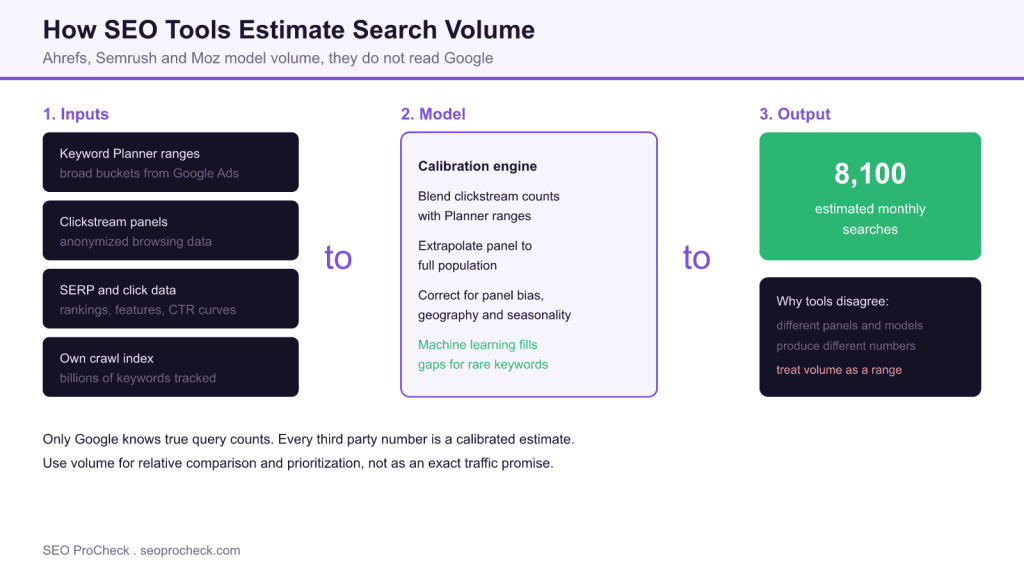
The short answer is that they do not know it, they estimate it. Google is the only party that can count how many times a query is typed, and it does not publish that number. Everything you see in a keyword tool is a model built from partial signals, calibrated to be useful for comparison. Understanding how that model works tells you exactly how much to trust the figure, and where it breaks down.
Where the raw signals come from
Three inputs do most of the work. The first is Google Keyword Planner, the free tool inside Google Ads. It reports volume in broad buckets, for example 1K to 10K, and it is aimed at advertisers rather than at giving precise organic numbers. It anchors the model but is far too coarse on its own. The second input is clickstream data: anonymized records of what real people search and click, gathered from panels of users through browser extensions, apps, and data partnerships. The third is each tool's own crawl of the search results, which captures rankings, SERP features, and how many keywords a page ranks for. The search volume definition in the lexicon covers the term itself in more detail.
How the model turns signals into a number
A clickstream panel is only a sample, perhaps a few million users, so the tool must scale it up to represent everyone who searches. That extrapolation is where the modeling happens. The engine blends clickstream counts with Keyword Planner ranges, corrects for known bias in the panel, for example an over representation of certain countries or demographics, and adjusts for seasonality so a spike in December does not distort the annual figure. For rare and long tail keywords, where the panel may show only a handful of searches or none at all, machine learning fills the gaps by inferring volume from related terms and from the behavior of similar queries. The output is a single tidy number like 8,100, which hides a genuine range underneath.
Why the tools disagree
Because each vendor runs a different panel, a different scaling model, and a different refresh cycle, the same keyword can show meaningfully different volumes across tools. This is not a defect: it is the natural result of estimating an unknowable quantity from different samples. Head terms with heavy search activity tend to converge, because there is plenty of clickstream signal to anchor them. Long tail terms diverge more, because the model is doing more of the guessing. When a number matters to a decision, check it in two or three tools and treat the spread as your confidence interval. The related keyword difficulty guide explains why a companion metric like difficulty is also modeled and should be read the same way.
How to read volume like a practitioner
Use volume for what it is good at: comparing keywords against each other and sizing the rough opportunity of a topic. Do not use it to promise an exact traffic number to a client or a stakeholder. A term listed at 8,100 might deliver a fraction of that in clicks once you account for your ranking position, the click through rate at that position, and how many SERP features push organic results down the page. Pair tool volume with your own Google Search Console impressions once you rank, since that shows how often your pages actually appeared for a query. For the full workflow around choosing and validating terms, see the keyword research fundamentals guide.
Volume data sources compared
| Source | What it provides | Precision | Main limitation |
|---|---|---|---|
| Google Keyword Planner | Official volume ranges for advertisers | Broad buckets, for example 1K to 10K | Coarse, and grouped for advertising |
| Clickstream panels | Real user searches and clicks | Sample based estimate | Panel bias, needs scaling |
| Tool crawl index | Rankings, SERP features, keyword counts | Relative, not absolute volume | Infers volume indirectly |
| Search Console impressions | Times your pages appeared for a query | Exact, for your site only | Only covers terms you already rank for |
How the major tools differ in practice
The vendors describe their methods a little differently, and those differences explain most of the gaps you see. Ahrefs leans heavily on a large clickstream dataset and reports a global volume as well as a country level one, which is why its figure can look higher than rivals for international terms. Semrush blends clickstream with its own keyword database and a machine learning model, and shows an intent label beside the volume. Moz calibrates its estimate against Google Keyword Planner ranges plus a clickstream signal and presents volume as a bucketed range rather than a single hard number, which is arguably the most honest way to display an estimate. None of these is the truth: each is a different lens on the same figure that only Google can actually count.
Blending figures into one working number
When a decision rides on volume, do not average the tools blindly. Pull the estimate from two or three sources, drop any obvious outlier that sits far from the rest, and take the median of what remains as your working figure. Treat the full spread as a confidence interval: a term that reads 6,000 in one tool and 12,000 in another is really "roughly ten thousand, give or take," so plan content and forecasts against the low end. Round aggressively too. A keyword shown as 8,100 is no more precise than one shown as 8,000, and pretending otherwise builds false confidence into any traffic model you hang off it.
Search Console impressions as your ground truth
Once a page ranks, you no longer have to guess. Google Search Console reports the exact number of times your pages appeared for a query under Performance, Search results, filtered by query, and that is real Google data rather than a modeled estimate. Compare the impression count against the tool volume for the same term: if a tool said 8,000, you rank on page one, yet you see only 2,000 impressions a month, the tool overstated demand or the query is more seasonal than its flat annual number implied. Over time this builds a private calibration for your niche, letting you trust or discount specific tools for the keywords that matter to you. Read impressions next to average position and click through rate in the same report to turn interest into a realistic traffic expectation.
What has changed since this discussion
Clickstream supply has become less stable in recent years, as browsers tightened privacy and several data brokers changed hands or shut down, which is one reason volume figures can shift between tool updates. At the same time, zero click searches and AI overviews mean a high volume keyword no longer guarantees clicks even at the top of the results. The practical takeaway is unchanged but sharper: volume tells you interest exists, not how much traffic you will capture, so always pair it with position and click through data.
Frequently Asked Questions
Does Google give these tools the real search volume?
No. Google never shares exact query counts. The closest public source is Google Keyword Planner, and even that reports broad ranges, such as 1K to 10K, rather than precise numbers, and only for advertisers. Every third party volume figure is modeled on top of partial signals.
What is clickstream data?
Clickstream data is anonymized browsing activity collected from a panel of real users, usually through browser extensions, apps, and data partnerships. Tools see which searches those users run and which results they click, then scale that sample up to the whole population to estimate volume.
Why do Ahrefs, Semrush and Moz show different numbers for the same keyword?
Each tool uses a different clickstream panel, a different model, and a different update schedule. Because they extrapolate from different samples and correct for bias in different ways, their estimates diverge, sometimes by a wide margin. That is expected, not a bug.
Which tool has the most accurate search volume?
There is no single winner, because accuracy varies by keyword, country, and how much clickstream data exists for that term. For high volume head terms the tools tend to agree, while for long tail and rare keywords they diverge and rely more on modeling. Compare two or three sources for important terms.
Should I trust the exact search volume number?
Treat it as a range and a relative signal, not a promise. A keyword shown at 8,100 might realistically sit anywhere from a few thousand to over ten thousand. Use volume to prioritize between keywords and to size opportunity, not to forecast exact traffic.
How can I check volume against Google's own data?
Run a campaign in Google Keyword Planner for the range, and use Google Search Console to see real impressions once you rank for a term. Search Console shows how many times your pages actually appeared for a query, which is the closest thing to ground truth you can get for your own site.
Source: https://old.reddit.com/r/bigseo/comments/17ebu28/how_does_ahrefs_and_semrush_and_moz_etc_know_the/
Take this with you
The assistant links open with a question about this page already written. Nothing is sent until you press enter.
Claude Vincent is a technical SEO consultant focused on crawlability, rendering, and AI-search visibility. He writes the field guides and case studies at SEO ProCheck, with a bias toward the durable, unglamorous work that decides whether search engines and AI answer engines can actually read and cite a site.
About SEO ProCheck
Technical SEO consulting and GEO strategy with 20 years of enterprise experience. Case studies, resources, and tools for search and AI visibility.
Work With Me
Technical SEO audits, GEO strategy, site migrations, and international SEO. Hourly consulting for teams who need hands-on support, not just reports.
Subscribe to our newsletter!








Recent Posts
- Most Top Sites Never Say Who They Are in Structured Data October 14, 2026
- Homepage Titles Are Mostly Too Short, Not Too Long October 8, 2026
- Who Actually Serves an llms.txt? 184 Top Sites Measured September 29, 2026