

AI Summary
A future proofed SEO strategy is one whose value does not depend on how results happen to be presented this year. That means weighting investment toward crawlable architecture, demonstrable expertise, brand demand and clean information structure, and treating tactics keyed to a single SERP feature as disposable by design.
- Ask of every tactic: does this still pay if the result format changes?
- Split measurement by search appearance and by brand versus non brand, or you cannot diagnose anything.
- Substitutable content is the exposed asset. Originating facts is the defence.
- Fix indexability and clarity before adding AI specific tactics on top.
"Future proof your SEO" is advice that usually arrives without a test attached, which makes it impossible to act on. Here is a test that works: for any piece of work you are about to commission, ask whether it still returns value if Google changes how results are displayed next quarter. Crawlable architecture passes. A page built to win one specific SERP feature does not.
That single question does most of the sorting, and it explains why the arrival of AI Overviews and answer engines feels catastrophic to some teams and largely procedural to others. The difference is not foresight. It is how much of the existing programme was keyed to a presentation format that just changed.
A durability test for every tactic
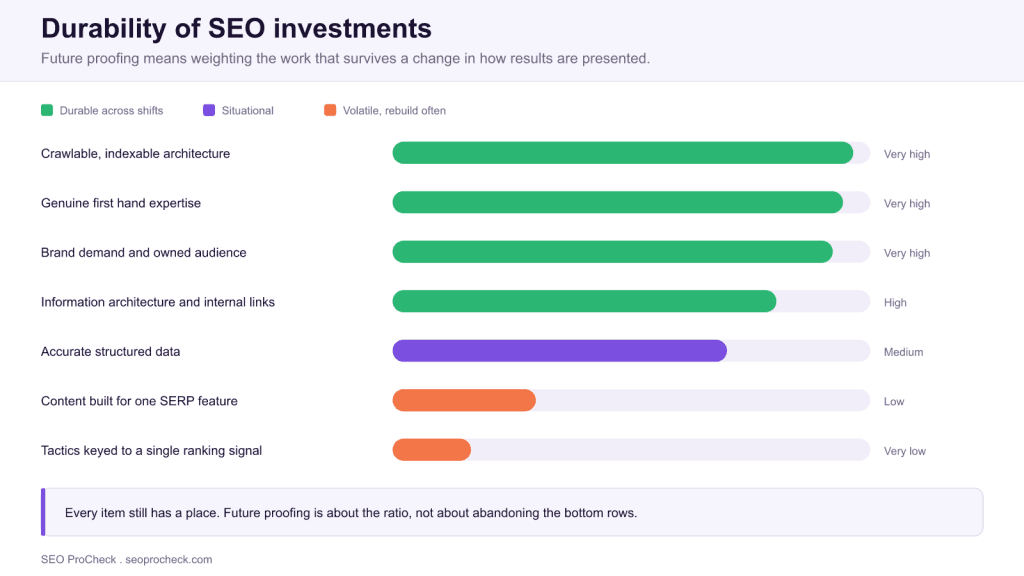
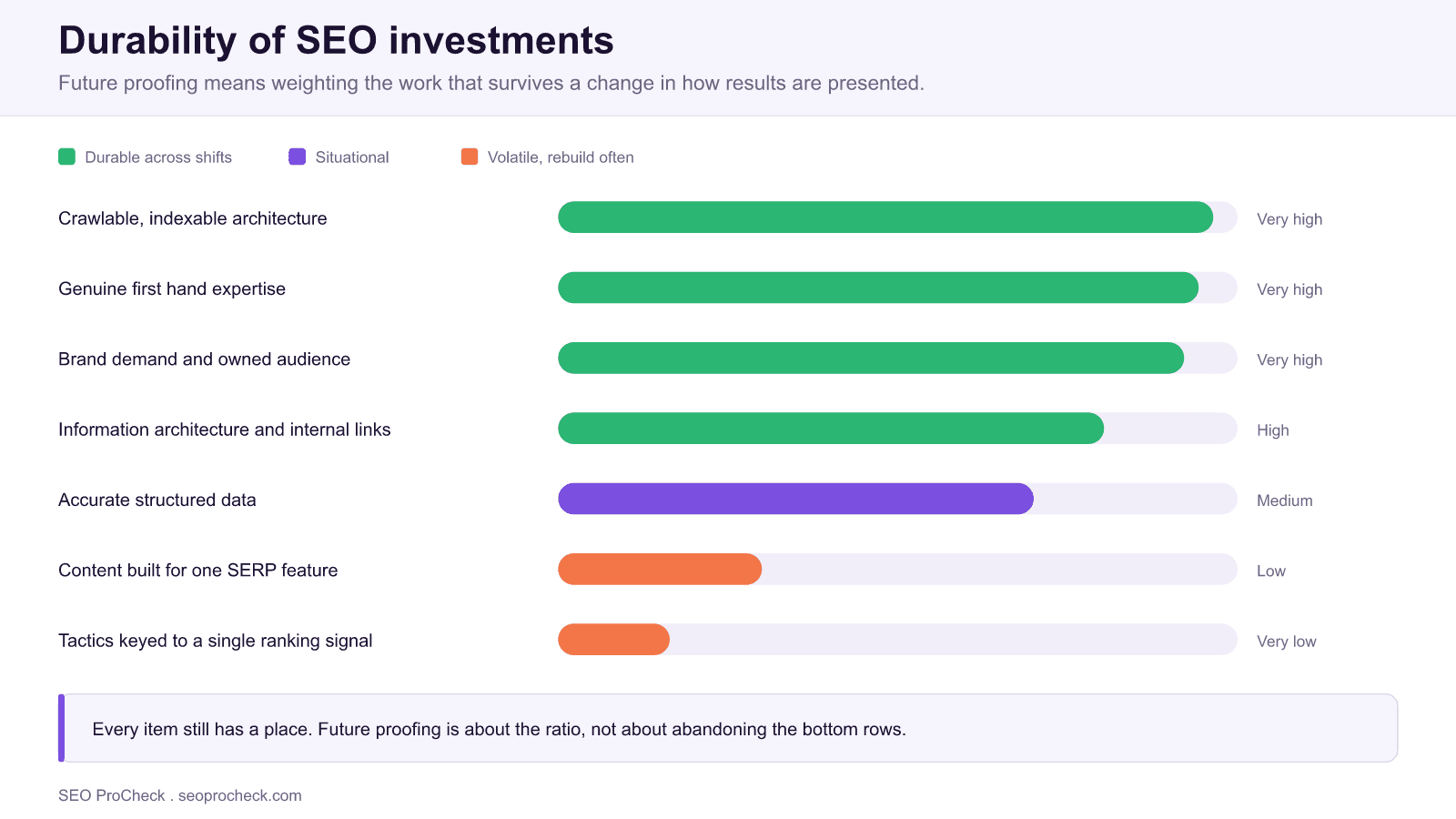
The chart above ranks common SEO investments by how well they survive a change in result presentation. To be clear about what it is: an editorial judgment based on which categories of work have held their value across previous shifts, not a measurement. The ordering is arguable at the margins; the shape is not.
What sits at the top has a common property. Crawlability, expertise, brand demand and internal linking are all inputs to any system that has to find, understand and choose content, whether it renders ten links, a summary, or something not invented yet. What sits at the bottom is keyed to a specific output format, so it depreciates the moment that format changes.
This is not an argument for ignoring the bottom rows. Feature specific optimisation is often the right call when a feature is dominant in your vertical and cheap to pursue. The argument is about ratio and about expectations: that work should be budgeted as a campaign with a finite life, not as an asset.
Understanding AI Content Consumption
The strategic question about AI surfaces is narrower than the discourse suggests. Answer engines change the presentation layer and the attribution model. They do not change what makes content worth attributing.
An extraction system reads a page to find claims it can repeat with confidence. That favours pages where the claim is stated plainly rather than built toward across five paragraphs, where dates are explicit rather than implied, where the author is a real identifiable person, and where structure maps question to answer without inference. None of that is new advice. It is the same clarity that helps a skim reader, now with a machine enforcing it.
What genuinely is new is the substitution risk. When your page is the only place a fact exists, a summary of it is an advertisement for you. When your page restates facts available in twenty other places, a summary replaces you completely. That asymmetry, more than any technical tactic, determines which parts of a content programme are exposed. It is why "publish more" stopped being a strategy and "publish what only we can publish" became one.
The practical implications for individual pages are covered in optimising for AI Overview citations, and the wider discipline in the generative engine optimization FAQ.
Optimization Approaches
Concretely, a future proofed programme allocates across five workstreams. The proportions vary by site, the presence of all five does not.
| Workstream | What it actually involves | Why it survives | Leading indicator |
|---|---|---|---|
| Technical foundation | Indexability, render parity, site speed, correct canonicals, per origin robots.txt | Every retrieval system must fetch and parse before anything else applies | Indexed ratio, crawl errors |
| Information structure | Clear IA, internal linking, one page per intent, accurate markup | Helps humans, rankers and extractors identically | Orphan pages, click depth |
| Demonstrable expertise | Named authors, credentials, original data, first hand testing | Cannot be synthesised from existing text | Citation and mention volume |
| Brand and owned audience | Newsletter, direct traffic, branded query volume | No intermediary sits between you and the audience | Brand query trend, list growth |
| Measurement | Surface split reporting, brand versus non brand, regex query grouping | You cannot respond to a change you cannot see | Time to detect a change |
Measurement is the workstream that gets cut first and costs the most when missing. The single most valuable change most teams can make is to stop looking at one aggregate organic line. Break performance out by search appearance so Discover, news and web results never average together, and split brand from non brand so growing brand demand cannot mask a collapse in discovery. Regex based query grouping in Search Console makes both of these tractable at scale, as covered in using regex in Search Console.
On the technical side, the tedious work is the durable work. A site with render dependent content, inconsistent canonicals or contradictory crawl directives across subdomains fails at the first step for every system, AI or otherwise. The page indexing report is the fastest route to that diagnosis, and it is worth reading before commissioning any content work at all.
On expertise, the operational question is simply whether a reader can verify who is speaking and why they would know. Author pages that resolve, credentials that are checkable, methodology that is described. This is unglamorous and it is the part competitors cannot copy from your HTML. The concrete signals are itemised in demonstrating E-E-A-T as a small site.
What to stop doing
Future proofing is partly a subtraction exercise, and three habits are worth naming.
- Publishing to a page count. Volume targets reliably produce the most substitutable content you own, and at scale they can make a site look machine generated in aggregate even when individual pages are fine.
- Optimising for a metric that is not the outcome. Word counts, keyword densities and content scores are proxies that stop correlating the moment they become targets.
- Rebuilding strategy around each new SERP feature. Features arrive and are withdrawn on a schedule nobody outside Google controls. A plan that needs rewriting each time was keyed to the feature rather than the audience.
Strategic Implications
The deeper shift is about what an SEO programme is for. When discovery meant ranking a page, the work was making pages rank. When discovery is split across query driven results, feed driven surfaces and answer driven assistants, the work is making an organisation legible: clear about what it knows, verifiable about who knows it, and structured so that any system can establish both without guessing.
That reframing has budget consequences. It favours fewer, better resourced pieces over programmatic volume. It moves spend toward the people who have the expertise and toward the infrastructure that exposes it, rather than toward the production line between them. And it makes brand investment an SEO line item rather than something owned elsewhere, because branded demand is the only traffic no intermediary can intercept.
The reassuring part is that almost none of this is new. Sites that stayed useful through mobile first indexing, the helpful content updates and the arrival of AI answers did so with the same fundamentals each time. What changes is the penalty for neglecting them, which rises every time a new system starts reading your pages on someone else's behalf.
Frequently asked questions
No, it means changing what you do with the output. Keywords remain the best available evidence of what people want to know, but treating a keyword list as a page plan is what produces thin, substitutable content. Use the research to understand demand and intent, then decide separately how many pages that demand actually justifies.
Almost certainly not. The properties that AI systems reward, clear claims, accurate dates, real authorship, clean structure, are the same properties that help human readers and traditional ranking. A site that is genuinely useful rarely needs rebuilding, it needs its facts stated more plainly and its expertise made verifiable.
Split your Search Console data by search appearance and compare impressions against clicks for the affected query set. A drop in clicks while impressions hold suggests interception at the result, whereas both falling together points at a ranking or demand change instead. Without that split you are guessing.
It has become one of the highest leverage ones. Brand demand produces queries that no answer engine sits in front of, and named entities are easier for retrieval systems to attribute confidently. It is also the part of your traffic that survives any change to how results are presented.
Chasing the newest surface while the fundamentals rot. Teams add AI specific tactics on top of a site with crawl problems, duplicated templates and unclear authorship, which is optimising the top of the stack while the bottom fails. Fix indexability and clarity first, because every surface depends on them.
Review the measurement quarterly and the strategy annually, unless something structural changes. Monthly strategy churn is itself a symptom of building on volatile signals. If your plan needs rewriting every time a SERP feature changes, the plan was keyed to the feature rather than to the audience.
Source: https://www.searchenginejournal.com/future-proof-seo-strategy-ai/489457/
Take this with you
The assistant links open with a question about this page already written. Nothing is sent until you press enter.
Claude Vincent is a technical SEO consultant focused on crawlability, rendering, and AI-search visibility. He writes the field guides and case studies at SEO ProCheck, with a bias toward the durable, unglamorous work that decides whether search engines and AI answer engines can actually read and cite a site.
About SEO ProCheck
Technical SEO consulting and GEO strategy with 20 years of enterprise experience. Case studies, resources, and tools for search and AI visibility.
Work With Me
Technical SEO audits, GEO strategy, site migrations, and international SEO. Hourly consulting for teams who need hands-on support, not just reports.
Subscribe to our newsletter!








Recent Posts
- Most Top Sites Never Say Who They Are in Structured Data October 14, 2026
- Homepage Titles Are Mostly Too Short, Not Too Long October 8, 2026
- Who Actually Serves an llms.txt? 184 Top Sites Measured September 29, 2026