

AI Summary
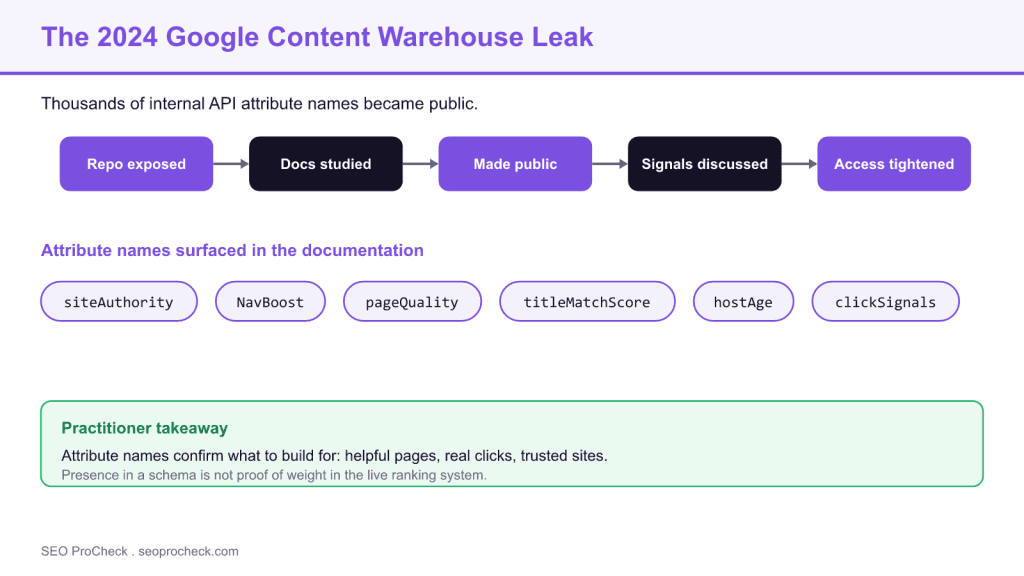
In 2024 thousands of internal Google Search API documents surfaced online, exposing attribute names for systems such as NavBoost and various site level signals. The files confirm many things Google measures, but they do not reveal how heavily each factor is weighted in the live ranking system.
- The leaked Content Warehouse documentation listed thousands of attribute names, not the live ranking weights or formulas.
- Names like NavBoost and siteAuthority suggest that click behavior and site level trust are modeled somewhere in the stack.
- The presence of a field is not proof that it is used, or used the way its name implies.
- The durable takeaway is unchanged: build genuinely helpful, trusted pages that earn real clicks.
Practitioner commentary on the leak
The source for this post, Dan Petrovic of Dejan Marketing, makes a pointed argument: by making the exposed repository public, the industry may have burned its own most valuable strategic resource and pushed Google to close off avenues that could have been quietly studied. Whether or not you share that framing, the underlying event is real. In 2024 a large set of internal documentation describing Google search API attributes became publicly accessible, and it circulated widely among SEOs.
What the documentation contained were attribute names and short descriptions, the kind of field definitions an engineer sees, drawn from an internal Content Warehouse API. It did not contain the ranking algorithm, the weights, or how any signal is combined at query time. That distinction is the single most important thing to hold onto, because most overreach comes from treating a field name as a confirmed, weighted ranking factor.
What it reasonably confirms
Read conservatively, the documentation lines up with things experienced practitioners already suspected. There are attributes that point to click and engagement modeling, often discussed under the name NavBoost. There are site level and host level fields that imply some concept of overall site trust or authority. There are freshness and content age fields. None of this is shocking; it is consistent with patents, public statements, and years of observed behavior.
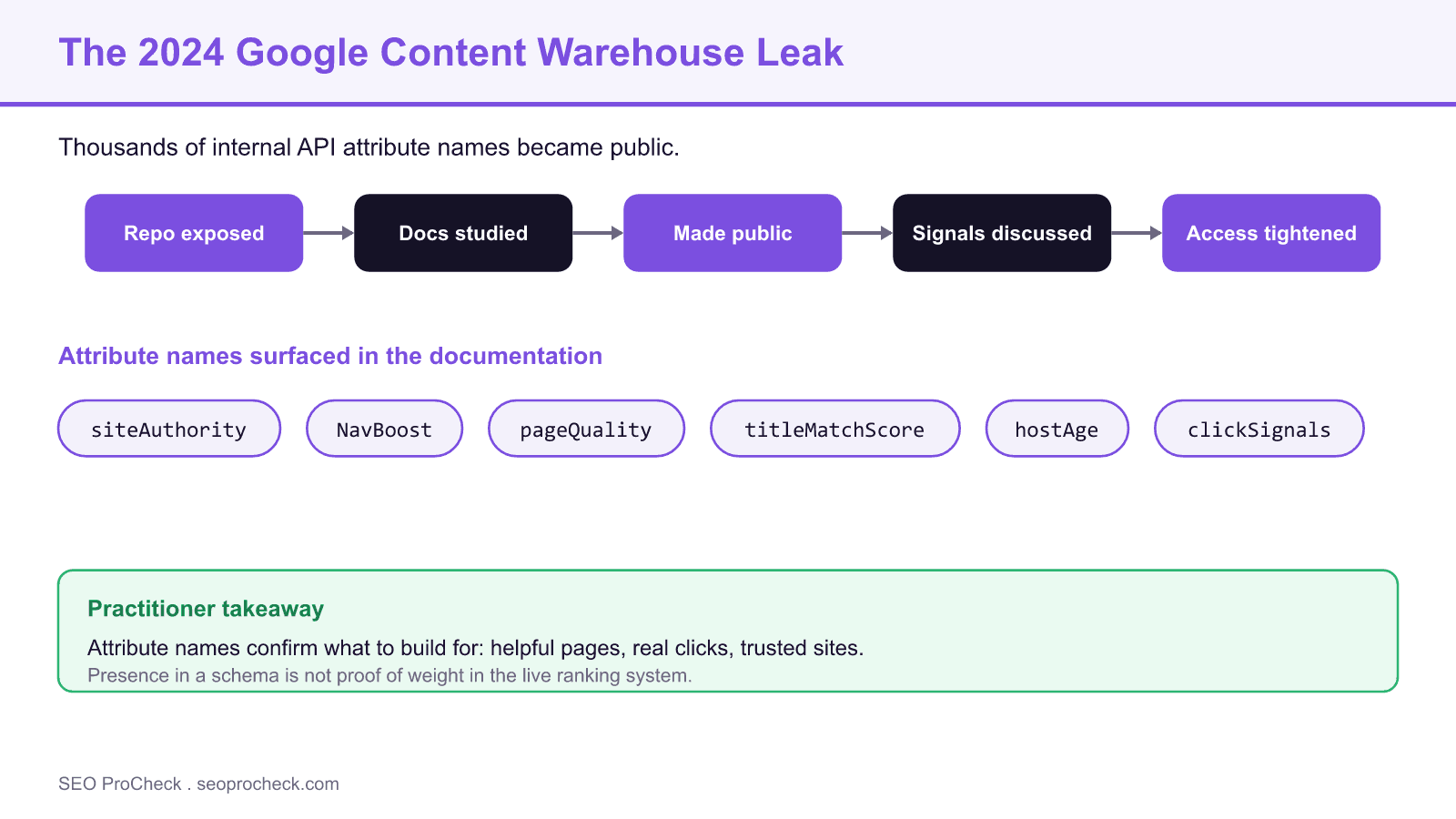
What it does not do is hand you a checklist. A field called siteAuthority does not tell you how it is computed, whether it is used in live ranking, or how much it matters relative to relevance. The diagram above lists example attribute names precisely to make that point: these are labels an engineer might see, not dials you can turn.
How to act on it without overreacting
The safe response is boring and correct: keep building pages that deserve to win. If clicks are modeled, then earning real clicks by writing compelling titles and genuinely useful content is the play, not manufacturing fake engagement. If site level trust exists, then a coherent, high quality site beats a bag of disconnected pages. Those conclusions were sound before the leak and remain sound after it.
On the technical side, the leak is a reminder that clarity helps machines rank you. Give search engines clean signals: strong content, correct structured data, and pages that stand up to a quality review like the AI content quality check. If you want to understand how Google isolates and ranks individual passages within a page, our guide to passage ranking and indexing is a useful companion.
What the leak did and did not confirm
| Claim you may hear | Status | Practitioner action |
|---|---|---|
| Google models click behavior | Consistent with named attributes | Earn real clicks with strong titles and content |
| A site level trust concept exists | Implied by host level fields | Build a coherent, high quality site |
| The docs reveal ranking weights | Not present in the documentation | Do not treat field names as dials |
| Every listed field is used live | Unconfirmed | Prioritize durable fundamentals, not field chasing |
| Freshness is tracked | Attributes suggest content age is stored | Keep important pages current where it helps users |
What has changed since June 2024
In the months after the documentation circulated, the noise settled. Google neither published the weights nor issued a detailed rebuttal, and access to the exposed material was tightened. The lasting effect was not a new tactic but a firmer consensus around a few durable ideas: click and engagement behavior is modeled, some notion of site level reputation exists, and content freshness is tracked. Sensible teams folded those confirmations into strategy they were already running and resisted the urge to optimize for individual field names.
Frequently asked questions
What was the 2024 Google API leak?
It was the public exposure of a large set of internal Google documentation describing search API attributes, drawn from a Content Warehouse system. It listed field names and descriptions, not the ranking algorithm or its weights.
Does the leak prove Google uses clicks for ranking?
It shows attributes consistent with click and engagement modeling, often discussed as NavBoost. It does not prove exactly how or how heavily clicks are used, so treat it as strong support for earning genuine clicks rather than a formula.
Is NavBoost a confirmed ranking factor?
NavBoost appears in the documentation as a named system related to click behavior. Its presence confirms the concept is modeled, but the docs do not reveal its live weight in ranking.
Should I change my SEO strategy because of the leak?
For most sites, no radical change is warranted. The leak reinforces existing best practices: publish helpful content, earn real engagement, and build a trustworthy site rather than chasing named fields.
Does an attribute in the docs mean Google uses it live?
Not necessarily. Documentation can include deprecated, experimental, or unused fields. A field name is evidence that something is measured somewhere, not proof it drives live rankings.
Where can I read more about the leaked signals?
The original commentary linked in the source below is a good starting point, and reputable SEO publications analyzed the documents in depth. Focus on the durable takeaways rather than any single field name.
Original summary and source
I have one thing to say. provides valuable insights for SEO practitioners. This resource examines approaches and considerations that can improve organic search performance.
Key Concepts
Understanding the fundamental principles behind this topic helps inform strategic decisions. Whether optimizing for traditional search or emerging AI platforms, foundational concepts remain relevant. This resource covers the essential knowledge practitioners need.
Implementation Considerations
Moving from concept to execution requires understanding practical constraints and opportunities. Different situations call for different approaches. This resource provides guidance for applying concepts in real-world contexts.
Measuring Impact
SEO efforts require measurement to demonstrate value and guide optimization. Identifying appropriate metrics, establishing baselines, and tracking progress enables data-driven improvement. This resource addresses how to evaluate success.
This resource contributes to the knowledge base SEO practitioners need for effective optimization in an evolving search landscape.
Source: https://dejanmarketing.com/i-have-one-thing-to-say/?utm_source=substack&utm_medium=email
Take this with you
The assistant links open with a question about this page already written. Nothing is sent until you press enter.
Claude Vincent is a technical SEO consultant focused on crawlability, rendering, and AI-search visibility. He writes the field guides and case studies at SEO ProCheck, with a bias toward the durable, unglamorous work that decides whether search engines and AI answer engines can actually read and cite a site.
About SEO ProCheck
Technical SEO consulting and GEO strategy with 20 years of enterprise experience. Case studies, resources, and tools for search and AI visibility.
Work With Me
Technical SEO audits, GEO strategy, site migrations, and international SEO. Hourly consulting for teams who need hands-on support, not just reports.
Subscribe to our newsletter!
Recent Posts
- Most Top Sites Never Say Who They Are in Structured Data October 14, 2026
- Homepage Titles Are Mostly Too Short, Not Too Long October 8, 2026
- Who Actually Serves an llms.txt? 184 Top Sites Measured September 29, 2026